AtScale launches 'AtScale for AI' with a striking claim: a semantic layer doubles every LLM's accuracy on business questions
Enterprise AI has an accuracy problem, and AtScale says the fix is not a smarter model. The Boston company launched AtScale for AI today, a suite that connects AI agents to the same governed metric definitions the business already runs on — and released benchmark research showing that adding its semantic layer doubled accuracy on business questions, on average, for every one of the seven large language models tested.
- Who: AtScale, the Boston-based provider of the universal semantic layer for enterprise AI and analytics; CEO Chris Lynch and President Jay Schuren; customers cited include HSBC and Carrefour.
- What: AtScale for AI — a suite combining AtScale Ava (Ask, Verify, Answer), AtScale CoModel, AtScale ACE (the AI Computation Engine) and AtScale Canary — plus companion research on LLM accuracy with a semantic layer.
- When: announced October 15, 2026. Ava and ACE are available now; CoModel and Canary are coming soon. AtScale hosts a webinar on the benchmark results October 28, 2026 at 2PM ET.
- Benchmark results: on 410 business questions (BIRD-Interact, 600 tasks across 22 databases, 317 with a verifiable correct answer), the AtScale semantic layer improved accuracy on average 1.7x to 2.4x across all seven models tested — roughly doubling it.
- Baseline gap: leading models answered fewer than four in ten business questions correctly when querying the database directly, even with schema, column documentation and a business glossary provided. Open-weight Kimi K2.5 scored within 1.2 points of OpenAI's GPT-5 with the layer in place.
- Customer evidence: HSBC's UK commercial banking team reported accuracy on AI-driven deterministic analytics rising from 65% to better than 99% on a 10 TB table in Google Cloud; Carrefour extends its existing semantic layer, governing thousands of KPIs, to AI agents.
The accuracy gap it wants to close
Enterprise AI has a business-logic problem, and AtScale's argument is that better models cannot fix it alone. A question as simple as "what was our revenue last quarter?" requires an agreed definition of revenue, the right reporting period and a governed calculation — definitions an enterprise has never necessarily made explicit. "The AI industry keeps telling enterprises to buy a smarter model, but a model can't reason its way to your definition of revenue," CEO Chris Lynch said in the launch announcement. "Enterprises need to define what an answer means, compute it correctly, and prove it holds up."
The point is to connect natural-language questions to shared business definitions and computation, so AI agents get the same governed metrics the business already runs on — rather than producing different answers depending on how someone asks the question. AtScale is also committing to open standards: the suite supports Apache Ossie, formerly Open Semantic Interchange, as the shared semantic interchange format.
The four pieces: Ava, CoModel, ACE and Canary
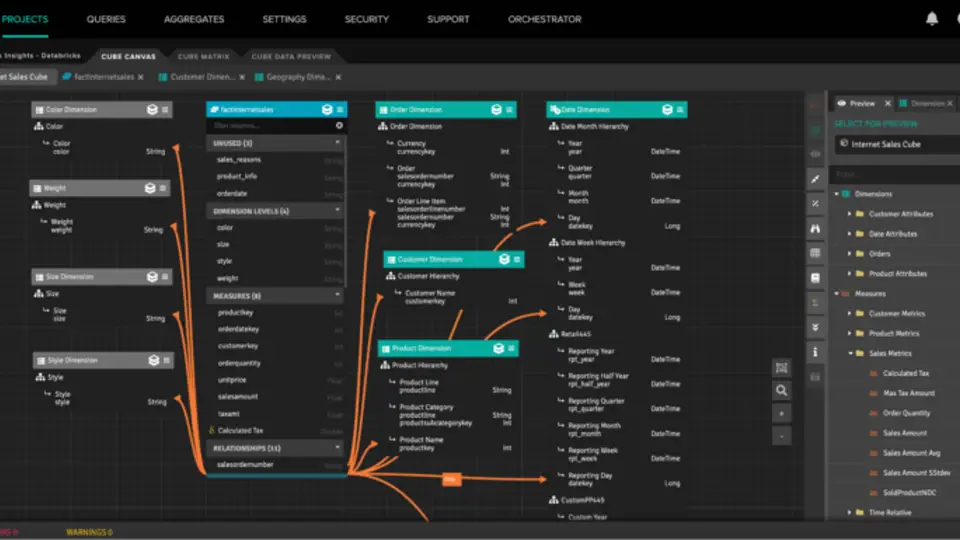
AtScale for AI is designed as a continuous improvement loop across four capabilities, all powered by AtScale's AI Computation Engine (ACE). AtScale Ava — for Ask, Verify, Answer — sits at the front door: it connects natural-language questions to the intended governed metrics before computation begins. Ask about "revenue" and Ava can clarify whether you mean bookings, recognized revenue or contract value, then hand the resolved request to ACE.
ACE applies the governed metric definitions and calculation logic to enterprise data, producing consistent results across AI agents, applications and analytics tools while optimizing query performance and computational cost. AtScale CoModel uses AI to create and maintain the semantic models themselves — translating business context into shared definitions of metrics, dimensions and relationships — with proposed changes kept under human review so definitions stay current as the business evolves. And AtScale Canary is the watchdog: it evaluates AI answers against validated results using a framework based on the BIRD-Interact benchmark plus a company's own business question-and-answer pairs, to find where answers go wrong and track regressions over time. Ava and ACE are available today; CoModel and Canary are coming soon. Read the launch announcement on Business Wire.
The benchmark: seven models, 600 tasks, every model improved
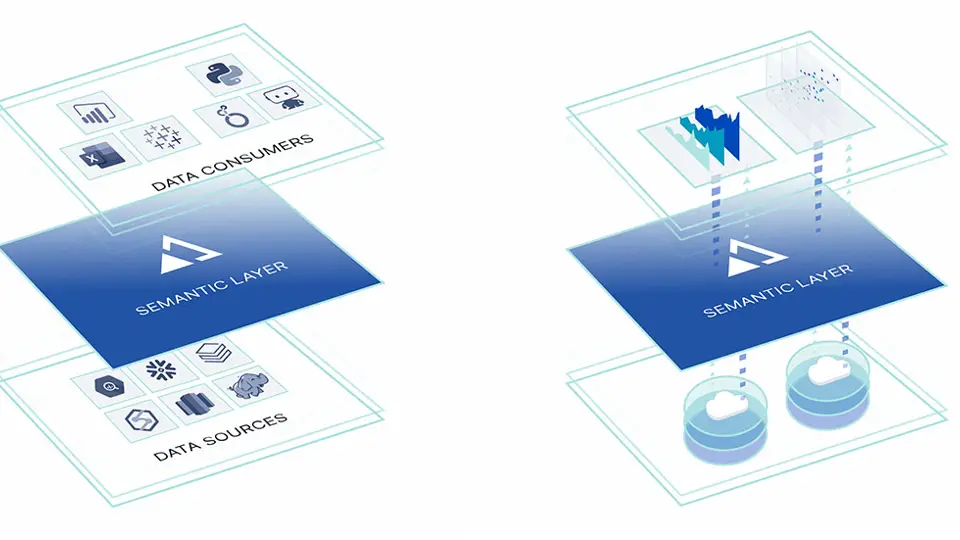
In a separate announcement published today, AtScale released research measuring what the semantic layer actually does to model accuracy. Using BIRD-Interact — an independently developed benchmark with 600 tasks across 22 databases, 410 of them business questions and 317 with a verifiable correct answer — the company tested seven large language models with and without its semantic layer.
The headline finding: accuracy on the 410 business questions doubled on average with the layer, ranging from 1.7x to 2.4x per model, and every model improved. The baseline is the alarming part — leading models answered fewer than four in ten business questions correctly when querying the database directly, even when handed the schema, column documentation and a business glossary. That gap, AtScale argues, is what keeps AI out of financial and operational workflows where the numbers have to be right. One more notable result: open weights kept pace — Kimi K2.5 scored within 1.2 points of OpenAI's GPT-5 on the business questions once the semantic layer was in place. "A semantic layer bridges the gap: the model reasons about the question, while governed business definitions and deterministic computation produce the answer," said Jay Schuren, AtScale's president. Full results and methodology are in the benchmark announcement, also covered by BigDATAwire and Morningstar.
Early customer evidence
The launch came with customer numbers, the strongest being HSBC. Dr. Kevin McLafferty, Head of Data & Analytics for UK Commercial Banking, said that on a 10 TB table in Google Cloud with AtScale as the semantic layer, accuracy on AI-driven deterministic analytics jumped from 65% to better than 99% — with no reinvention of the bank's existing governed logic. Carrefour's Nicolas Treanton, Data & Analytics Director, said the retailer's semantic layer already governs thousands of KPIs, and extending that foundation to AI means its agents use the same definitions as its analysts and BI tools.
Why it matters
The honest caveat: this is vendor research, tested on the vendor's own stack. But the pattern it names is real and widely felt — enterprises keep discovering that their blocker is not model intelligence but metric governance, and the "almost right" answers in banking are still wrong. The interesting move here is Canary: if evaluation of AI answers against validated results becomes a repeatable enterprise discipline, "accuracy" stops being a marketing claim and starts being a measurable, regressable property. Whether AtScale's specific layer is the one that standardizes that is the open question — but the framing is directionally right. AtScale is hosting a webinar on the benchmark results, "Make Your AI Show Its Homework," on October 28, 2026 at 2PM ET, alongside its newly relaunched website at atscale.com.
Frequently asked questions
What is AtScale for AI?
It is a suite of capabilities, announced October 15, 2026, that connects AI agents and applications to governed business definitions and computation. It has four parts: AtScale Ava, which connects natural-language questions to the intended governed metric before computing; AtScale CoModel, which uses AI to create and maintain semantic models with human review; AtScale ACE, the AI Computation Engine that applies governed definitions and calculation logic; and AtScale Canary, which tests AI answers against validated results and tracks regressions over time. Ava and ACE are available now; CoModel and Canary are coming soon.
How big were the accuracy gains in AtScale's benchmark?
On 410 business questions drawn from the BIRD-Interact benchmark (600 tasks across 22 databases), adding the AtScale semantic layer improved accuracy on average 1.7x to 2.4x across all seven large language models tested — effectively doubling accuracy. Without the semantic layer, leading models answered fewer than four in ten business questions correctly, even when given the schema, column documentation and a business glossary. The open-weight Kimi K2.5 scored within 1.2 points of OpenAI's GPT-5 on the business questions once the semantic layer was in place.
What evidence is there from real customers?
HSBC's UK commercial banking data and analytics team said accuracy on AI-driven deterministic analytics jumped from 65% to better than 99% on a 10 TB table in Google Cloud when AtScale served as the semantic layer. Carrefour said extending its existing semantic layer — which governs thousands of KPIs — to AI lets agents use the same definitions as the company's analysts and BI tools instead of producing different answers per question.