AutoDNA: AI agents ran a DNA lab end to end — humans did the restocking
Researchers at Shanghai Jiao Tong University built a lab where AI agents design and run DNA experiments from a single typed prompt. In its longest test, the system worked for 203 hours across 11,382 steps — and read the data back without a single error.
- What: AutoDNA, an AI-native laboratory at Shanghai Jiao Tong University, built around Google’s Gemini 2.5 Pro and a team of seven specialized AI agents.
- Longest run: 11,382 hardware steps over about 203.5 hours to store a sentence in DNA and recover it exactly.
- Synthesis: 97.8% stepwise yield in enzymatic DNA synthesis, matching expert-optimized results; parallel protocols ran 3.2 times faster.
- Clinical test: correctly identified a KRAS G13D cancer mutation in a patient sample, matching the clinical finding.
- Limits: 14 hardware errors in testing — the agents fixed 8, people fixed 6 — and the team warns the models’ randomness can change results between runs.
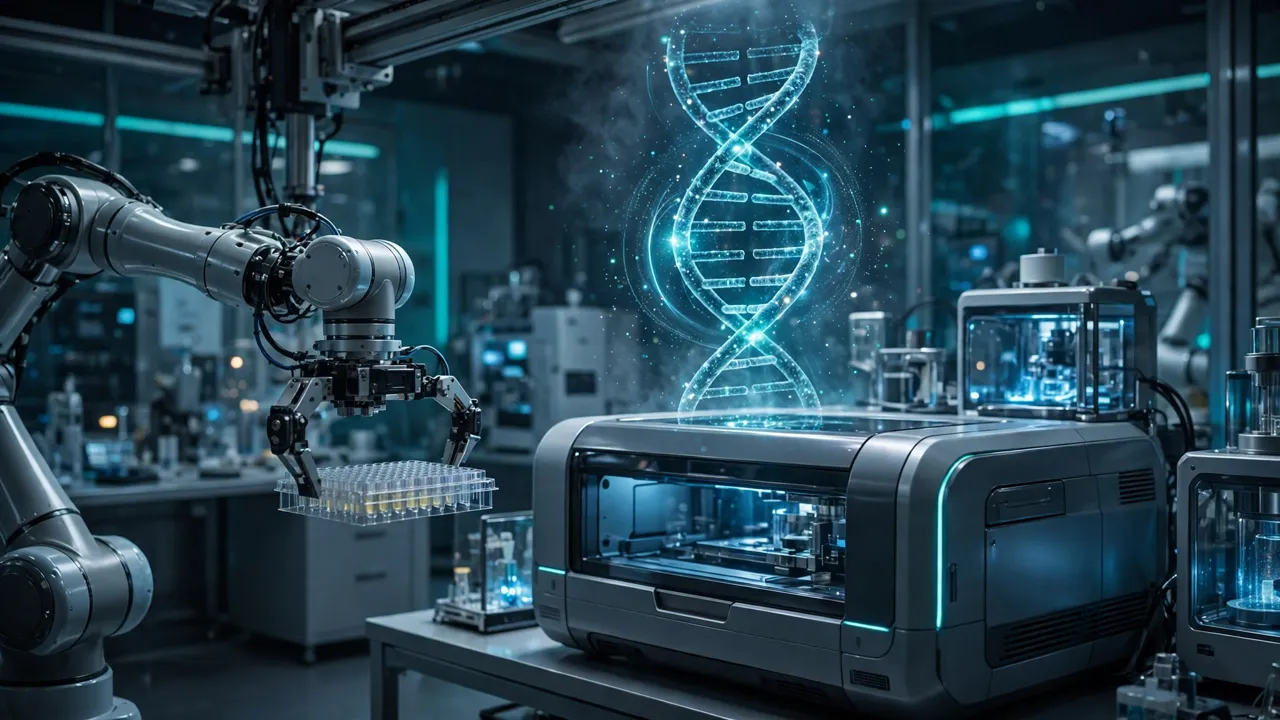
Give a laboratory one typed instruction and walk away. That is the promise of AutoDNA, a system described this week in Nature: a team of AI agents that designs DNA experiments, runs the instruments, fixes its own mistakes, and keeps going for more than eight days straight — while the people in the room mostly top up chemicals and keep the machines running.
The work comes from Shanghai Jiao Tong University, where computer scientist Haibo Chen and colleagues built the lab around AI from the start, instead of bolting automation onto a human workflow. In its most demanding test, the system turned a sentence into DNA and read it back perfectly after 11,382 automated steps.
What AutoDNA actually did#
AutoDNA is not one model doing everything. It is seven specialized agents: one reads the literature, one designs the protocol, one checks reagents, one writes the code that drives the hardware, one watches the instruments, one plans the task, and one forms hypotheses. A human types a plain-language request; the agents take it from there.
The lab holds more than 20 types of instrument, with robotic arms moving samples between them. The system is built around Google’s Gemini 2.5 Pro, and the agents were designed to work with the hardware rather than around it — a break from the usual pattern, where AI is added to one corner of an existing lab.
That design choice is the point. Labs have automated individual steps for years — mixing, heating, pipetting — but the planning, the troubleshooting, and the handoffs between machines stayed human. AutoDNA hands all three to the agents.
Four tests, one long run#
First, enzymatic DNA synthesis: the agents repeatedly adjusted reaction times, reagent concentrations, and wash steps until they reached a 97.8% stepwise yield — on par with expert human optimization. Running several protocols at once, the system finished about 3.2 times faster, cutting a roughly 1,434-minute workload to about 454 minutes.
Second, DNA data storage. The researchers asked AutoDNA to store the sentence “Intelligence is the ability to adapt to change” — a line often misattributed to Stephen Hawking — in DNA. The system encoded it into 78 DNA strands, synthesized and stored them, then sequenced them back. The whole job took about 203.5 hours and 11,382 hardware steps, and the sentence came back exactly.
Third, a clinical test. Working with a real patient sample, AutoDNA identified a KRAS G13D mutation, a genetic change linked to cancer, matching the clinical finding. It designed the primers and ran the assay end to end — the kind of diagnostic workflow that normally passes through several specialists.
The four tests cover the basic operations of working with DNA — making it, copying it into RNA, multiplying it, and reading its sequence — all under agent control, with the parallel speedup showing where the time savings compound.
Where humans still matter#
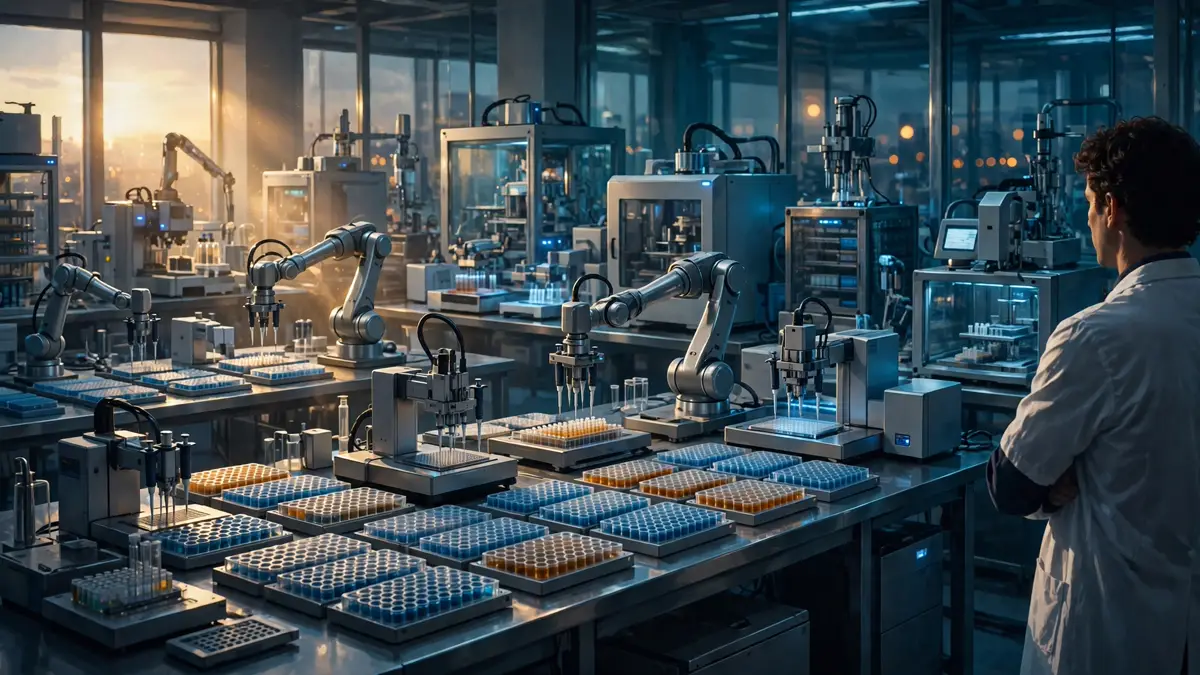
The lab is not fully autonomous, and the paper is candid about that. Fourteen hardware errors occurred during the experiments: the agents resolved eight, and six needed a person. Humans also refill reagents, swap labware, and service the hardware — the chores the system cannot do for itself.
There is a subtler limit too. The team warns that the randomness built into large language models can change whether the same plan produces the same result when it is run again — a reproducibility problem worth watching before anyone trusts such a lab with high-stakes work.
Why it matters#
AutoDNA lands amid a push toward so-called self-driving labs, where AI does not just analyze results but designs and executes the experiments that produce them. “The future of science is going to involve a lot of autonomous labs,” Milad Abolhasani, a chemical engineer at North Carolina State University, told Nature. A commentary in the same journal argued the work may bridge the gap between AI planning experiments and actually carrying them out.
Contrast this with OpenAI’s BioBasicsBench, covered here yesterday, which tests whether AI models can correctly interpret messy laboratory evidence. AutoDNA runs the lab itself. Reading the bench and working the bench are different skills, and the field is now chasing both at once.
If systems like this generalize, the payoff is speed and scale: experiments running around the clock, protocols optimized by trial rather than by a researcher’s calendar. The team has put the code on GitHub and the sequencing data and agent outputs on Zenodo, so other groups can try.
What to watch#
Three things decide whether AutoDNA is a milestone or a demo. First, reproducibility: can other labs rebuild the system and get the same yields, or does it depend on the Shanghai team’s specific hardware and tuning? Second, scope: the tests so far stay inside nucleic-acid work, and it is an open question how far the agent approach stretches into messier biology. Third, oversight: as DNA synthesis gets easier to automate, the rules about who can run it, and with what checks, will matter as much as the technology.
Sources#
- Nature — “AI agents run this automated biology lab that sequences DNA and more” (November 4, 2026)
- Nature — “An AI-native experimental laboratory for autonomous biomolecular operations” (November 4, 2026)
- RathBiotaclan — “AutoDNA autonomous lab runs DNA synthesis and sequencing from a prompt” (November 4, 2026)
- Maccus — “AI agents ran an 11,382-step DNA experiment” (November 5, 2026)