ERNIE 5.5 Flash Base: Baidu’s 280B open-weights model for fine-tuning — with a license that excludes the EU
Baidu has released the raw pre-training checkpoint of ERNIE 5.5 Flash Base, a 280-billion-parameter mixture-of-experts model that activates only 14 billion parameters per token — its first open-weights release since the ERNIE 4.5 series in June 2025 — and paired it with a custom license that bars use in the EU, the UK, and South Korea.
- Who and when: Baidu’s ERNIE Team released ERNIE-5.5-Flash-Base on November 5, 2026.
- What: A text-only, sparse mixture-of-experts base model with 280 billion total parameters and 14 billion activated per token — the checkpoint at the end of pre-training, before any mid- or post-training.
- Training: Pre-trained from scratch on 33.5 trillion tokens with the Muon optimizer and FP8 mixed precision; training context up to 128K tokens, with 1 million tokens supported for fine-tuning and inference.
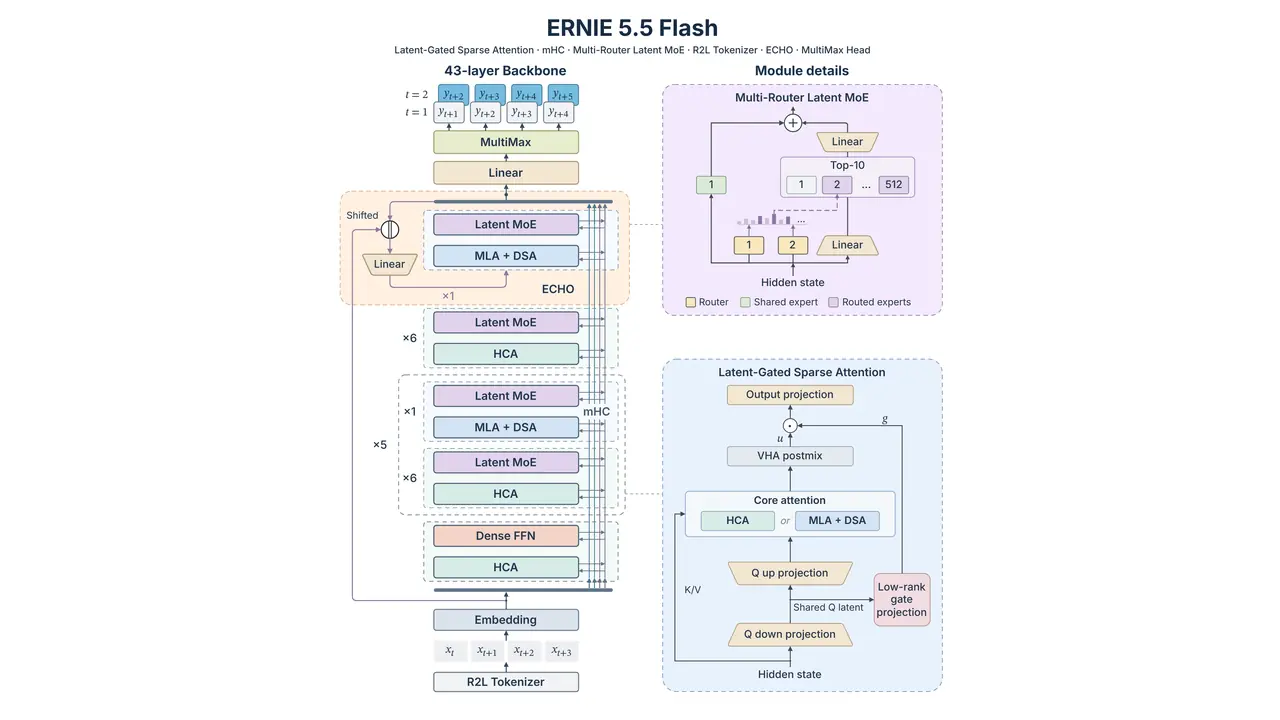
- Architecture: 43 layers (1 dense + 42 MoE), 512 routed experts with top-10 activation plus one shared expert per MoE layer, and 37 Heavily Compressed Attention layers that cache one entry per 128 tokens.
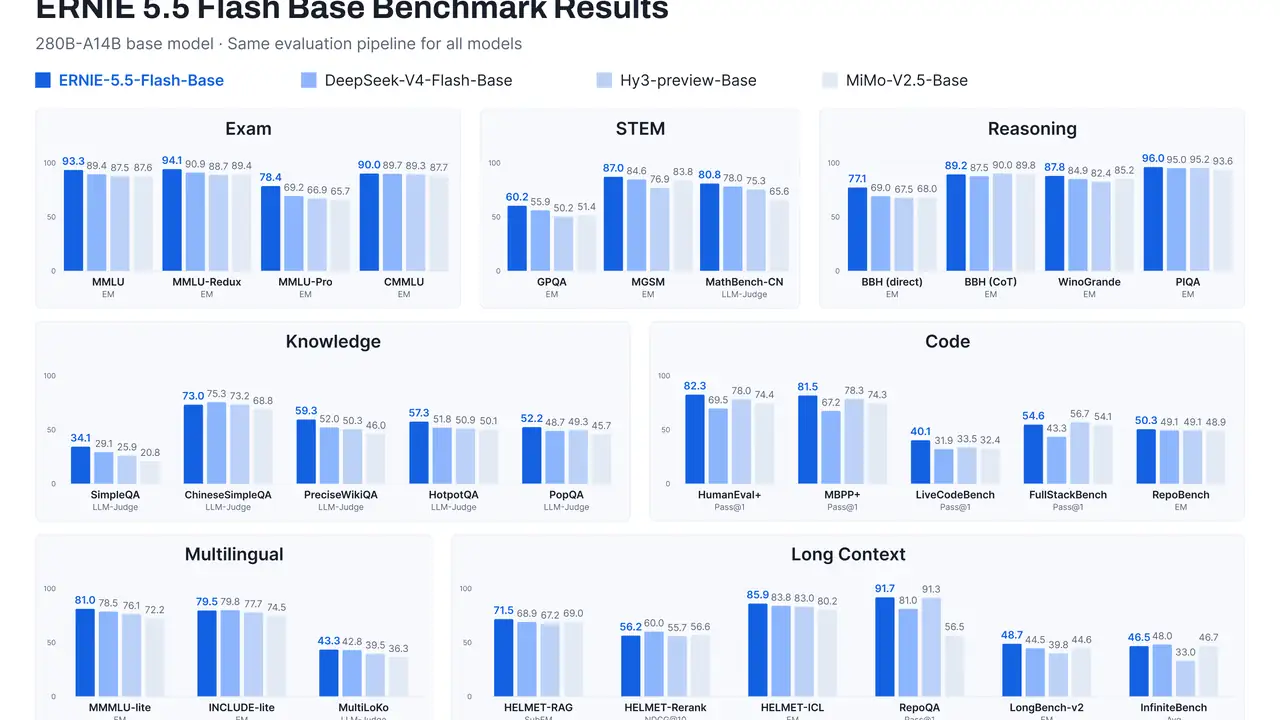
- Benchmarks: In Baidu’s unified evaluation against DeepSeek-V4-Flash-Base, Hy3-preview-Base, and MiMo-V2.5-Base, it ranked first in 24 of 30 benchmarks — MMLU 93.3 and HumanEval+ 82.3 — while trailing on FullStackBench and InfiniteBench.
- License: Custom ERNIE 5.5 Flash Base Model License Agreement v1.0; territory excludes the European Union, United Kingdom, and South Korea, and commercial use above $50 million in related annual revenue needs Baidu’s prior written authorization.
- Downloads: FP8 and BF16 safetensors weights on Hugging Face and ModelScope, with production serving via SGLang and vLLM.

Baidu released ERNIE-5.5-Flash-Base on November 5, 2026, publishing the downloadable weights of a text-only mixture-of-experts model with 280 billion total parameters and 14 billion activated per token. The checkpoint ends pre-training, before mid-training or post-training, giving developers a common starting point for domain adaptation, instruction tuning, and reinforcement-learning research. Baidu said a post-trained ERNIE 5.5 Flash model will follow this base version.
The release matters for two reasons that pull in opposite directions. Technically, it is a serious efficiency play: a 280B model that spends only 14B parameters per token, trained on 33.5 trillion tokens, with a 1-million-token context for fine-tuning and inference. Legally, it is one of the most restricted “open” releases from a major lab this year: the custom license bars use in the European Union, the United Kingdom, and South Korea outright, and puts a $50 million revenue line in front of larger commercial use.
A base checkpoint, not a finished chatbot
ERNIE-5.5-Flash-Base is exactly what its name says: the model as it stood when pre-training finished. It has had no instruction tuning, no alignment pass, and no agentic post-training, so it is not a chatbot you can talk to out of the box. It is raw material — a fixed baseline that research teams can fine-tune for their own domains, and a controlled starting point for comparing training methods without repeating Baidu’s pre-training run.
The weights are available in FP8 and BF16 safetensors formats on Hugging Face and ModelScope, and the model card documents production serving with SGLang and vLLM through the completions API, which matches its base-model status. NVIDIA has also published a Megatron Bridge supervised fine-tuning recipe for the model, with a full-model recipe that uses 16 nodes with four GB300 GPUs each — a reminder that “open weights” and “cheap to run” are very different things at 280 billion parameters.
The efficiency bet: attention that compresses the past
The headline design choice is how the model handles long context. Of its 43 layers — one dense feed-forward layer plus 42 mixture-of-experts layers — 37 use what Baidu calls Heavily Compressed Attention, caching a single entry for each 128-token block, while six Multi-head Latent Attention layers keep token-level access to the full context and use an indexer to pick the highest-scoring earlier positions. Baidu says this keeps per-query core-attention cost constant as context grows, and training context was gradually extended to 128K tokens.
Each MoE layer has 512 routed experts, of which 10 are activated per token, plus one shared expert, operating in a 2,048-dimensional latent space — half the model’s 4,096 hidden width — which Baidu says roughly halves expert dispatch traffic and expert FLOPs. Around that core sit four more efficiency ideas: a Multi-Router design that replaces a single routing decision with several independently initialized routers, a final layer that doubles as a multi-token prediction module, manifold-constrained hyper-connections in place of the standard residual stream, and a MultiMax output head with a learnable piecewise temperature.
How it scores — on Baidu’s own scoreboard
Baidu evaluated ERNIE against three publicly released base checkpoints — DeepSeek-V4-Flash-Base, Tencent’s Hy3-preview-Base, and Xiaomi’s MiMo-V2.5-Base — with the same harness, prompts, few-shot examples, and LLM judge for free-form question answering. On that unified pipeline, Baidu reports ERNIE first in 24 of 30 benchmarks, including MMLU at 93.3 (against 89.4 for DeepSeek, 87.5 for Hy3, and 87.6 for MiMo) and HumanEval+ at 82.3 (against 69.5, 78.0, and 74.4).
The comparison is not a clean sweep, and Baidu’s own table shows it: Tencent’s Hy3 leads FullStackBench at 56.7 against ERNIE’s 54.6, and DeepSeek leads InfiniteBench at 48.0 against ERNIE’s 46.5. These are vendor-run numbers on Baidu’s chosen pipeline, so they are best read as evidence that the model is competitive with its named peers on knowledge and coding tests — not as an independent ranking. Independent evaluations will matter more once the weights circulate.
The license is the real story
ERNIE 5.5 Flash Base ships under the custom ERNIE 5.5 Flash Base Model License Agreement v1.0, and it is a sharp break from the Apache 2.0 license Baidu used for ERNIE 4.5. Its territory excludes the European Union, the United Kingdom, and South Korea, and use, modification, or distribution outside that territory is not authorized. Non-commercial use is free of license charges; commercial use at or below $50 million in annual revenue from related products or services requires a one-time notice and prominent “Powered by ERNIE” attribution. Above that threshold, users need Baidu’s separate prior written authorization.
The agreement also bars using the licensed materials, derivative models, or their outputs to improve an unrelated AI or machine-learning system — a restriction that bites directly on distillation and synthetic-data workflows, which the license addresses expressly. For a research lab, those terms are workable. For a European company, or a large commercial deployer, they may be disqualifying — which is the point. Baidu is publishing the weights while keeping a tight grip on who can build a business on them.
A crowded week for Chinese open weights
ERNIE 5.5 Flash Base lands in the middle of a remarkable run of Chinese open-model releases. Tencent launched Hy4 on November 4, a 770-billion-parameter model that adds vision and computer use, with weights promised in the coming days. Moonshot posted the weights of Kimi K3.1 Pro, a 2.8-trillion-parameter sparse model, to Hugging Face the same day. Baidu’s release is the smallest of the three by total parameters and the only one shipping weights today — but it is also the most legally fenced.
It is also Baidu’s first open-weights release since the ERNIE 4.5 series in June 2025, a gap of about 16 months during which the ERNIE 5.0 and 5.1 models were never open-sourced. The return to open weights, even a gated one, says something about where Baidu thinks the competition now sits: not in hoarding a checkpoint, but in setting the starting point other teams build on — and in writing the terms on which they do it.
For researchers and fine-tuners with the hardware to run it, ERNIE-5.5-Flash-Base is a genuinely useful artifact: a strong, efficient base model with a published training recipe and serving support on day one. For everyone else, the release is a reminder that “open weights” is now a spectrum — and Baidu has chosen to stand at its most conditional end.
Sources: Baidu’s ERNIE-5.5-Flash-Base model card on Hugging Face, Unite.AI’s report on the release, and ChainCatcher’s coverage of the license terms.
Frequently asked questions
What is ERNIE 5.5 Flash Base?
It is the checkpoint of Baidu’s ERNIE 5.5 Flash model at the end of pre-training, before any mid- or post-training: a text-only, 280-billion-parameter mixture-of-experts model that activates 14 billion parameters per token. It is raw material for domain fine-tuning, instruction tuning, and reinforcement-learning research, not a finished chatbot, and Baidu says a post-trained version will follow.
How does it compare with DeepSeek V4 Flash and Tencent Hy3?
In Baidu’s unified evaluation against DeepSeek-V4-Flash-Base, Hy3-preview-Base, and MiMo-V2.5-Base, ERNIE ranked first in 24 of 30 benchmarks, including MMLU at 93.3 and HumanEval+ at 82.3. It trails on some tests: Hy3 leads FullStackBench at 56.7 against ERNIE’s 54.6, and DeepSeek leads InfiniteBench at 48.0 against 46.5. These are vendor-run numbers on Baidu’s pipeline, not independent results.
Can I use ERNIE 5.5 Flash Base commercially?
Only within the limits of its custom license. The territory excludes the European Union, the United Kingdom, and South Korea. Non-commercial use is free; commercial use at or below $50 million in related annual revenue requires a one-time notice and “Powered by ERNIE” attribution, and use above that threshold needs Baidu’s prior written authorization. The license also bars using the model or its outputs to improve an unrelated AI system.