China Telecom and HKUST launch a joint AI-for-telecoms lab: research wired to a 304-terabit global network
- Who: China Telecom Global (CTG) — established 2012, headquartered in Hong Kong, a wholly-owned subsidiary of China Telecom Co., Ltd. — and the Hong Kong University of Science and Technology (HKUST).
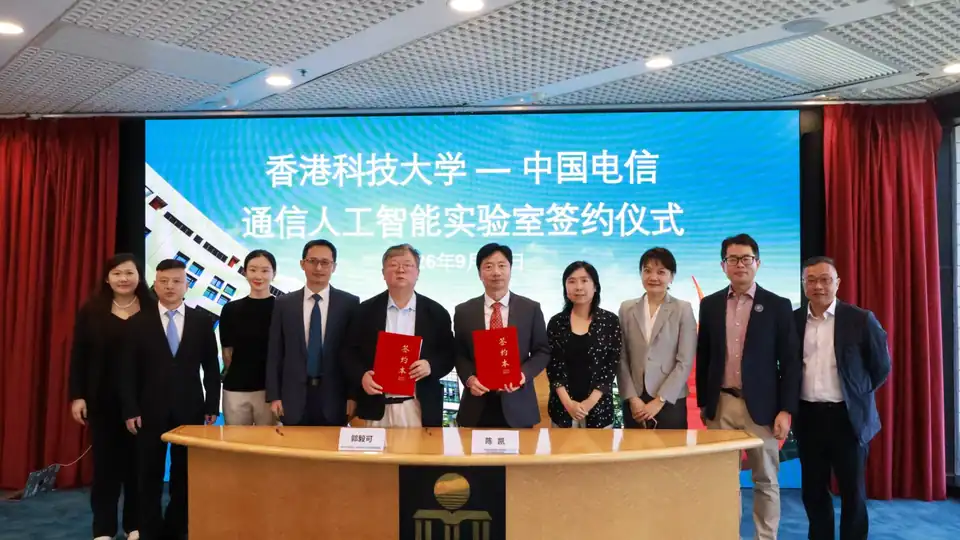
- What: the HKUST–China Telecom Joint Laboratory on AI for Telecommunications, created by a cooperation agreement signed at a ceremony on the HKUST campus.
- When: October 21, 2026 — the signing ceremony and the lab’s first Scientific Advisory Committee meeting were held the same day.
- Scale of the carrier’s testbed: CTG operates in 53 countries and markets, with 185 submarine and terrestrial cables, over 304T of intercontinental capacity, 259 points of presence and 15 proprietary data centres.
- Leadership: Chen Kai, Executive Vice President of CTG, and Prof. Guo Yike, Provost of HKUST, executed the agreement; Prof. Guo serves as Director of the Joint Laboratory.
- First actions: the advisory committee approved the first batch of research projects, adopted the Laboratory Charter and Rules of Procedure, and discussed 2027 R&D directions. Background: a strategic cooperation agreement the two parties signed in March 2025.
China Telecom Global and the Hong Kong University of Science and Technology have signed the agreement creating a joint laboratory on AI for telecommunications — and they did not waste the day. At the signing ceremony on the HKUST campus on October 21, 2026, the two parties also convened the laboratory’s first Scientific Advisory Committee meeting, which approved the lab’s first batch of research projects on the spot.
The ceremony moves a strategic cooperation agreement the two signed in March 2025 into what the announcement calls its implementation phase: the lab is now chartered, governed, and staffing research topics.
Signed in the morning, governing by the afternoon
Chen Kai, Executive Vice President of China Telecom Global (CTG), and Prof. Guo Yike, Provost of HKUST, delivered the keynote addresses and executed the cooperation agreement on behalf of the two parties. Prof. Guo will also serve as Director of the Joint Laboratory.
The advisory committee’s first meeting went well beyond ribbon-cutting. It approved the laboratory’s first batch of research projects, adopted the Laboratory Charter and its Rules of Procedure, and held in-depth discussions on 2027 research and development directions — including how to translate CTG’s telecommunications business scenarios into formal research topics.
What the lab will actually research
The lab’s mandate is frontier AI technologies for telecommunications. Research topics will be defined around CTG’s business scenarios in global networks and its AI-powered intelligent computing cloud, alongside joint talent development — and the whole thing is meant to run as a closed loop: business scenarios feed research topics, which feed commercialised outcomes.
Carrier operations are one of the richest real-world AI testbeds in existence, and CTG’s is unusually large: a presence in 53 countries and markets, 185 submarine and terrestrial cables with over 304T of intercontinental capacity, 259 points of presence, and 15 proprietary data centres around the world. Networks at that scale generate oceans of operational telemetry — exactly the raw material AI research needs.

Why it matters
“China Telecom is accelerating its development into a technology-driven enterprise,” said Chen Kai. “Leveraging the company’s business scenarios in global networks and the AI-powered intelligent computing cloud, the joint laboratory will work with HKUST on frontier research, drive collaborative innovation across telecommunications and artificial intelligence, and serve the development of Digital China and the Greater Bay Area.”
Prof. Guo framed it from the university’s side: “The joint laboratory is an important platform for HKUST to advance the deep integration of AI research with real-world industry scenarios. We will give full play to the university’s research strengths, accelerate the translation of research outcomes, and contribute to building Hong Kong into an international innovation and technology hub.”
The lab will operate on a governance rhythm of quarterly written reports plus biannual review meetings, explicitly designed to keep research aligned with industry needs and outcomes measurable and translatable. Industry–academia AI labs are hardly new — but one wired directly into a 304-terabit global network gets to test its ideas against reality faster than most.
Frequently asked questions
What is the HKUST–China Telecom Joint Laboratory on AI for Telecommunications?
A joint research laboratory created by a cooperation agreement signed by China Telecom Global and HKUST on October 21, 2026, at the HKUST campus. It focuses on frontier AI technologies for telecommunications: research topics are defined around CTG's business scenarios in global networks and its AI-powered intelligent computing cloud, alongside joint talent development and a closed-loop path from business scenarios to commercialised outcomes.
Who leads the laboratory?
Prof. Guo Yike, Provost of HKUST, serves as Director of the Joint Laboratory. The cooperation agreement was executed by Chen Kai, Executive Vice President of China Telecom Global, and Prof. Guo. A Scientific Advisory Committee oversees the research programme; its first meeting approved the first batch of projects and adopted the Laboratory Charter and Rules of Procedure.
What happens next?
The laboratory runs on quarterly written reports plus biannual review meetings to keep research aligned with industry needs. The first advisory meeting already approved the first batch of research projects and held in-depth discussions on 2027 R&D directions, so project work is underway rather than planned for later.