Flatkey raises $10M for one API key that reaches 100+ models and 1,000 tools — most of them below list price
San Jose's Flatkey announced a $10M Series A Tuesday after passing 10,000 developers in two months, pitching one key, one balance, and one invoice for 100+ official models and 1,000+ AI tools — at 60 to 90% of the labs' list prices.
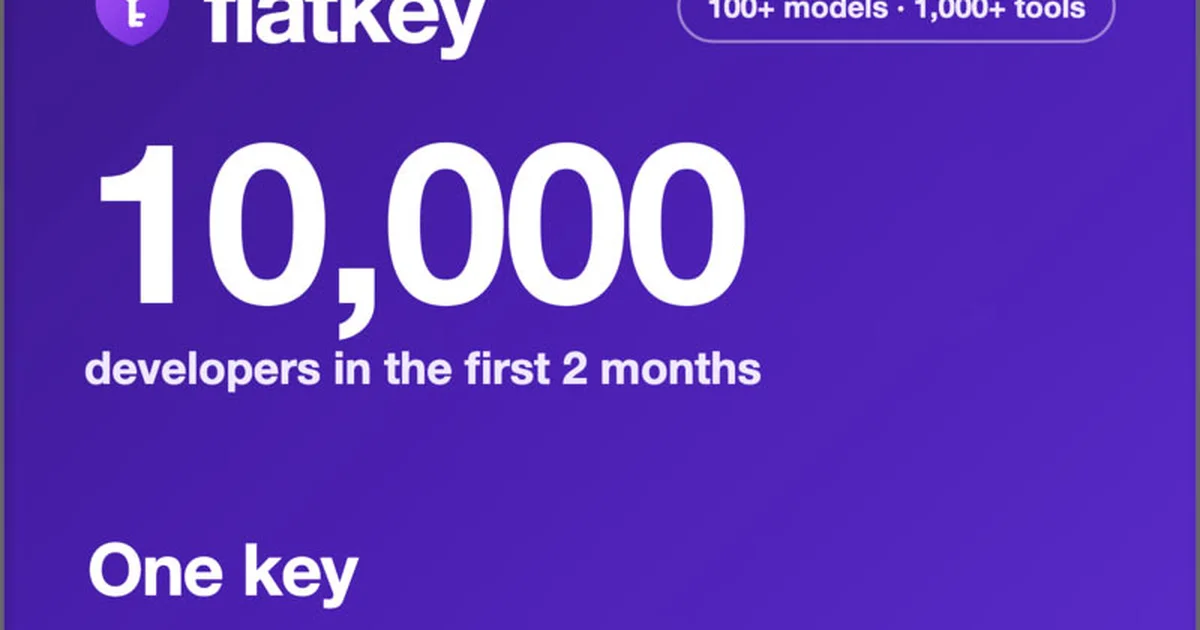
Flatkey, a San Jose AI-infrastructure startup, announced Tuesday it has raised $10 million in Series A funding after more than 10,000 developers signed on in the two months since its July launch. The pitch is one API key, one balance, and one invoice for over 100 official AI models and 1,000+ AI tools — with most models priced at around 80% of the labs' official rates.
The announcement is notably thin on the usual funding details: no investors are named, and the release says only that "Flatkey and Realset AI" raised the $10 million. The company says the capital will go toward adding more official models and tools and scaling the infrastructure that routes developer traffic.
The sprawl problem it wants to sell away#
A production AI app today rarely depends on one model. It combines several models across text, image, audio, and video, then pairs them with tools for search, browsing, and data enrichment — and each provider adds an account, a top-up, an API key, a rate limit, and an invoice. Flatkey's bet is that those three layers — models, tools, and the data they act on — converge into a single interface: one key and one balance covering models from OpenAI, Anthropic, Google, DeepSeek, Kimi, and GLM, image and video models such as ByteDance's Seedance, and a tools layer spanning search, browsers, enrichment, media generation, and actions.
New models are made available through official channels as soon as they are released, so developers don't have to set up a new provider account every time something new ships. It's a drop-in replacement for any OpenAI-compatible client: change one line of code — the base URL — and existing code works.
The 20% discount#
Because it buys upstream capacity in volume, Flatkey says it prices many APIs at 60 to 90 percent of the providers' official list prices, with most models landing at around 80 percent. Subscription plans start at $10 a month, and pay-per-use credits cover both models and tools on the same balance.
One mechanical claim does real work here: every model call goes through the official provider endpoint. Flatkey says it does not self-host modified or quantized versions and label them as the original model — and its site claims each of the 100+ models is probed against official fingerprints hourly, on a public log. Tree-structured sub-keys with budgets and model allowlists, a per-request token ledger, and invoices within 48 hours round out the enterprise pitch.
"AI development is becoming less about choosing one model and more about combining models, data and tools across text, image, audio and video," founder Hunter Guo said in the announcement. "If developers can reach all of that through one key, the platform stops being a convenience layer and starts to look like infrastructure. That is the company we are building."
Why it matters#
The timing is the agentic turn. Real apps now combine several models across modalities with tools that act — which is exactly the sprawl Flatkey monetizes. It is not alone at this layer: Cribl launched its StreamAI gateway the same day with a model router aimed at the same token-bill anxiety. Flatkey's distinguishing bet is price: resell official access below list and keep the spread. That works only while the labs' volume pricing leaves enough slack — and only if those 10,000 developers convert from signups into paying traffic.
| Item | Detail |
|---|---|
| New raise | $10 million Series A (investors not named) |
| Founded / HQ | July 2026, San Jose, California |
| Traction | 10,000+ developers in first two months |
| Catalog | 100+ official models, 1,000+ tools |
| Pricing | 60–90% of official list; subscriptions from $10/mo |
| Founder | Hunter Guo |
What to watch#
- The arbitrage math. Below-list reselling depends on volume discounts and on the labs not squeezing reseller margins. If Flatkey's own bills scale with its developer count, the ~20% haircut is the whole margin.
- The "official endpoint" guarantee under load. Everything routes through the real lab APIs, so Flatkey inherits their outages, rate limits, and pricing changes. Its answer is a mesh of channel classes with automatic failover and a signed 99.5% SLA — worth watching in practice.
- Conversion, not signups. 10,000 developers in two months is the headline number. The Series A will be judged on how many of them put real traffic through the one key.