Gemini Omni 1.2 Flash: Google's AI video model now makes 15-second clips for $0.07 a second
Google has made its AI video generator meaningfully more useful — and cheaper. Gemini Omni 1.2 Flash, generally available from November 5, 2026, generates and edits video clips natively up to 15 seconds long, takes conversational follow-up edits instead of full re-renders, and costs 30% less than its predecessor at $0.07 per second for 720p video.
- Who and when: Google DeepMind announced Gemini Omni 1.2 Flash on November 5, 2026; it is generally available across the Gemini API and Gemini for business.
- What: An AI video generation and editing model with native clips up to 15 seconds long, up from 10 seconds with Omni 1.1. Clip length can be set in one-second increments from 3 to 15 seconds.
- Price: 30% cheaper than Omni 1.1 at $0.07 per second for 720p video — about $0.70 for a 10-second clip and $1.04 for a 15-second clip on the paid Gemini API.
- Editing: Multi-turn conversational edits swap a product, background, lighting, weather or aspect ratio without re-generating the clip; up to six reference images, short motion clips up to three seconds, and audio cues can guide generation.
- Consistency: Google DeepMind’s side-by-side tests give 1.2 a 62% visual-consistency win rate over 1.1 (38%), and 63% vs 37% on multi-reference identity consistency.
- Rollout: Gemini API, Google AI Studio, Google Cloud console, Flow, Google Vids, the Gemini app (AI Ultra subscribers) and Google Ads; API output carries an invisible SynthID watermark. Omni 1.1 requests auto-route to 1.2 on December 3, 2026.
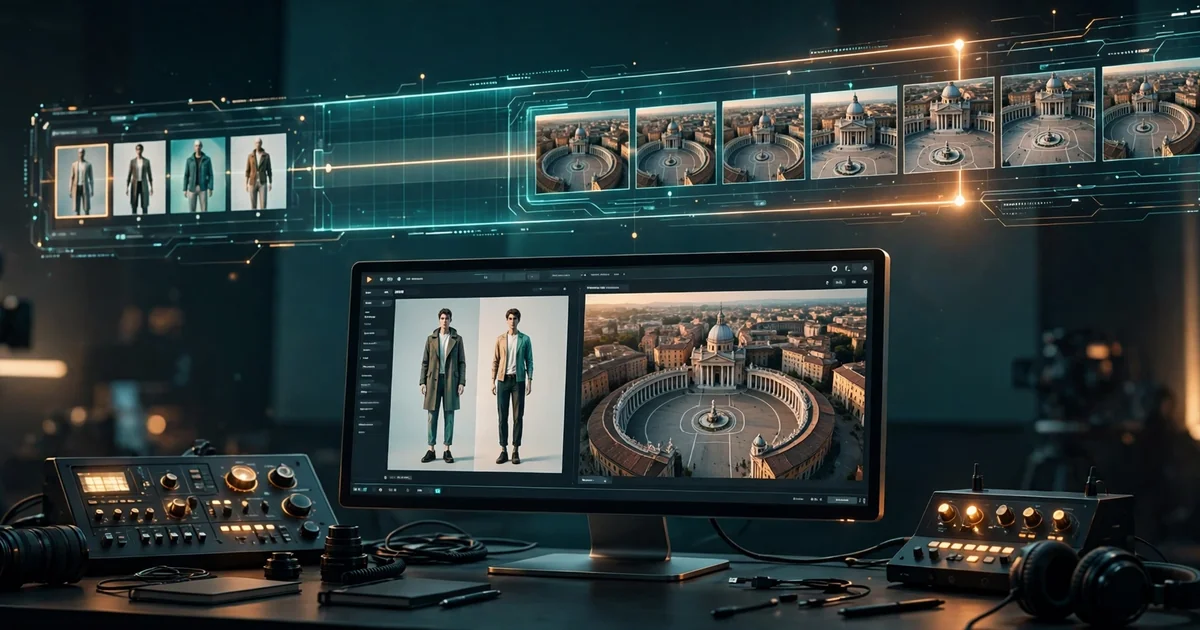
Google announced Gemini Omni 1.2 Flash on November 5, 2026, making its AI video-generation model generally available across the Gemini API and Gemini for business. The update stretches native clips from 10 seconds to 15, adds multi-turn conversational editing, and cuts 720p pricing by 30% to $0.07 per generated second.
Fifteen seconds is the number that changes what the model is for. Ten seconds is a teaser; fifteen covers a complete product explainer, a full social ad spot, or a short with a beginning, a middle and an end in a single generation, as Google puts it. Clips can be set to any whole-second length from 3 to 15 seconds, with 10 seconds as the default.
What’s new
The price cut is the other half of the story. Beyond the headline $0.07 per second, the workflow is designed to keep costs down: draft fast at 360p or 720p, fix a detail with a follow-up edit instead of re-generating the whole clip, then upscale only the best results to 1080p or 4K. On the paid Gemini API, pricing is $12 per million video-output tokens, metered at 5,792 tokens per second of 720p video — roughly $0.70 for a 10-second clip and $1.04 for a 15-second clip. The model is not available on the free tier.
Edit in conversation instead of starting over
The headline feature for anyone producing video at volume is multi-turn conversational editing. You can refine the same clip turn by turn — swap a product or background, change the lighting or weather, switch the aspect ratio — instead of starting from scratch, and the edits work across full 15-second clips. A previous-interaction identifier preserves context between API requests, so the prior video does not have to be uploaded again.
Reference following gets the same treatment. Generation can be guided by up to six reference images, including up to three images per character for up to two characters, plus short motion clips of up to three seconds and audio cues. Faces, garments, packaging typography and brand colors are supposed to stay consistent across camera angles, so existing product photography or character sheets can become virtual try-on clips, catalog spins and branded video ads.

Consistency is the real upgrade
Google’s pitch is that longer clips are only useful if the subject survives them. In Google DeepMind’s side-by-side evaluations, Omni 1.2 wins 62% of text-to-video visual-consistency comparisons against Omni 1.1’s 38%, and 63% vs 37% on multi-reference identity consistency. The showcase example is virtual try-on: combining one model photo with front-and-back product shots of three outfits, the model generates a 15-second sequence of 360-degree turns and match cuts while keeping the model’s identity and each garment’s cut, drape and back details consistent.
Dialogue gets a similar upgrade, with more fluid, natural-sounding speech, clearer lip-sync and distinct conditioning for multiple speakers. Camera work is steadier too: Google says complex, continuous movements — sweeping FPV flythroughs, dramatic zoom-outs and orbits — now come with significantly fewer unwanted jump cuts. One demo flies a single continuous FPV shot across a piazza, through bronze doors and up through the Pantheon’s dome to the oculus with zero jump cuts.

Where you can use it
The rollout covers the Gemini API and Google AI Studio for developers, the Google Cloud console for businesses, and Flow, Google Vids, the Gemini app and Google Ads for everyone else. Vids users get 15-second clips at no additional cost with a Google account or Workspace subscription; in the Gemini app, 15-second videos are rolling out to Google AI Ultra subscribers. Every video generated through the API carries an imperceptible SynthID watermark for provenance, and Google Cloud offers Provisioned Throughput for production workloads.
Early production use is already visible. Photoroom, which powers its Video Ad Maker and Product Animator with the model, said the longer generation limit was a top user request and that general availability with service-level agreements would let the company rely on it in production for sellers and enterprise customers.
The limits
Google is open about what still needs work: fast sports action, rapid script changes and complex physics remain in development. The Gemini API fully supports English but has not evaluated other languages, and voice editing, uploaded audio inputs and audio references are unsupported in the current API. Video extension is separate from native generation: it appends 3 to 10 seconds per turn, using the final 10 seconds as context, up to 30 seconds total.
Migration is on a clock. Omni 1.1 stays available during a four-week transition, and on December 3, 2026, API requests to 1.1 will automatically route to 1.2 without code changes, at the lower 1.2 rates.
Why this one matters
AI video has been racing toward longer, cheaper, more controllable clips all year — from image-to-video models pushing generation speed to DeepMind’s own world models that talk back. Omni 1.2 Flash’s bet is different: not a bigger leap in quality, but a production loop. Draft cheap, fix with a sentence instead of a re-render, upscale only the keepers. If the consistency gains hold outside Google’s demos, that loop is what turns AI video from a demo toy into a tool ad teams and creators can actually schedule around. The comparison that matters now is no longer which model makes the prettiest single clip, but which one survives the tenth edit.
Frequently asked questions
What is Gemini Omni 1.2 Flash?
Google DeepMind's AI video generation and editing model. Announced on November 5, 2026 and generally available across the Gemini API and Gemini for business, it generates video with synchronized native audio from text, image and video inputs, with native clips up to 15 seconds long.
How much does Gemini Omni 1.2 Flash cost?
720p video costs $0.07 per generated second, 30% less than Omni 1.1. On the paid Gemini API that works out to about $0.70 for a 10-second clip and $1.04 for a 15-second clip. The model is not available on the free tier.
Where can I use Gemini Omni 1.2 Flash?
Through the Gemini API and Google AI Studio, the Google Cloud console, Flow, Google Vids, the Gemini app (rolling out to Google AI Ultra subscribers) and Google Ads. Every video generated through the API carries an invisible SynthID watermark.