Google DeepMind launches AlphaGenome 2: DNA predictions tuned to individual cell types
Google DeepMind's AlphaGenome 2 predicts how DNA variants act in specific cell types, not tissue averages — trained on more than 107 million cell profiles, it finds nearly twice as many causal variants as its predecessor.
Google DeepMind has released AlphaGenome 2, a model that predicts how a change in DNA plays out inside a specific kind of cell — not just in a tissue as a whole. Announced on Wednesday, it is the lab’s second-generation genome model, trained on more than 107 million individual cell profiles drawn from 68 tissues.
The shift matters because the same stretch of DNA is read differently by different cells. A variant that is harmless in one cell type can drive disease in another, and tissue-wide averages wash that difference out. On a benchmark covering 28 immune cell types, DeepMind says the new model picks up nearly twice as many variants that change gene expression as its predecessor did.
From tissue averages to single cells#
The original AlphaGenome, released last year, took a million-letter DNA sequence and predicted molecular activity across thousands of experiments from many tissues at once. That parallel approach was efficient, but it spread the model’s capacity thin and blurred the differences between closely related cell types. DeepMind also shipped the AlphaGenome Atlas alongside it: precomputed predictions for all 9 billion possible single-letter changes in the human genome.
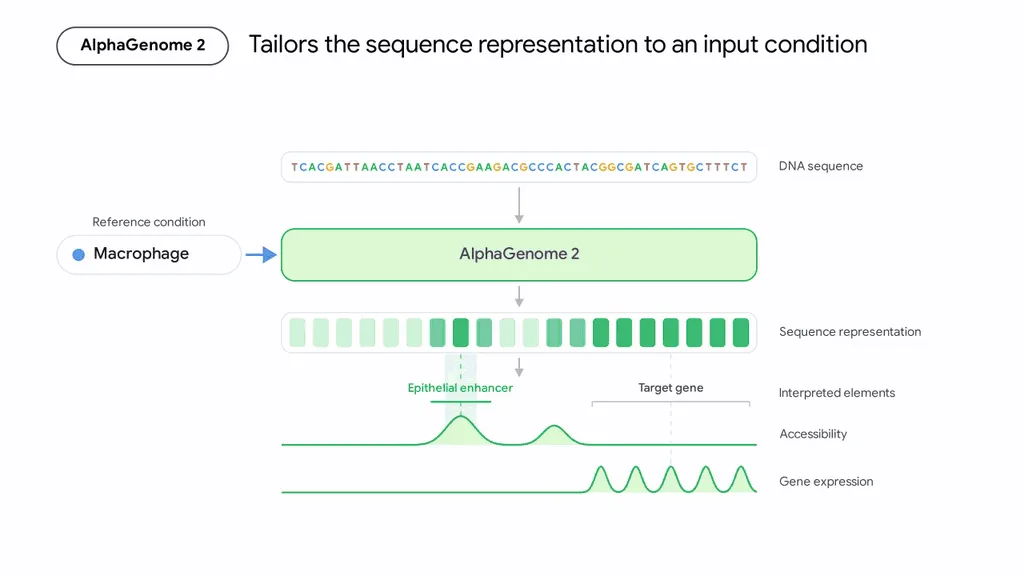
AlphaGenome 2 redesigns that setup. It is a conditional model: alongside the DNA sequence, it takes one biological condition at a time — a tissue, a cell type, or a cell state — and feeds that condition into every stage of its architecture. The condition can come from a reference catalog, or be generated on the fly from a researcher’s own single-cell experiment through a cell encoder.
The redesign also widens what the model predicts. It keeps the original readouts — gene expression, histone modifications, chromatin accessibility — and adds DNA methylation, a widely requested one. And because it separates a cell’s biological state from its outputs, it can fill in missing measurements: feed it single-cell gene activity and it can predict unmeasured properties such as chromatin accessibility, helping researchers choose which experiments to run next.
The numbers#
DeepMind’s headline benchmark is TenK10K, a large single-cell map of 28 primary immune cell types. At 90% precision, AlphaGenome 2 recovered 30% of the variants that change gene expression, against 16% for the original AlphaGenome fine-tuned on single-cell data — and it did better on directional effects too, calling whether a variant turns a gene up or down in 43% of cases versus 23%.
| Measure | AlphaGenome 2 | AlphaGenome 1 (fine-tuned) |
|---|---|---|
| Causal variants found (TenK10K) | 30% | 16% |
| Directional gene effects called | 43% | 23% |
| Training data | 107M+ cell profiles, 68 tissues | Bulk tissue averages |
| DNA context | 1 million letters | 1 million letters |
The percentages are still modest in absolute terms — the model recovers a minority of the variants statistical analyses nominate as likely causal — but the jump is the point. In variant hunting, doubling the recall at the same precision means fewer disease-linked variants slipping through unnoticed.
Two checks that matter#
The first check is a real disease story. A landmark study showed that a variant in a distant regulatory switch drives inflammatory bowel disease by overactivating the ETS2 gene in gut immune cells called macrophages. Running predictions across immune cell types in the gut, AlphaGenome 2 reproduced the finding computationally: it singled out the causal variant and showed it selectively boosts ETS2 in gut macrophages, leaving other cell types and genes largely unaffected.
The second check is about states the model never saw. Scientists can upload a single-cell RNA snapshot from just a few dozen cells, and the model compresses it into a cell-state representation it can condition on — no retraining. Given unseen data from a COVID-19 mRNA vaccine study, it distinguished vaccine-activated immune T cells from resting ones, and showed that a variant linked to severe COVID-19 disrupts gene activity more strongly in the activated state — an effect invisible in unactivated cells.

What Reddit made of it#
The announcement surfaced on r/accelerate and r/singularity within the hour, and the reaction was fast but measured. One top comment called it “another big step to cure cancer”; the most substantive reply pushed back on exactly that reading, arguing the gain is real but incremental — a better model for cell lines, not a solved problem. That is the right framing: AlphaGenome 2 is a sharper lens for finding where variants act, not a treatment.
Access and limits#
AlphaGenome 2 is available from today for non-commercial research through the AlphaGenome API, with commercial research in private preview. DeepMind also plans to release AlphaGenome 2 Skills in Google Antigravity, its agentic development platform, pairing the specialized model with Gemini 4 for research workflows. The lab is soliciting interesting use cases from researchers until November 30.
Two limits are worth stating plainly. The model is for research only: DeepMind notes it has not been validated or approved for clinical or diagnostic use. And it does not replace its predecessor — genomics lead Žiga Avsec told The Verge the new model’s higher computational cost makes it too expensive to run everywhere the original runs. DeepMind is also precomputing AlphaGenome 2 predictions for trait-associated variants across hundreds of human cell and tissue conditions, so researchers can look up enhancer–gene links and likely causal variants without running the model themselves.
What to watch#
First, whether the recall gains hold up outside DeepMind’s own benchmarks — independent groups will now put the API through its paces on their own cohorts, and the real test is variants the model has never seen.
Second, whether cell-type-specific predictions change drug discovery in practice. The ETS2 example shows the mechanism: a variant that matters only in macrophages points at a drug target in macrophages, not in the whole immune system. Expect the first papers that use AlphaGenome 2 to find a variant to be the ones that matter.
And third, the Antigravity pairing. If AlphaGenome 2 Skills land in Google’s agentic platform as promised, the model stops being a standalone API and becomes a tool an agent can call while designing experiments — which is where DeepMind’s science models have been heading all year.