Kolmena launches AI agent swarms: MAYA coordinates your personal AI workforce
Kolmena launched its agentic AI platform on Monday, November 9 — announced just over an hour ago — pitching coordinated teams of specialized agents, or “swarms,” as the successor to the single AI assistant: you describe the goal, and its MAYA companion assembles the workforce, routes each task to the best-suited model, and hands back the result.
What we checked: Kolmena’s launch announcement (PR Newswire, November 9, 2026, 8:00 a.m. ET), cross-checked against the company’s live site, kolmena.ai.
- What: Kolmena launched its agentic AI platform on November 9, 2026, built around coordinated teams of specialized agents it calls “swarms.”
- How it works: You describe a goal to MAYA; Kolmena assembles agents with roles, KSPR (Kolmena Smart Prompt Routing) picks a different AI model per task, and the agents share context and results through an orchestration layer.
- Scale: More than 1,600 integrations, plus persistent memory, governance and observability, and deployment to Discord, Telegram, the web or via API.
- Proof point: A regulatory-intelligence workflow for Celnova Pharma that monitors FDA and EMA drug approvals cut time spent on regulatory research by 85%, according to Kolmena.
- Access: Invitation-only. Individuals get free entry with usage-based plans through MAYA; organizations get an AI coordination layer with enterprise controls.
- Who: Kolmena is a U.S.-based company with an office in Stamford, Connecticut, and a distributed team across the United States, Europe and Latin America.
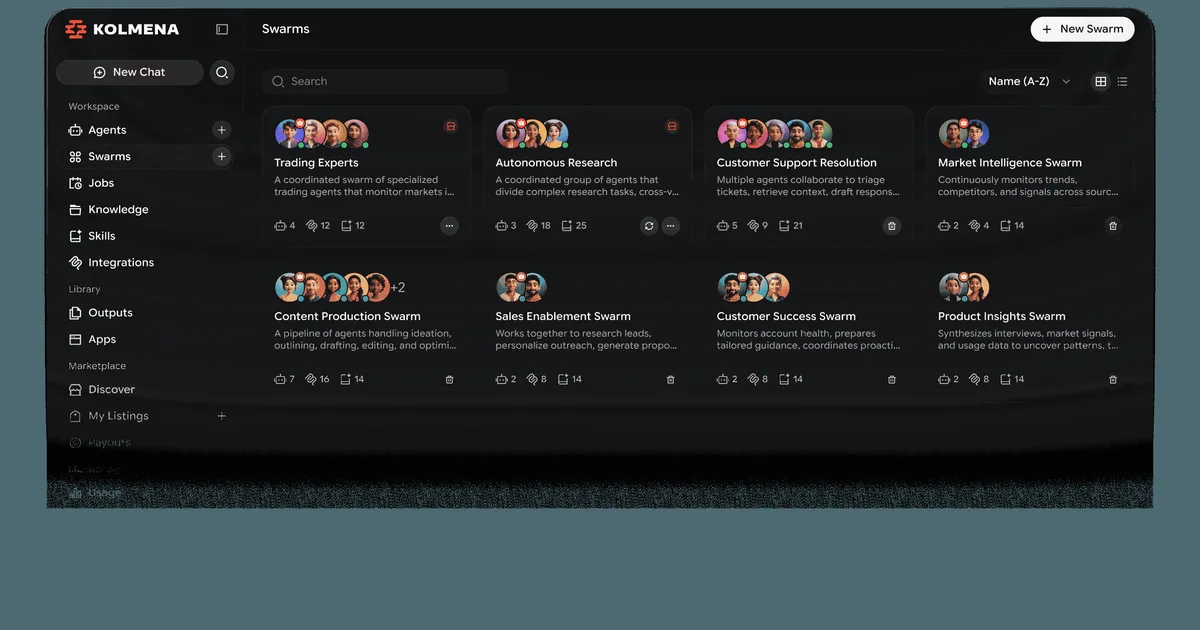
How a Kolmena swarm works
The pitch starts with a frustration anyone who has chained prompts across five tools will recognize: one general-purpose assistant doing everything, badly. Kolmena’s answer is to split the job. Here is the mechanism, step by step.
1. You describe the goal. The entry point is MAYA, Kolmena’s bee-inspired companion. You state what you want done in plain language — no prompt engineering, no picking a model, no wiring tools together.
2. Kolmena assembles a swarm. The platform builds a team of specialized agents and gives each a role: one monitors, one researches, one drafts, one checks. The agents communicate and exchange context, instructions and results, so work progresses across specialists without you managing every prompt. Its launch tools include an Agent Builder and a Swarm Builder for defining those roles.
3. KSPR picks the model per task. At the heart of the platform is Kolmena Smart Prompt Routing, which selects different AI models for different tasks inside one workflow. The point is cost and capability at once: a cheap fast model for triage, a stronger one for judgment, without depending on a single provider. That matters more every month, as models keep leapfrogging each other on price and benchmarks — the same week LG opened a free API for its 750B-parameter K-EXAONE 2.5, a model that rivals DeepSeek and GLM-5.3 on agentic tests.
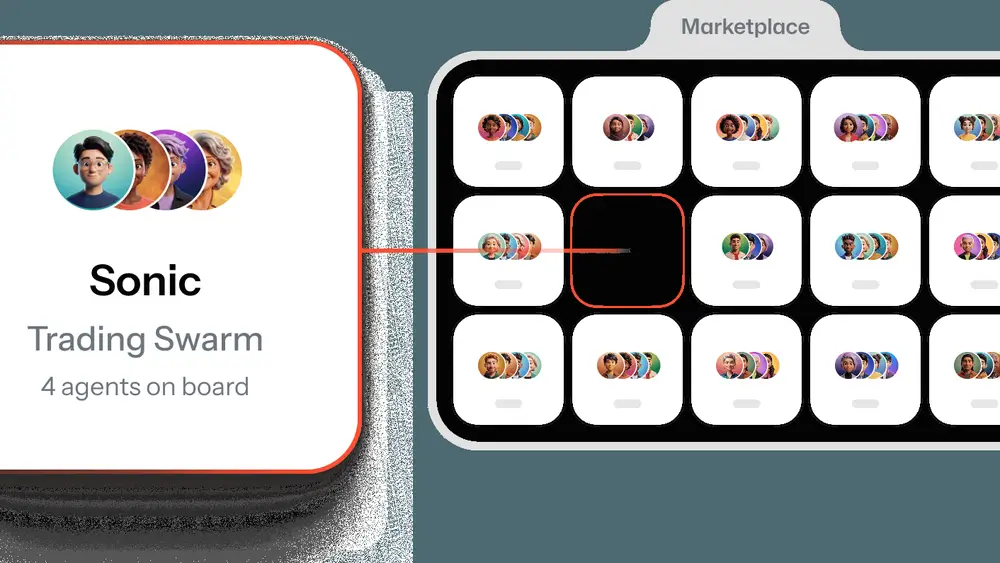
4. The swarm works your apps. Kolmena claims more than 1,600 integrations, persistent memory, governance and observability. Swarms can be deployed to Discord, Telegram, the web or via API, and listed in a marketplace. The dashboard’s example swarms show the intended range: Trading Experts, Autonomous Research, Customer Support Resolution, Market Intelligence, Content Production, Sales Enablement, Customer Success and Product Insights.
5. A concrete example: drug approvals. The one worked example in the launch is pharmaceutical. For Celnova Pharma, Kolmena runs a regulatory-intelligence workflow that automatically monitors FDA and EMA drug approvals, identifies molecules aligned with the company’s therapeutic and commercial priorities, and organizes opportunities for business-development teams. Kolmena says the system cut time spent on regulatory research by 85% — the kind of single-customer figure that is encouraging, and that only independent use will confirm.
One assistant vs. a swarm
| Single AI assistant | Kolmena swarm | |
|---|---|---|
| Who does the work | One generalist model | Specialized agents with assigned roles |
| Model choice | Whatever the assistant runs on | KSPR routes each task to a different model |
| Context | One conversation thread | Shared across agents, with persistent memory |
| Integrations | Whatever the app ships | 1,600+ claimed, plus Discord, Telegram, web and API deployment |
| Oversight | You read the output | Governance and observability tooling |
What launched today
The platform is live in invitation-only access. For individuals, MAYA is the product: free entry with usage-based plans. For organizations, Kolmena sells the coordination layer itself, with enterprise controls. The launch bundle is the Agent Builder, the Swarm Builder, persistent memory, governance tools, and an implementation partner program for agencies, consultancies and AI specialists. Kolmena is U.S.-based, with an office in Stamford, Connecticut, and a distributed team across the United States, Europe and Latin America. Invitations can be requested at kolmena.ai.

Why this matters — and what to watch
Multi-agent orchestration is the crowded next race after the single-assistant era: every vendor now promises teams of agents, and the differentiator is whether the coordination actually works under real load. Two recent reality checks frame the launch. SemiAnalysis’s GDPx benchmark found the best AI agent finishes just 12% of real professional work — the gap Kolmena’s swarms are built to close. And Microsoft’s ThinkingBox showed two in three failed agent runs looked finished, which is exactly why Kolmena’s governance and observability claims deserve scrutiny rather than applause.
What to watch: who actually gets invitations and how fast, whether KSPR’s per-task routing produces visible cost or quality wins, and whether the partner program turns agencies into a real distribution channel. Until outsiders can use it, the 85% Celnova figure is a company example, not a verdict. The swarm idea is sound; the proof is a queue of users.