Nous Research raises $90M at a $1.5B valuation: the open-source Hermes agent is going enterprise
Nous Research announced on October 7 that it has raised a $90 million Series B at a $1.5 billion valuation, led by Robot Ventures with NVIDIA, Microsoft's M12 and Samsung Next participating. The company says the money will take its open-source Hermes agent into the enterprise — and build a mobile app.
Nous Research announced on October 7, 2026 that it has raised a $90 million Series B at a $1.5 billion valuation. The round was led by Robot Ventures, with NVIDIA, Microsoft’s M12, Samsung Next, Union Square Ventures, Y Combinator and Menlo Ventures among the participants, and it was first reported by The Wall Street Journal. The financing will expand Hermes, the company’s open-source AI agent, for business customers and fund a mobile app.
The size of the round is itself the news within the news. In July, TechCrunch reported that Nous was finalizing a round of at least $75 million at the same $1.5 billion valuation — but the financing had not closed. Today’s $90 million announcement is the completed deal, and it’s larger than what was on the table in the summer. Before this round Nous had raised roughly $70 million, putting cumulative capital at about $160 million.
Why investors paid $1.5B for an open-source agent
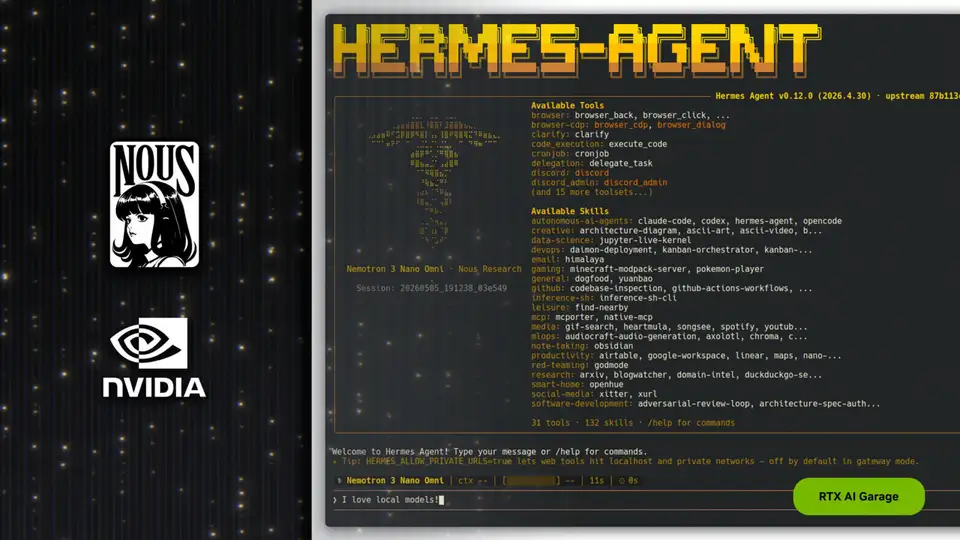
Hermes is not a model; it is an agent that users can run, inspect and modify. It browses the web, edits files, writes and executes code, keeps persistent memory, learns reusable “skills” from user activity, and connects to messaging platforms and other tools. The code ships under an MIT license, and users can run it on their own computers or servers — or pay for hosted model access, tools and cloud hosting through Nous Portal.
Adoption is the pitch. The Journal reports Hermes has been downloaded more than 22.7 million times since February, and TechCrunch reported in July that the project had roughly 214,000 GitHub stars and 40,000 forks. Nous’s bet is that openness becomes distribution: let developers run the agent themselves, then charge companies for deployment, security, management, and enterprise features around it.

The enterprise play
Nous’s business offering pitches team-level controls, shared skills, model choice, and private or on-premises deployment, with single sign-on and service-level agreements for enterprise customers. The framing is control and portability: companies that want capable AI without sending every sensitive workload through a proprietary hosted service, or being tied permanently to one model provider. Portal’s public subscription page lists individual plans at $20, $100 and $200 per month alongside a free tier — those consumer plans are distinct from the tailored enterprise deployment Nous is now positioning for businesses.
Management’s forecast is aggressive: annualized revenue is expected to exceed $100 million by year-end, up from $36 million in mid-September, according to the Journal. That is a company forecast, not realized revenue — and it captures the whole gamble. Open-source projects can accumulate enormous developer adoption without capturing much of it as cash. Converting GitHub enthusiasm into durable enterprise spending is the unproven half of the story, against competition from open models at Mistral, Meta and Chinese labs as well as commercial offerings from OpenAI and Anthropic.
A short, strange history
Nous was founded in 2023 by Jeffrey Quesnelle, Karan Malhotra, Ryan “Teknium” and Shivani Mitra, and its founders built their reputation on open work — early on fine-tuning Meta’s Llama models to better reflect individual users’ preferences. CEO Dillon Rolnick, in a note accompanying the financing, described Nous as a team that began with few resources and built in public, and says the company formed to resist the concentration of AI behind closed products.
Hermes itself launched in February as a direct competitor to the viral OpenClaw desktop agent, shipping with built-in skills — web search, coding, image understanding — and a self-improving learning loop that acquires new skills from usage patterns without manual updates. OpenClaw’s creator later joined OpenAI; Nous stayed independent, and today’s round doubles down on that independence.
Why it matters
The battle over enterprise AI is creating room for companies selling control and portability rather than access to a single closed model. Nous is the purest test of that thesis: a $1.5 billion valuation on software anyone can run for free, justified only if businesses will pay for the governance layer around it — deployment, administration, privacy guarantees — at scale. The mobile app, another planned expansion with no announced timing, extends the same idea to the consumer side. Whether the $100 million year-end revenue forecast materializes will tell the industry how much developer love is actually worth as a business.
Sources: Tech Startups (Oct. 7, 2026); Runtime Wire (Oct. 7, 2026); The Wall Street Journal (original report); Nous Research’s announcement via @NousResearch (Oct. 7, 2026).