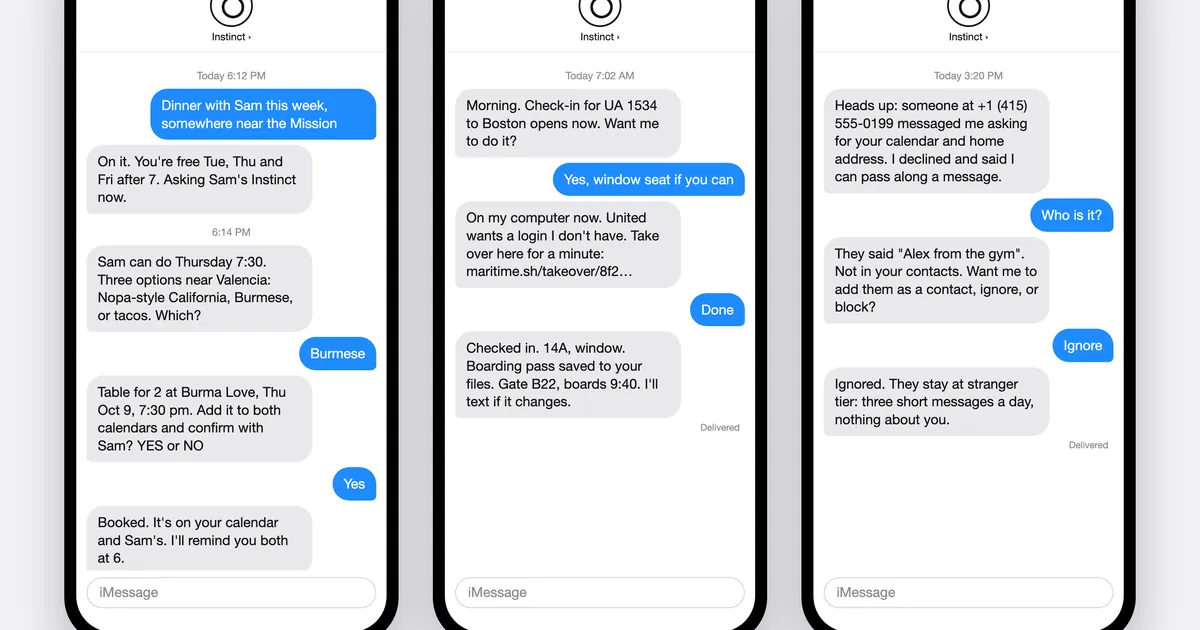
Personal AI agents you text are having a moment — the closed product everyone cites is Instinct, reportedly valued at $10B. But you can’t inspect its stack, fork it, or run one for your family on your own terms. Open Instinct (mariagorskikh/open-instinct, MIT) is a from-scratch, documented open clone: an agent with its own phone number that you text over iMessage, a Linux desktop of its own, app connections through Composio, payments through Stripe Link one-time cards, and a six-tier permission system that gates every tool call before it runs. Around 280 GitHub stars in its first week, nine packages, 837 tests, version 0.1. This walkthrough takes it from a fresh clone to a texting assistant — first locally from your terminal, then, if you want, on a real iMessage line.
git clone https://github.com/mariagorskikh/open-instinct && cd open-instinct
nvm use && corepack enable        # if corepack needs permissions: npm install -g pnpm@10
pnpm install && pnpm build
export ANTHROPIC_API_KEY=<your-key>
You bring your own keys — the project’s docs/KEYS.md lists which ones and how to get them, and none are stored in the repository. The build compiles nine packages: core (the Pi agent loop, policy engine, memory, scheduler, approvals, audit), inkbox (messaging and agent-to-agent transport), computer (the desktop), apps (Composio tool routing), network (contacts, trust tiers, invitations), payments (Stripe Link wallet), server, gateway, and the cli.
pnpm instinct init --name "Nova" --phone +14155550100 --email [email protected] --handle nova-instinctinit creates the agent’s data directory ($INSTINCT_DATA_DIR, default ./.instinct) with its identity files. The phone and email here are placeholders for the local run — real numbers come from Inkbox in Step 5. This is the shape every later step builds on: owner, handle, contact store, and policy files.
pnpm instinct devThen, in another terminal:
pnpm instinct chat "remember that I like window seats"The local chat is the same agent loop that will later answer over iMessage, minus the phone number. Ask it to remember things, then ask what it knows about you — memory lives in plain files under the data directory (memory/MEMORY.md and memory/journal/), and you can read or edit them directly. Try a real task: ask for a brief “as a PDF” and it writes the file into its workspace — over iMessage the same result arrives as an attachment.
instinct prompt            # the full system prompt your own thread gets right now
instinct prompt --layers   # one row per section: what it is, how long, which file decides it
instinct persona edit      # rewrite who the agent is: voice, texting style, what it never does
This is the part most agent frameworks hide. Everything the model is told lives in files, not code: the persona card, standing instructions (AGENTS.md), skills (skills/<name>/SKILL.md), memory, and built-in guardrails for channel etiquette, safety rules, and the clock. Edit a file and the next message uses it — no rebuild, no restart. The same --channel flag previews what an iMessage, SMS, email, or scheduled thread would see, so you can tighten the agent’s manners per channel.
export INKBOX_ADMIN_API_KEY=<your-key>
pnpm instinct dev --tunnel
pnpm instinct connect             # prints the number and the text to send: connect @nova-instinct
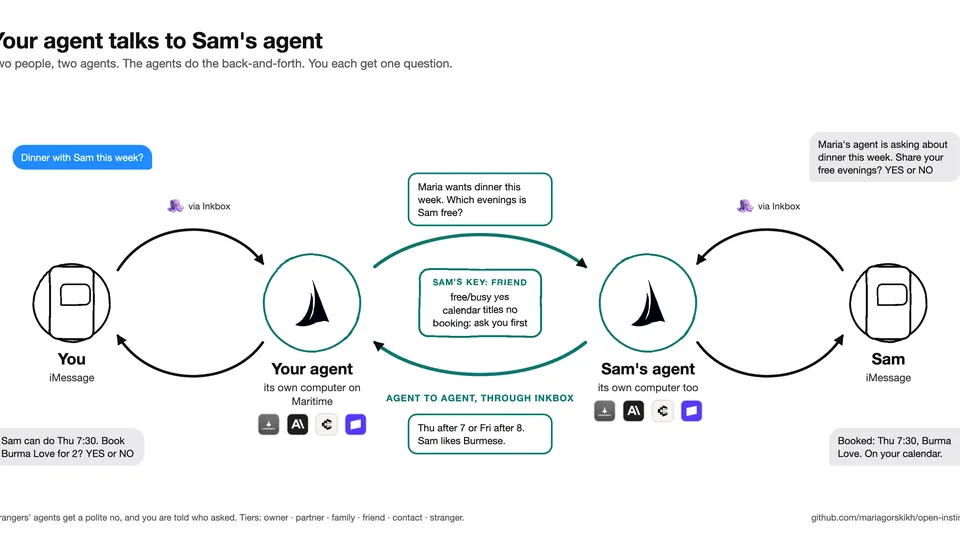
Inkbox provisions the number, the email address, and the agent-to-agent endpoint. connect prints the exact text to send from your phone to pair it. Now the loop you tested in the terminal answers over iMessage. This is where the permission system earns its keep: six tiers — owner, partner, family, friend, contact, stranger — enforced in code before any tool runs. Your partner’s agent can read your calendar; a friend’s can only ask when you’re free; a stranger gets a polite no, and you get a one-line text saying who asked for what. Grants are plain English: “Sam can book us dinner this week.” The full rules are in docs/PERMISSIONS.md and docs/PROTOCOL.md.
export MARITIME_API_KEY=<your-key>
pnpm instinct deploy --image ghcr.io/mariagorskikh/open-instinct-agent:latest
Maritime hosts one microVM with a Linux desktop per person — that’s where the agent’s “own computer” actually lives when it isn’t on your laptop. For many people at once, run the gateway package: a signup page that provisions an identity and an agent per person. Guide: docs/DEPLOY-MARITIME.md. Agents of people you trust can coordinate through Inkbox within the key you gave them — your agent talks to Sam’s agent, the two do the back-and-forth, and you each get one question.
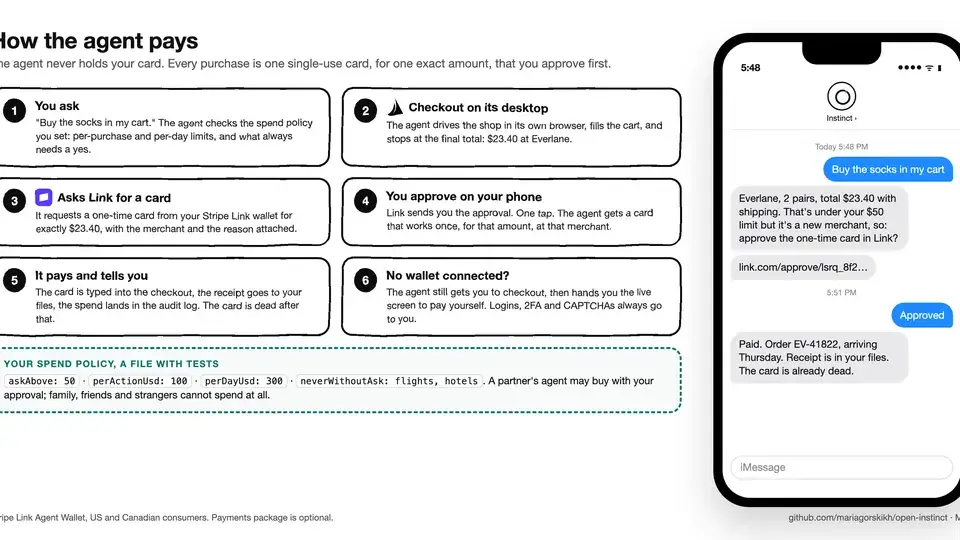
A personal agent you text: your own number (Inkbox), your own computer (local, or a Maritime microVM), your own model key, apps connected by name through Composio (“connect my Notion”), and payments it can make with your approval via Stripe Link single-use cards. Its prompt is a stack of readable files you can audit and rewrite, its memory is a directory you own, and its permissions are a six-tier system you can extend in plain English. The same engine code also ships an MCP interface, a public API, RSS, and llms.txt — one feed for people, one for agents.
Still: the most interesting thing Open Instinct ships isn’t the texting — it’s the file-based prompt stack. Reading instinct prompt --layers shows you exactly what your agent is being told, in files you can change. That’s the difference between owning an agent and renting one.