Quantinuum Reimei H2: Japan's 56-qubit quantum computer now works inside an AI supercomputing loop
RIKEN's quantum computer got a bigger brain on Tuesday — and a new job. Quantinuum and RIKEN announced on November 10, 2026 that Reimei, the trapped-ion system installed at RIKEN in Japan, has completed its upgrade to the 56-qubit System Model H2, and that the two partners are expanding their work into quantum-AI hybrid supercomputing, including a possible link between quantum machines and Japan's AI data centers. Two research projects are already running on the upgraded machine, pairing quantum-generated data with AI models trained on RIKEN's supercomputers.
What we checked: Quantinuum–RIKEN press release “Quantinuum and RIKEN Expand Partnership to Accelerate the Commercialization of Quantum-AI Hybrid Supercomputing in Japan,” distributed November 10, 2026 via PR Newswire (read via HPCwire), cross-checked against Unite.AI's November 10 coverage of the same announcement.
- What: Reimei's upgrade to Quantinuum's System Model H2 — a 56-qubit trapped-ion quantum computer — is complete, and Quantinuum and RIKEN have expanded their partnership into quantum-AI hybrid supercomputing.
- When: announced Tuesday, November 10, 2026, in Tokyo, at a ceremony at RIKEN's Wako campus.
- Where: RIKEN, Japan. Reimei runs inside the NEDO-funded JHPC-quantum project, which pairs the quantum machine with RIKEN's supercomputers.
- Project 1 — magnetism: RIKEN's ROQUO GPU supercomputer trains an AI model on Reimei-generated quantum data for magnetism simulations; preliminary results beat AI trained on classical simulations alone.
- Project 2 — biomolecules: Reimei, the Fugaku supercomputer and an NVIDIA evolutionary AI agent running on ROQUO simulate a photoactive biomolecule, aiming at more efficient solar cells.
- Next: a fault-tolerant “Made with Japan” quantum computer with Japanese universities and suppliers, plus a SoftBank exploration of a Quantum AI Datacenter; the work aligns with a planned $1 billion U.S.–Japan AI for Science partnership.
How the hybrid loop works#
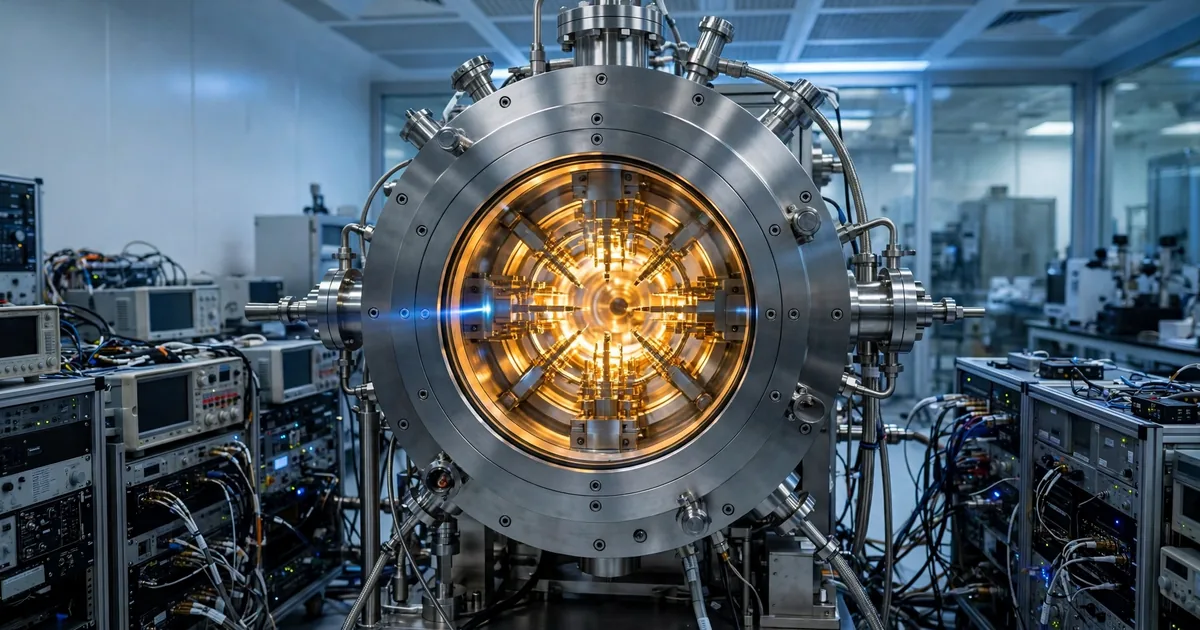
The idea is simple to state and hard to build: let each machine do the part of the problem it is best at, and pass the result along. At RIKEN, the loop has three stations, and the upgraded Reimei is the first one.
Step one: the quantum computer runs the physics. Reimei simulates magnetic materials at the atomic level — quantum systems that get exponentially harder for classical computers to simulate as they grow.
The output is not an answer. It is training data: measurements of quantum behavior that no classical simulation could have produced.
Step two: a supercomputer trains the AI. That quantum data flows to ROQUO, RIKEN's GPU supercomputer inside the JHPC-quantum project, which trains an AI model to predict magnetism from it. The model learns patterns in the quantum data the way an image model learns patterns in photographs.
Step three: the AI outperforms both of its parents. The preliminary results are the reason this announcement matters: the AI trained on quantum data makes more accurate predictions than AI trained on classical simulations alone — and more precise predictions than the quantum computer itself.
The quantum machine supplies data classical computers cannot, and the AI generalizes from it better than the raw quantum output. Understanding magnetism at the atomic level could inform materials for ultra-high-field MRI machines and smart power grids, according to the announcement.
| Machine | What it is | Its job in the loop |
|---|---|---|
| Reimei (H2) | 56-qubit trapped-ion quantum computer at RIKEN | Generates quantum data classical machines cannot simulate |
| ROQUO | RIKEN's JHPC-quantum GPU supercomputer | Trains AI models on Reimei's quantum data |
| Fugaku | RIKEN supercomputer | Runs the biomolecular simulation alongside an NVIDIA AI agent |
The same loop runs a second experiment, this time on a living molecule rather than a magnet. Reimei, Fugaku and an NVIDIA evolutionary AI agent running on ROQUO are simulating a complex photoactive biomolecule — one that reacts to light — at what the partners describe as unprecedented scale and detail. The payoff they are chasing: a better understanding of how biomolecules respond to light, which could inform the design of more efficient solar cells.
What Quantinuum and RIKEN actually announced#
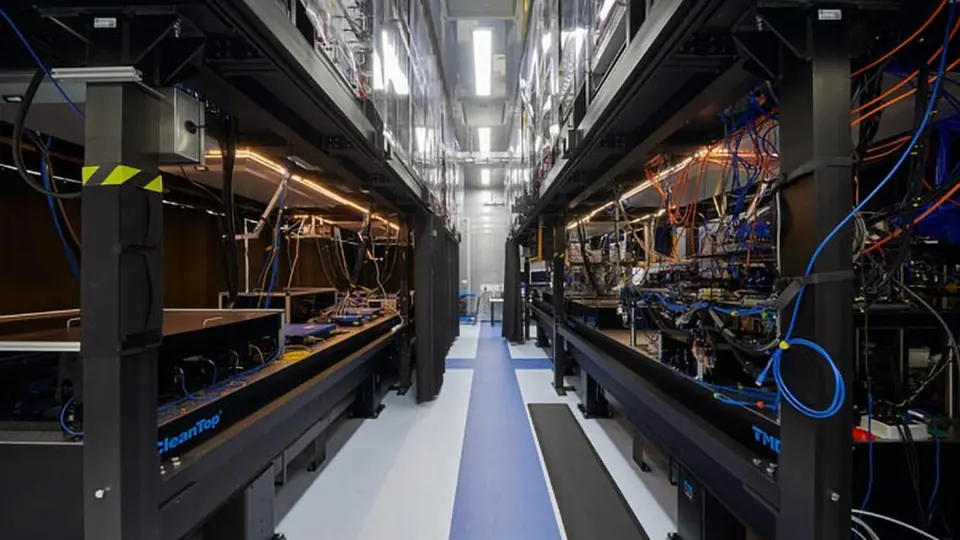
The announcement, made in Tokyo on November 10 and marked with a ceremony at RIKEN's Wako campus, has four parts. The first is the hardware: Reimei's upgrade from the H1 system to System Model H2 is finished. The H2 hardware was delivered for assembly in April 2026; the upgrade is now complete, and the two research projects above are already running on it — before the public launch of Reimei's services.
The second part is the research program. Under a newly signed memorandum of understanding, the partners will expand their work on quantum computing for AI for Science, the RIKEN initiative that sits behind both projects.
“With the upgraded Reimei quantum computer, we will be able to tackle more complex and larger-scale scientific problems that were difficult to address with the previous H1 system,” said Dr. Mitsuhisa Sato, division director of RIKEN's Quantum-HPC Hybrid Platform Division.
The third part is the long game: a fault-tolerant “Made with Japan” quantum computer, developed with Japanese universities and domestic component suppliers, combining Quantinuum's technology with Japanese research and manufacturing expertise. The announcement sets no date and no budget for it — it is a development goal, distinct from the H2 upgrade that is already done.
The fourth part reaches beyond the lab. Under a separate agreement, Quantinuum, RIKEN and SoftBank will explore connecting quantum computers directly to AI data centers in Japan, assessing infrastructure readiness and how connected systems could support commercial quantum-AI hybrid services. SoftBank's Takenori Kobayashi put the ambition plainly: “Together with RIKEN and Quantinuum, we aim to advance a Quantum AI Datacenter that connects quantum computing with AI and HPC, making these capabilities accessible to businesses across Japan.”
What this changes — and what it doesn't#
What changes is the shape of a national quantum program. RIKEN is no longer running a quantum computer and an AI program side by side; it is running one workflow in which quantum data feeds AI training, and the AI's predictions feed back into the science. The magnetism result is the proof of concept: quantum data in, better AI out.
If it holds up at larger scale, that template is one other national labs will copy — and it is the same instinct behind the open AI-native infrastructure stack Google Cloud published the same morning: the race is now about the plumbing that lets different kinds of machines work together, not just the machines themselves.
What doesn't change is the timeline for useful quantum computing. The results Quantinuum reports are preliminary, achieved in experimental settings, and the company cautions they may not be confirmed at larger scale or in commercial use.
The fault-tolerant machine is a goal with no date. The SoftBank datacenter link is an exploration, not a service. And the work sits inside a research program funded by NEDO, Japan's energy and industrial technology agency, aligned with a planned $1 billion US–Japan AI for Science partnership under the Genesis Mission — public money, public timelines.
That is the honest frame for the day: a completed upgrade, two real experiments, and a credible loop from quantum data to AI predictions. The rest — the fault-tolerant machine, the datacenter connection — is a plan with partners and a ceremony, not a product.
Quantum computing keeps producing that split, and last week's proof of the 18-year-old Aaronson-Ambainis conjecture showed the other side of the same coin: AI systems are now doing quantum science, not just waiting for quantum computers to arrive. WorldParticle, a single AI model that simulates sand, cloth, fluids and folding proteins, points the same way — simulation is becoming an AI problem first and a hardware problem second.
Sources#
- PR Newswire via HPCwire: Quantinuum and RIKEN Expand Partnership to Accelerate the Commercialization of Quantum-AI Hybrid Supercomputing in Japan (November 10, 2026)
- Unite.AI: Quantinuum Upgrades Reimei and Broadens RIKEN Quantum-AI Partnership (November 10, 2026)
- RuntimeWire: Quantinuum upgrades Reimei to H2 for hybrid supercomputing in Japan (November 10, 2026)