Qwen-Image-2.1-Turbo: Alibaba's 7B image model generates and edits 2K images in 8 steps — with a research-only license
Alibaba's Qwen team released Qwen-Image-2.1-Turbo on October 9: an accelerated 7B checkpoint that generates and edits images at 2K resolution in 8 denoising steps instead of 40. The weights are downloadable, but the Qwen Research License bars commercial use without a separate deal.
Alibaba's Qwen team released Qwen-Image-2.1-Turbo on October 9: an accelerated 7B checkpoint that generates and edits images at 2K resolution in 8 denoising steps instead of 40. The weights are downloadable, but the Qwen Research License bars commercial use without a separate deal.
The release, announced on Qwen's official Qwen-Image-2.1 GitHub page on October 9, also put hosted Pro and Turbo APIs live on Alibaba Cloud Model Studio the same day. It's the latest move in a crowded open-weight image-model race, where the fight is increasingly about steps and licenses as much as pixels.
Eight steps, same 7B brain
Turbo keeps the same 7B visual-generation architecture as the base Qwen-Image-2.1 — a single-stream diffusion transformer — paired with a Qwen3-VL 8B text encoder, according to MarkTechPost. The checkpoint ships with its recommended 8-step sampling schedule saved inside, runs at CFG=1 by default, and uses prefix KV caching to reuse text and reference-image context across denoising steps. It loads directly with QwenImage21Pipeline in Diffusers, running in bfloat16 on CUDA GPUs. That's five times fewer denoising steps on identical hardware, though fewer steps is not the same as five times faster — Qwen says Turbo "retains strong image quality" at the short schedule, but independent benchmarks have yet to land.
Generate, edit, and go transparent
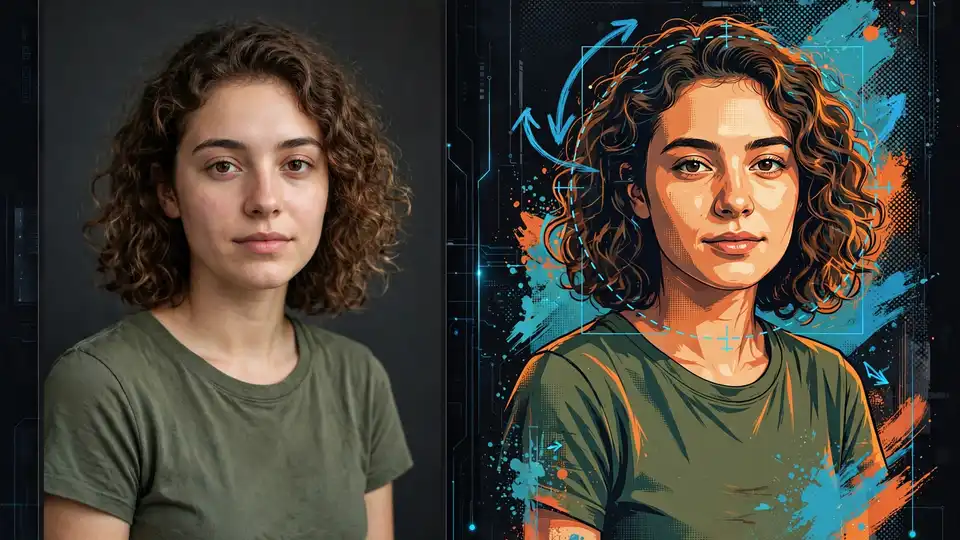
Turbo covers the full base feature set: text-to-image generation up to 2048×2048 (2752×1536 at 16:9), natural-language editing such as adding objects or changing a scene, native RGBA transparency, typography and poster design, and multi-reference composition. For editing, you pass image=input_image with an instruction prompt; the base model supports up to 10 reference images and local edits via circles, painted annotations, or masks. One practical note from the release notes: setting num_inference_steps alone does not override the saved schedule — only an explicit sigmas argument does, and Qwen says other schedules haven't been evaluated for this checkpoint.
How to run it
Setup needs Diffusers from source with transformers>=5.17.0, plus Diffusers PR #14950, which adds pipeline-configured sampling sigmas. The usage code is short:
pipe = QwenImage21Pipeline.from_pretrained(
    "Qwen/Qwen-Image-2.1-Turbo", dtype=torch.bfloat16).to("cuda")
image = pipe(prompt="A ceramic teapot on a wooden table, soft window light",
             width=2048, height=2048, use_kv_cache=True).images[0]
Qwen publishes no Turbo VRAM minimum; estimates for the base model range from 11 GB VRAM with GGUF to 24 GB with INT8/FP8, per MarkTechPost.

The license catch
Here's the asterisk: the weights are released under the Qwen Research License Agreement, not a permissive license. Self-hosting for commercial use needs separate permission from Alibaba, as RuntimeWire notes — a sharper restriction than peers like Alibaba's own Z-Image-Turbo (Apache 2.0) in the same few-step lane. The hosted route sidesteps that: the Turbo API costs CNY 0.1 per image with a 120 RPM limit, versus CNY 0.25 and 20 RPM for Pro — 2.5× cheaper per image with 6× the request rate.
Why it matters
Qwen shipped Qwen-Image-2.1 itself on September 20 and has iterated fast since: a base model that scores 60.28 on Qwen-Image-Bench, its own vendor benchmark and the top open-weight score Qwen reports. Turbo now hands tinkerers the speed-friendly version on day one, alongside the APIs — a sign Alibaba wants both developers and paying API users in the same funnel. But "open weights" increasingly comes with fine print, and Turbo's research-only terms are a reminder to read the license before building a business on a checkpoint.