SiMa.ai raises $150M at $1.45B: the Physical AI chipmaker betting robots don't need the cloud
SiMa.ai closed a $150M Series C at a $1.45B valuation — $500M raised total — to scale its purpose-built silicon for robots, drones, and cars, promising 1,000 dense TOPS in its next-gen hardware by 2028.
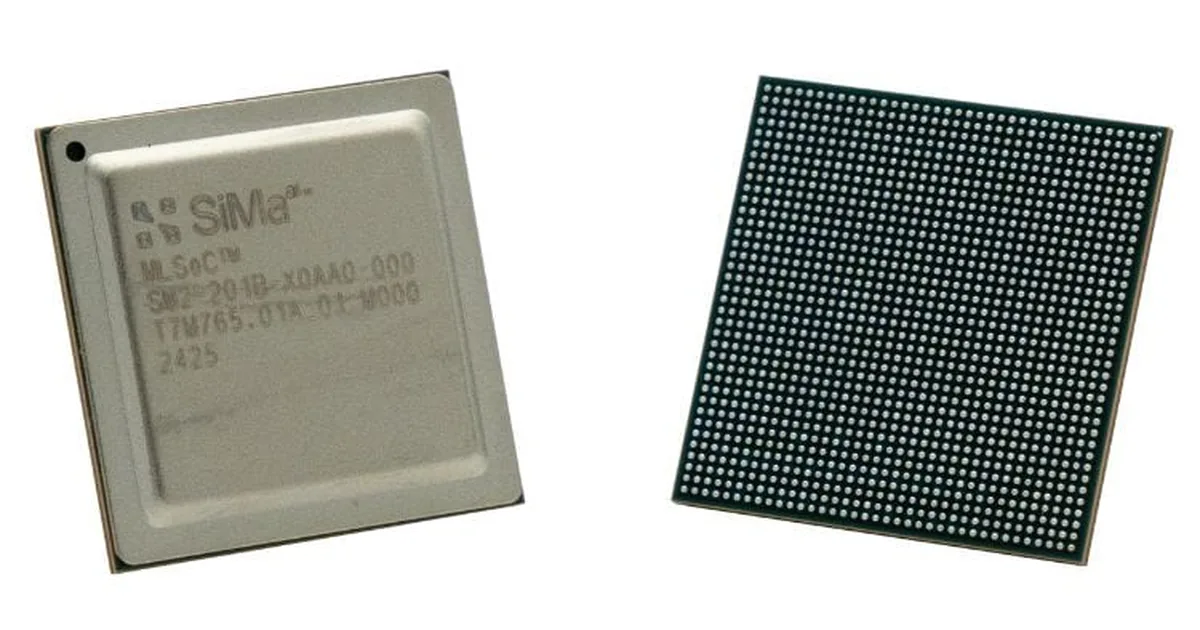
The “Physical AI” money race just got another big check. SiMa.ai announced a $150 million Series C on Monday at a $1.45 billion valuation, bringing the San Jose chip startup's total capital raised to $500 million. The round was oversubscribed and co-led by Fidelity Management & Research Company and Amplify, with new money from AllianceBernstein, Baron Capital, J.P. Morgan, and the State of Michigan.
The bet is simple to state and hard to execute: AI is moving off the cloud and into the world — robots, drones, cars — and that hardware needs chips purpose-built for running models at the edge, not repurposed data-center GPUs.
The round#
Existing and returning participants in the round include Alter Venture Partners, Dell Technologies Capital, Maverick Capital, +ND Capital, Point72, and StepStone Group. SiMa.ai's last raise was an $85 million Series B in July 2025 that valued the company at $960 million, according to PitchBook — this round is a roughly 50% valuation step-up in about 14 months.
Founder and CEO Krishna Rangasayee isn't shy about the scale of the ambition. “Physical AI in humanoids, automotive, and drones is the gateway to a $50 trillion market that has remained largely untouched by modern innovation,” he said in the company's announcement. “While others are still figuring out the pieces or repurposing their cloud offerings, we’ve built the entire puzzle.”
Silicon, not servers#
Founded in 2018 by Rangasayee, a former COO of chipmaker Groq, SiMa.ai builds energy-efficient chips and software that let robots, drones, and cameras run AI models directly on the device, eliminating the latency, cost, and connectivity dependency of sending data back and forth to the cloud. That's the core pitch against NVIDIA's GPUs, which the company characterizes as expensive, complex, and power-hungry for edge deployment.
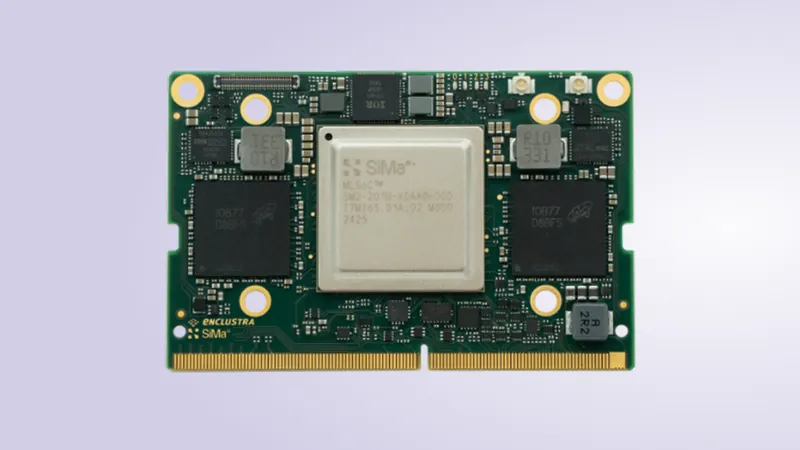
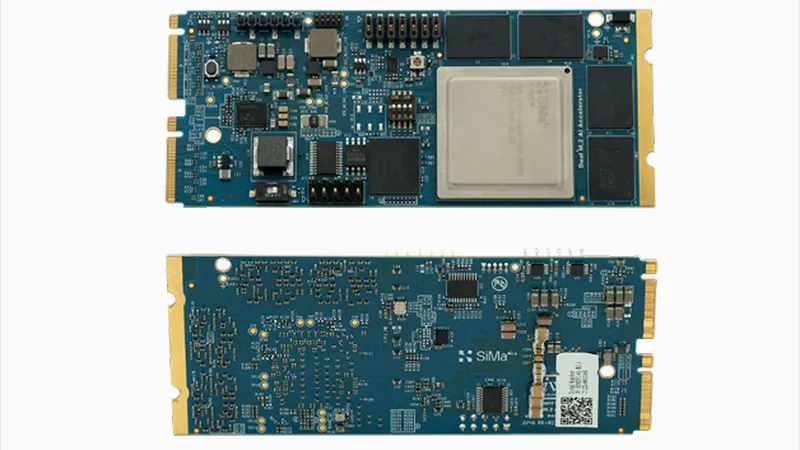
SiMa.ai's platform pairs purpose-built silicon — its Modalix MLSoC line — with Palette Neat, which the company describes as the industry's first agentic software environment for Physical AI. The claim the startup is making to customers is operational, not just benchmark-based: deployments that used to take months can go live in days or hours.
The 1,000-TOPS roadmap#
Much of the new capital is earmarked for what comes next: next-generation hardware targeting 1,000 dense TOPS of compute in purpose-built Physical AI silicon, slated for the first half of 2028. The offerings will span machine learning IP, chiplets, and SoCs, aimed at medium to high-end drones, humanoid robotics, automotive ADAS, and AI-powered cockpits — and current customers will be able to migrate applications onto the new architectures.
The scale argument behind it: Counterpoint Research projects cumulative shipments of Physical AI devices — robotics, automotive, drones — to hit 145 million units by 2035, which SiMa.ai frames as the transition of AI from software applications into tangible hardware.
Traction, not just thesis#
The raise comes with commercial numbers attached, which matters in a year when investors are interrogating AI valuations. Between 2024 and 2025, SiMa.ai quadrupled its year-over-year revenue growth, and the company says 2026 is tracking continued upward momentum. Its customer and partner roster includes ARK Electronics, AVerMedia, Bosch, Emerson, Intrinsic, Kontron, L&T Technology Services, Micron, STIGA, Synopsys, TRUMPF SE, and Virya Autonomous Technologies — over 150 customers across automotive, drones, and robotics, according to Entrackr.
What to watch#
Three things. First, the 2028 hardware roadmap: 1,000 dense TOPS is a headline number, but the history of edge-AI silicon is littered with impressive TOPS figures attached to software ecosystems nobody adopted — Palette Neat has to carry its weight. Second, whether the “Physical AI'” wave stays real: humanoids and drones are the industry's current obsession, and SiMa.ai is now one of its best-funded chip bets. Third, NVIDIA: the incumbent won't cede the edge quietly, and every Physical AI startup is ultimately arguing it can deliver enough performance per watt to justify existing.
For now, the market has spoken with a check: $150 million, a $1.45 billion valuation, and a 50% step-up in a market that suddenly wants silicon that can think where the work happens.
Sources
- SiMa.ai press release — Business Wire (September 28, 2026)
- “Physical AI chip developer SiMa.ai hits $1.45B valuation” — TechCrunch (September 28, 2026)
- “Physical AI Chipmaker SiMa.ai Lands $150M Series C” — Unite.AI (September 28, 2026)
- “Physical AI company SiMa.ai raises $150 Mn in Series C round” — Entrackr (September 28, 2026)