Kimi K3 on a single server: Skymizer and MiTAC fit a 2.8T-parameter model into one air-cooled box
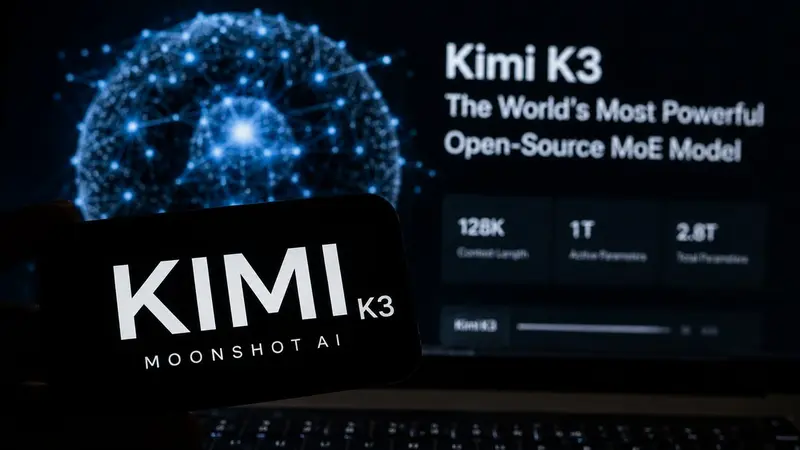
Skymizer and MiTAC Computing plan to run Moonshot AI’s Kimi K3 — a 2.8-trillion-parameter mixture-of-experts model — on a single air-cooled server at the SC26 supercomputing conference, using eight Skymizer HTX301 inference cards and 2 TB of card-attached memory. The demo, announced November 5, 2026, is a bet that the biggest open-weight models can live on premises instead of in a cloud data center.
- Who and when: Skymizer and MiTAC Computing announced the joint SC26 showcase on November 5, 2026.
- What: Moonshot AI’s Kimi K3, a 2.8-trillion-parameter mixture-of-experts model, running on one MiTAC server with eight Skymizer HTX301 LPU cards and 2 TB of card-attached memory.
- Weights: Kimi K3 uses native MXFP4 weights; the weight set is about 1.56 TB, leaving headroom in the 2 TB configuration for KV cache.
- Prior step: At COMPUTEX 2026 (June 2–5), Skymizer demonstrated the 30-billion-parameter Qwen3-VL-30B-A3B on its evaluation hardware.
- Card power: The HTX301-4S card has an approximately 155W card-level power figure; whole-system power is still subject to engineering validation.
- Availability: HTX301 chip production is expected to begin in Q1 2027; sampling and broader commercial availability will be announced separately. Skymizer also presents at ICCAD-Expo 2026 in Beijing on November 19–20.
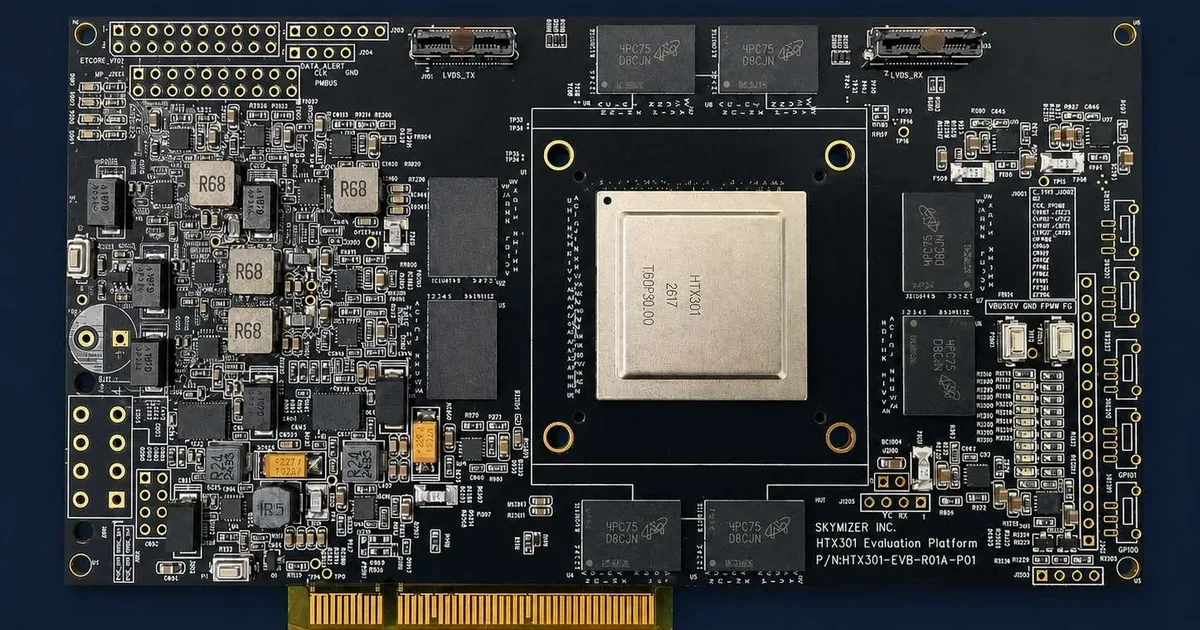
Skymizer and MiTAC Computing announced the showcase on November 5, 2026, ahead of SC26 in Chicago. The demo puts Moonshot AI’s Kimi K3 — a 2.8-trillion-parameter mixture-of-experts model — on a single MiTAC server equipped with eight Skymizer HTX301 LPU cards and 2 TB of card-attached memory. The pitch is aimed squarely at enterprises that want to run the biggest open-weight models inside their own walls, on air cooling, without assembling a cluster.
Why one server for 2.8 trillion parameters is a statement
The headline number is a capacity claim, and the arithmetic is what makes it interesting. Kimi K3 uses native MXFP4 weights — 4-bit floating point the model was trained with from the start, not a post-hoc squeeze — so the full weight set is about 1.56 TB. The 2 TB configuration is sized to hold those weights and still leave room for KV cache, the working memory a model needs while it generates. Skymizer’s own caveat matters here: final memory allocation and supported workloads remain subject to engineering validation. Fitting the weights is a capacity claim, not a performance benchmark, and no latency, throughput or power numbers were published with the announcement.
Moonshot’s Kimi family has been busy: the weights for Kimi K3.1 Pro landed on Hugging Face on November 4, and Fireworks has already built a post-trained version of Kimi K3 that reasons with roughly 40% fewer tokens. The Skymizer demo is the other half of that story — not a better model, but a cheaper place to run the one that already exists.
The hardware: eight HTX301 cards, one toolchain
The HTX301 is a Language Processing Unit (LPU), purpose-built silicon for LLM inference rather than a repurposed training chip. Skymizer describes it as decode-optimized and capacity-first: the card is built to hold enormous models and serve them, not to train them. The HTX301-4S card carries an approximately 155W card-level power figure, though whole-system power is still subject to engineering validation. Underneath sits the HyperThought platform, which pairs compiler-driven software with transformer-optimized hardware, and LISA — Skymizer’s Language Instruction Set Architecture — which scales a single toolchain from 4-billion-parameter models to the trillion-parameter class. Skymizer, founded in Taiwan in 2013, has been building LPU IP and silicon for on-premises and on-device inference since long before the current open-weight boom.
From a 30-billion-parameter demo to 2.8 trillion
The Kimi K3 demo is a deliberate step up from Skymizer’s last public showing. At COMPUTEX 2026, June 2–5, the company demonstrated Qwen3-VL-30B-A3B, a 30-billion-parameter multimodal mixture-of-experts model, on its evaluation hardware. “Our team is currently successfully extending that work to a single-server configuration designed for Kimi K3,” said Luba Tang, Skymizer’s chief technology officer. “LISA provides a common instruction set and toolchain as we develop the memory-residency and scheduling capabilities required for larger models.”
The commercial framing is control, not raw speed. “Enterprises want greater control over the models, data, and infrastructure behind their AI services,” said William Wei, Skymizer’s chief marketing officer. “Our work with MiTAC aims to make larger open-weight models more practical to deploy on premises.” MiTAC, which supplies the server engineering, says the collaboration explores Prefill–Decode disaggregation and optimized inference deployment across workloads — splitting the prompt-processing and token-generation phases so each can be tuned separately.
Who it’s for — and what still isn’t proven
The target is enterprise on-premises deployment in financial services, healthcare, government, manufacturing and semiconductor design — sectors where data governance and operational control are central to adoption. Skymizer is also developing an AI-assisted delivery approach to help enterprises pick models for their workloads, prepare the software environment, install and configure the inference stack, and validate the deployment before use, under its “Own Your Intelligence” direction.
What the announcement does not do is put a product on sale. HTX301 chip production is expected to begin in Q1 2027, development and validation of the server platform are ongoing, and sampling and broader commercial availability will be announced separately. Skymizer will also present at ICCAD-Expo 2026 in Beijing on November 19–20. Until the SC26 demo runs, the open question isn’t whether 1.56 TB of weights fit in 2 TB of memory — that’s arithmetic — but how fast, and at what power, the finished server actually serves. Fitting a giant model in one box is only half the serving problem; a shared KV cache storage system launched the same day attacks the other half, reusing context instead of recomputing it.
Frequently asked questions
How does a 2.8-trillion-parameter model fit on a single server?
Kimi K3 uses native MXFP4 weights, so its full weight set is about 1.56 TB. The demo server pairs eight Skymizer HTX301 cards with 2 TB of card-attached memory — enough for the weights plus headroom for KV cache. Skymizer notes that final memory allocation and supported workloads are still subject to engineering validation.
What is the Skymizer HTX301?
A Language Processing Unit (LPU) — purpose-built silicon for LLM inference, designed decode-first with a capacity-first approach to memory. The HTX301-4S card has an approximately 155W card-level power figure, and eight of them power the Kimi K3 demo server. Chip production is expected to begin in Q1 2027.
When and where is the demo, and can enterprises buy this setup?
At SC26 in Chicago, with Skymizer also presenting at ICCAD-Expo 2026 in Beijing on November 19–20. Not yet — the platform is still in development and validation, and sampling and broader commercial availability will be announced separately.