Sophon-Realtime v1: open full-duplex voice model hears your tone, answers in 0.31 seconds
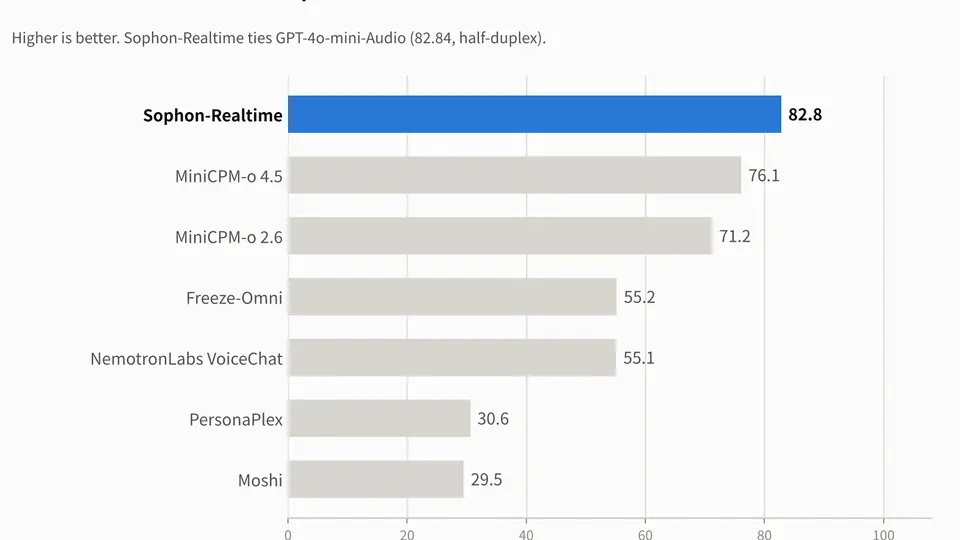
Adventists AI has open-sourced Sophon-Realtime v1, a full-duplex voice model family that listens while it talks, hears the tone in your voice, and answers with a voice that laughs and sighs on cue. The 32B brain scores 82.8 on VoiceBench — the best among open full-duplex models — and the fastest build answers in 0.31 seconds from a single 80 GB GPU.
- Released: November 8, 2026, by Adventists AI — GitHub release v1.0 of the Sophon-Realtime repository, with weights on Hugging Face and ModelScope and a package on PyPI.
- What it is: an open full-duplex voice model family — it listens while you talk, decides turn-taking itself, and answers in a voice that performs laughter, sighs, and emphasis instead of reading them aloud.
- The brain: one 32B model shared by all three builds — Tag (recommended, expressive), Flash (fastest), and E2E (research preview, no separate speech model).
- Speed: first audio in 0.31 seconds with Flash, about 0.6 seconds with Tag, and about 1 second with E2E. Tag serves 16 users per 80 GB GPU; Flash serves 40.
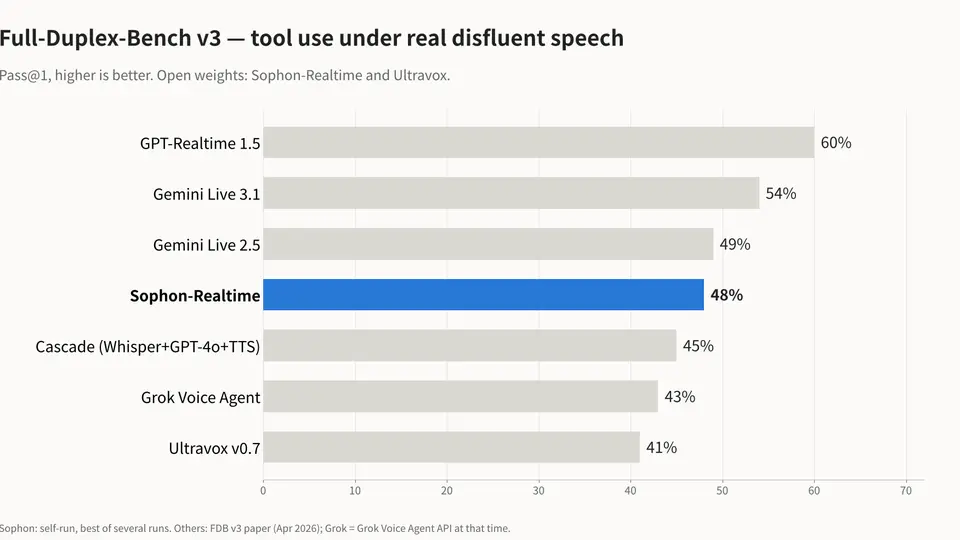
- Benchmarks (team-reported, self-run): VoiceBench 82.8 and Big Bench Audio 81.8% — first among open full-duplex models, level with GPT-4o-mini-Audio on VoiceBench. Full-Duplex-Bench v3 tool calling Pass@1 48%, ahead of Grok at 43%.
- Running it:
pip install sophon-realtime, thensophon-realtime serve— one 80 GB GPU (H100, H800, or A100 80G), Linux, CUDA, Python 3.12; the Tag weights are about 42 GB. Apache 2.0 code and weights, free for commercial use.
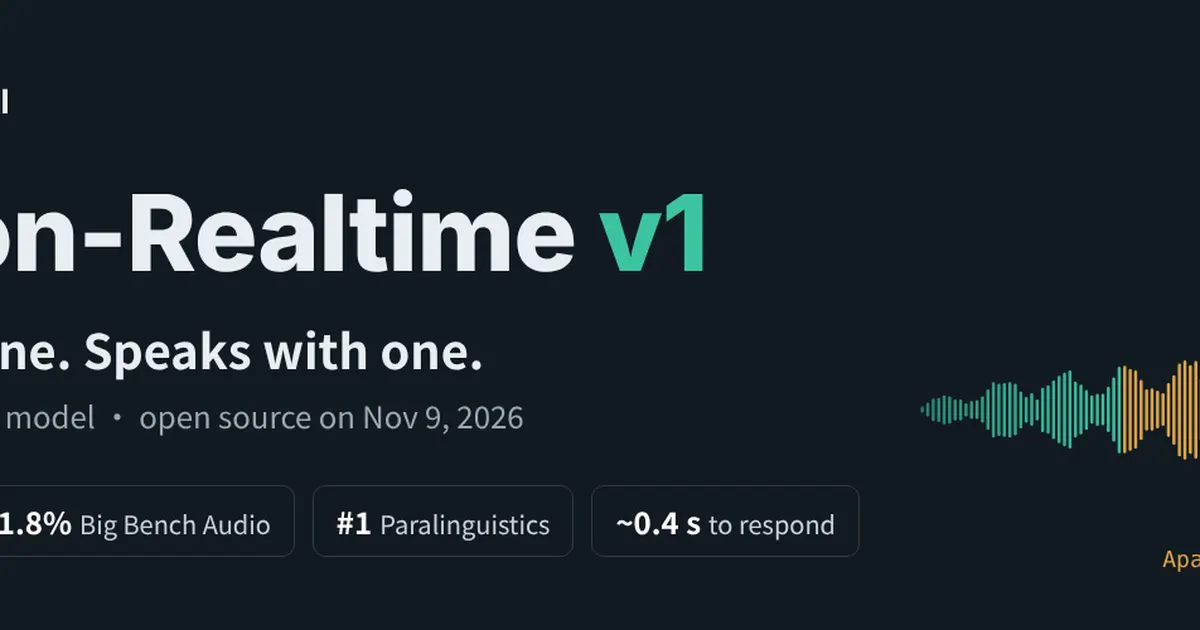
Most voice AI still works like a walkie-talkie: you talk, it waits, it thinks, it answers. Adventists AI released a model on November 8 that works more like a phone call. Sophon-Realtime v1 is an open full-duplex voice model family: it listens while you talk, hears how you say things, and answers with a voice that laughs, sighs, and breathes when the moment calls for it. The code and the weights are Apache 2.0, free for commercial use, and the whole thing runs on a single 80 GB GPU.
The release is the v1.0 tag on the team's GitHub repository, published November 8, with the weights on Hugging Face and ModelScope and a sophon-realtime package on PyPI. It is a family, not a single model: three builds share one 32B brain and differ only in how the reply becomes sound.
Three builds, one brain#
The recommended build is Tag. The brain writes its reply with sound tags — [laughter], [sigh], <strong> for emphasis — and an expressive speech model performs them, instead of reading the tags aloud. It answers in about 0.6 seconds and serves 16 users per 80 GB GPU. Flash swaps in a lighter, faster voice — one forward pass per 80-millisecond frame — for first audio in 0.31 seconds and 40 users per GPU. E2E, a research preview, puts the talker inside the 32B model itself, with no separate speech model; it answers in about a second and needs two 80 GB GPUs.
Getting started is one command. pip install sophon-realtime followed by sophon-realtime serve downloads the roughly 42 GB Tag weights on first run, then serves a full-duplex WebSocket at ws://HOST:8000/v1/realtime and a POST /v1/chat/completions endpoint. You need Linux, CUDA, Python 3.12, and one 80 GB GPU — an H100, H800, or A100 80G. There is also a Live mode gateway that speaks the OpenAI GPT-Live protocol, so existing GPT-Live clients switch by changing the URL and key, and the team says you can LoRA-tune persona and domain knowledge on one GPU while keeping the voice and turn-taking.
How it listens#
The listening is the point. At each pause, the same 32B model decides in a single token whether you have finished, are still talking, are back-channeling, or are thinking — and it drafts a reply from your first pause, releasing it the moment it decides it is its turn. If you keep talking, the draft is dropped before you hear it. When you cut in, it stops at once and keeps only the part you actually heard in the conversation history.
Its ears are DuplexJev, the team's open speech-decision model, and the brain also marks where to laugh, sigh, breathe, cough, or stress a word. That is what the benchmarks are really measuring: on paralinguistic understanding — emotion, emphasis, sarcasm, laughter, sighs — the team reports 48.6, ahead of Gemini 3.8 Flash at 46.9 and Qwen3-Omni at 44.6. On non-verbal sounds, the Tag build scores 0.86 in Chinese and 0.80 in English on NVV-SuperBench.
The numbers — and the caveats#
On the headline benchmarks, the team reports VoiceBench 82.8 and Big Bench Audio 81.8% — first among open full-duplex models on both, and level with GPT-4o-mini-Audio on VoiceBench. On Full-Duplex-Bench v3 tool calling, it reports Pass@1 of 48%, ahead of Grok at 43%, with a 100% response rate. The E2E build got a new decoder in November, cutting the long-reply error rate from 1.78% to 1.51% and lifting voice similarity to an unseen speaker from 0.33 to 0.52.
Every one of those numbers is self-run by the team, and there is no independent third-party evaluation yet. The team is also candid about the weak spots: the sigh and laugh-while-speaking tags are still weak, Mandarin is slightly less clear than English, and replies longer than about a minute exceed the training range. Until someone else runs the benchmarks, the honest reading is that this is the strongest open full-duplex voice model on the team's own scoreboard — and the first one whose scoreboard you can reproduce yourself, because the weights are open.
What to watch#
Three things to watch. First, whether independent evaluations confirm the numbers — VoiceBench 82.8 level with a closed OpenAI model is the claim that will draw the most scrutiny, and it is also the easiest to check now that the weights are public. Second, whether the one-GPU serving story holds up outside the team's lab: 40 concurrent Flash users on a single H100 is a customer-service pitch, and real traffic will test it. Third, the voice-model pile-up: Shizuku-Duplex, a Japanese full-duplex model, landed the same day — but as a research blog with no release — while ElevenLabs shipped two speech-to-speech models for live voice agents in October and Mistral's Voxtral 3 arrived as a full voice-agent stack. Sophon is the open one in that crowd, and the GPT-Live-compatible Live mode is a deliberate invitation to switch.
Until the independent numbers arrive, the summary is short: a small team shipped an open voice model that listens while you talk, hears your tone, and runs on hardware you can rent by the hour. The benchmarks are theirs. The weights are yours.
Sources: Adventists AI, Sophon-Realtime v1 release v1.0 (November 8, 2026), here; Adventists AI, Sophon-Realtime README (November 2026), here; AICoder, ‘Adventists AI Open-Sources Sophon-Realtime v1’ (November 8, 2026), here. Cover and inline charts are from the Sophon-Realtime project.
Frequently asked questions
What is Sophon-Realtime v1?
An open full-duplex voice model family from Adventists AI, released November 8, 2026. One 32B brain powers three builds — Tag, Flash, and an E2E preview — that listen while you talk, decide turn-taking themselves, and answer in a voice that laughs, sighs, and breathes on cue. The code and weights are Apache 2.0, free for commercial use.
How fast is it, and what hardware does it need?
Flash reaches first audio in 0.31 seconds and serves up to 40 users per 80 GB GPU; Tag answers in about 0.6 seconds and serves 16. You need Linux, CUDA, Python 3.12, and one 80 GB GPU such as an H100, H800, or A100 80G. Install with pip install sophon-realtime, then sophon-realtime serve.
How good is it, and can I trust the benchmarks?
The team reports VoiceBench 82.8 and Big Bench Audio 81.8% — first among open full-duplex models and level with GPT-4o-mini-Audio on VoiceBench — plus 48% Pass@1 on Full-Duplex-Bench v3 tool calling. All of those numbers are self-run by the team, and there is no independent third-party evaluation yet, so treat them as the team's own scoreboard until someone else reproduces them.