South Korea will put 1,700 AI robots to work in the public sector — defense, firefighting and policing first
South Korea plans to distribute more than 1,700 AI robots across the public sector next year, starting with a two-day briefing at Seoul’s SETEC where nine government institutions will test wheeled and quadruped robots from 11 domestic makers against real field jobs in defense, firefighting and law enforcement.
- Who: South Korea’s Ministry of Trade, Industry and Energy, with nine demand institutions and 11 domestic robot makers.
- What: a plan to distribute more than 1,700 AI robots to the public sector next year, starting with defense, firefighting and law enforcement jobs.
- When and where: a two-day product briefing, October 28–29, 2026, at SETEC in Seoul.
- The companies: 11 domestic wheeled and quadruped robot makers, including Rainbow Robotics, Robotis and Hyundai Motor.
- The guardrails: public robot supply guidelines due by the end of the year, covering parts makers, data use and maintenance — plus a RoboWorld exhibition November 4–7 at KINTEX in Goyang.

South Korea wants its public sector to become the first big customer for its own robot makers. The Ministry of Trade, Industry and Energy said on October 28 that it will distribute more than 1,700 artificial intelligence robots to public institutions next year, and it opened a two-day briefing in Seoul where the buyers and the builders can size each other up before a single machine ships.
The logic is deliberately practical. For AI robots, the ministry argues, collecting data at a variety of real sites after development — and using it to raise performance — is a critical step. Public agencies acting as first customers give domestic companies both field operating data and a sales record, helping research results turn into commercial business. It is an industrial-policy bet as much as a procurement plan: use public demand as a springboard, then let the field experience help win private-sector customers later.
What happens at SETEC#
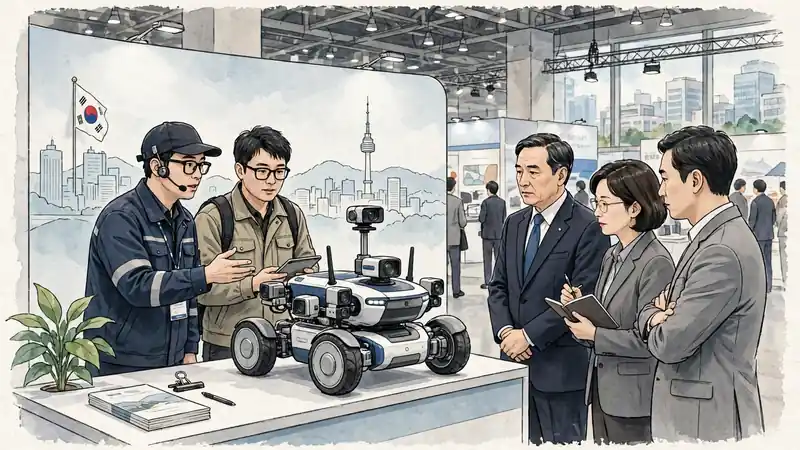
The briefing, the “2026 Public Demand Linked Four-Wheeled & Quadruped Robot Product Presentation,” runs October 28–29 at the Seoul Trade Exhibition and Convention Center (SETEC). Nine demand-side organizations are taking part, including the Ministry of National Defense, the Army Headquarters, the National Fire Agency, the National Police Agency, the Ministry of Agriculture, Food and Rural Affairs, and the Korea Industrial Complex Corporation. On the supply side are 11 domestic wheeled and quadruped robot makers, among them Rainbow Robotics, Robotis and Hyundai Motor.
The format is hands-on rather than ceremonial: company presentations, case studies, product exhibitions and live demonstrations, followed by one-on-one consultations. Demand institutions will review key functions, performance and civilian use cases, then discuss specific requirements — functions, scale, costs and validation conditions — with each company. Based on the consultations, a survey of each institution’s robot adoption needs will follow.
Not a unilateral pick#
One detail matters for reading the 1,700 number correctly. The presentation is designed to clarify which robots and operating conditions fit actual public-field demand, rather than having the government unilaterally select products. And the target of distributing more than 1,700 robots next year refers to the overall plan for AI robots — it is not limited to the quadruped and four-wheeled robots in this presentation.
That framing also explains the fields named first: defense, firefighting and law enforcement, where the initiative aims to verify the performance and operating conditions of robots needed in public work. The ministry’s stated line is that it will support public institutions in directly verifying products and finding suitable uses for their own operations, rather than buying on specification sheets alone.

The guardrails — and what comes next#
The ministry is also drawing up the rules for after deployment. Public robot supply guidelines, to be established with related ministries by the end of the year, will cover ties with parts makers, data collection and use, and defect repairs — an attempt to make sure the push does not end in one-time purchases, and that early demand benefits parts makers as well as finished-product companies. Data gathered in the field is meant to feed back into improving robot performance.
The same demand-first approach extends beyond robots. The ministry plans to sign agreements with public institutions under its umbrella next month to expand purchases of domestic AI chips, supporting adoption of Korean-made neural processing units (NPUs). And the robots themselves get a public showcase soon after: from November 4 to 7, an exhibition at KINTEX in Goyang, part of the “2026 RoboWorld” event, will feature quadruped and four-wheeled robots alongside humanoids and care robots.
What to watch#
Three things will show whether this is a launchpad or a press release. First, the adoption survey: how many of the nine institutions convert briefings into pilot conditions with real budgets. Second, the year-end guidelines — whether data-use and maintenance rules are concrete enough for agencies to actually run robots in the field. Third, the spillover: whether a public-sector sales record and field data genuinely translate into private orders for the same 11 makers. The briefing is the easy part; the 1,700 number will be judged on what ships next year.
Sources: Aju Press (October 28, 2026) and Seoul Economic Daily (October 28, 2026). The editorial illustrations are AI-generated.