Ptarmigan-1: Talus Bio's AI skips protein folding to drug the ‘undruggable’ — 5,000x faster screening
Talus Bio released Ptarmigan-1 today, the first AI model to predict small-molecule binding across the entire human proteome without ever modeling a 3D structure — screening 3.4 billion compounds in a day and reaching the roughly 40% of proteins that folding-based tools can't touch.
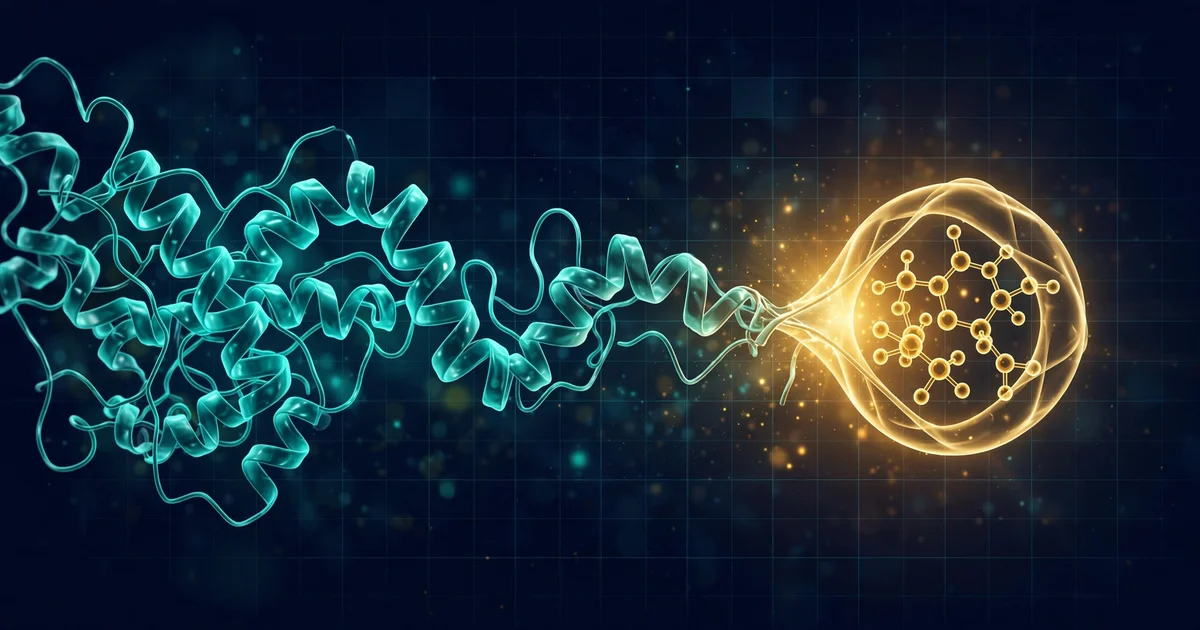
Talus Bioscience released Ptarmigan-1 today, billing it as the first AI model that can accurately predict how small molecules bind to proteins across the entire human proteome without modeling a 3D structure. Access is available now through a public portal, the company said in a press release issued this morning.
The “structure-free” part is the whole pitch. Nearly every AI drug-discovery tool in use today starts by folding: predicting a protein's 3D shape, then docking candidate molecules into its pockets. But roughly 40% of the human proteome — including many transcription factors and regulatory proteins central to disease — is flexible or disordered, with no fixed shape to fold. For those targets, the structure-first playbook that won the 2024 Nobel Prize in Chemistry simply has nothing to grab.
The data behind it#
Ptarmigan-1 is powered by MARMOT, Talus Bio's proprietary proteomics platform, which measures proteins engaging small molecules at work inside living human cells rather than in a test tube. Instead of simulating a 3D pose, the model embeds every protein residue and every compound into one shared latent space, where proximity predicts engagement — turning a screening run into a nearest-neighbor lookup instead of a simulation. The company described the approach ahead of today's launch.

5,000x faster is the point#
Skipping folding is a speed story as much as a science story. In Talus's reported benchmark on a single Nvidia H100 GPU, Ptarmigan-1 averaged about 10 milliseconds per compound — versus 54 seconds for Boltz-2, an open-source co-folding model, as reported by Drug Discovery Trends. That roughly 5,000-fold gap shrinks a million-compound screen against one protein from nearly two years to under three hours. With its compound library pre-encoded, Talus says it retrieved the top predicted binders for all 20,431 human proteins from 3.4 billion compounds in under a day, using about 20 H100 GPU-hours.
“This is not only about reaching new targets, it is about accessing new chemistry,” said Gavin Hirst, PhD, vice president of small molecule drug discovery at insitro and a member of Talus Bio's scientific advisory board. “Structure-based methods are strongest on chemotypes that already have a solved 3D complex, which quietly biases every campaign toward the chemistry we have already explored. Scoring without a pose breaks that coupling, and the speed of this model lets us test far more hypotheses, breaking us out of the cage of common chemistry.”
The STAT6 test#
The headline validation runs through STAT6, a validated target for inflammatory disease with a disordered, hard-to-model binding site. Talus tested Ptarmigan-1 against a recently disclosed STAT6 inhibitor series the model had never seen in training: it outperformed structure-based methods at picking out the working drug candidates and identified novel small molecules that bound the flexible pocket — later confirmed in a third-party lab.
Independent coverage of the company's data reports Ptarmigan-1 scoring an AUC of 0.94 on STAT6 inhibitors from Pfizer patents published after Boltz-2's training cutoff, versus 0.58 for Boltz-2 and a docking baseline — essentially chance. “With Ptarmigan-1, we now have a complementary approach for roughly half of all human proteins that have evaded drug discovery because they can't be folded in a computer,” said Alex Federation, PhD, CEO and co-founder of Talus Bio.
What it changes#
The practical significance is twofold: targets and chemistry. Targets — disordered proteins, cryptic pockets, the flexible half of the proteome — that no structure-based method could reach. Chemistry — scoring without a pose avoids quietly biasing every campaign toward molecules that already have a solved structure. “The data we're building at Talus is structure-agnostic, meaning we can measure proteins whether or not they hold a fixed shape,” said Lindsay Pino, PhD, chief technology officer and co-founder.
Researchers can access Ptarmigan-1 through the public portal starting today; for expanded usage or target-specific campaigns, Talus is inviting direct collaboration. The model won't replace structure-based methods on well-folded targets — but for the “undruggable” half of the proteome, folding just became optional.
Sources
- Business Wire (via FinancialContent) — “Talus Bio Launches Ptarmigan-1, the First Structure-Free AI Model for Proteome-Wide Drug Discovery” (October 1, 2026)
- Business Wire — source version of the Ptarmigan-1 release
- Drug Discovery Trends — “‘A plate of spaghetti’: Talus Bio boasts 5,000-fold faster drug screening by skipping protein folding”
- Talus Bio — “Structure-free drug discovery”
- Talus Bio — “Welcome to the structure-free future of drug discovery”