Wysera launches a brand-voice AI agent: marketing drafts that sound like the company, held for human approval
Wysera has launched an AI agent that drafts marketing copy in a company’s own voice — and nothing it writes goes out until a person approves it. Announced on November 1, 2026, the agent works from a stored, versioned brand-voice document and is already used by 42 teams, the company says — a bet that distinctive voice, not volume, is what marketing content is missing.
- Who and when: Wysera HQ Ltd, registered in Dover, Delaware and founded by Girish Kotte, announced the launch on November 1, 2026, via Newsfile. The agent is available to businesses worldwide from November 2026.
- What it is: an AI agent, Wyse, that drafts email, social posts, articles and replies in a company’s stored brand voice, rather than in the generic register of most AI writing tools.
- How it works: a company defines its identity, tone and guardrails once in BrandWyse, a versioned document every part of the system reads; drafting happens in PostWyse, covering email outreach, social publishing, articles and website analytics. The agent reads the customer record — conversation history, deal and what was discussed last — before drafting a reply.
- The human gate: drafts are queued for review and can be approved, edited or rejected, with every action written to the record and changes rollable back. Autonomy can be increased one content category at a time, once an operator has watched the system work on that type.
- Traction, company-reported: 42 teams are using the software, across dental practices, medical devices, home care agencies, med spas and professional services. No performance benchmarks were disclosed.
- Privacy and compliance: customer content and data are not used to train public models and the agent learns only inside a given account; data can be exported or deleted on request. Encryption, role-based access control and audit logging are live; a SOC 2 Type II audit and HIPAA readiness work are in progress.
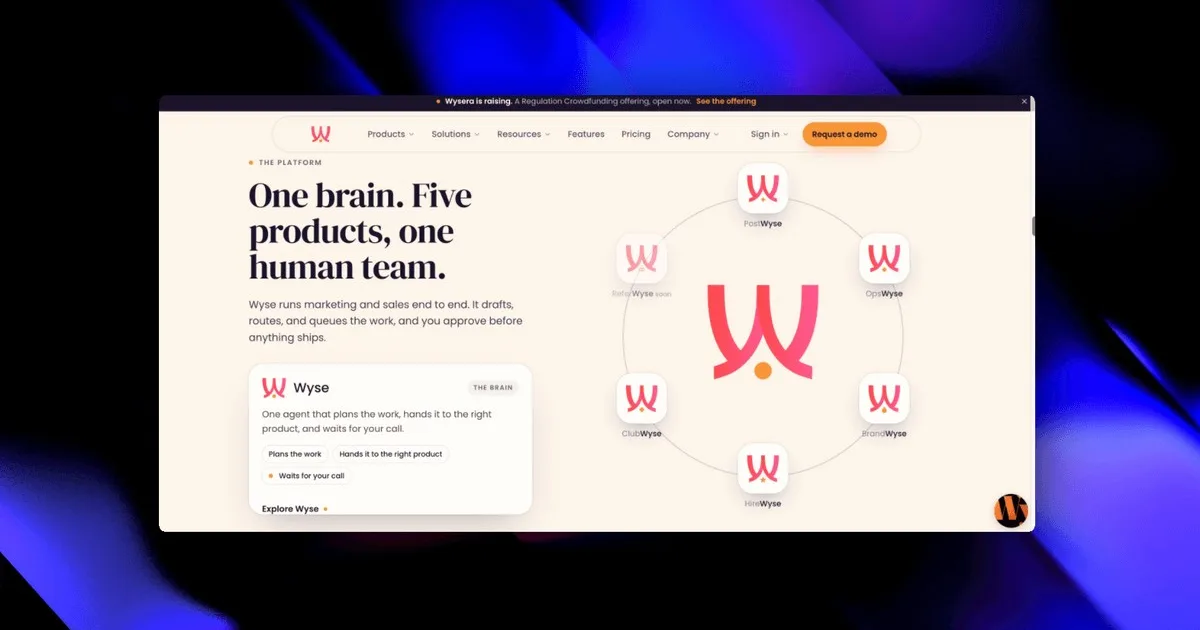
Wysera has launched an AI agent that drafts marketing copy in a company’s own voice — and nothing it writes goes out until a person approves it. Announced on November 1, 2026, the agent works from a stored, versioned brand-voice document and drafts email, social posts, articles and replies against it, according to Wysera’s announcement. The company says 42 teams are already using the software.
The bet is that the volume problem is solved and the voice problem is not. Anyone can now generate a month of posts in an afternoon, Wysera argues, and most of it reads the same because most of it comes from the same handful of models given roughly the same instruction. Buyers, the company says, have grown fluent at spotting machine-written copy, and search engines have moved to demote generic, mass-produced material — so volume alone no longer buys visibility and can work against a business.
How it works#
The approach treats brand voice as a stored asset rather than a prompt typed fresh each time. Inside BrandWyse, a company defines its identity, tone and guardrails once. That definition is versioned, so updating it creates a new version rather than overwriting history, and every other part of the system reads from the same document — an email and a social post pick up the same change without anyone coordinating it by hand.
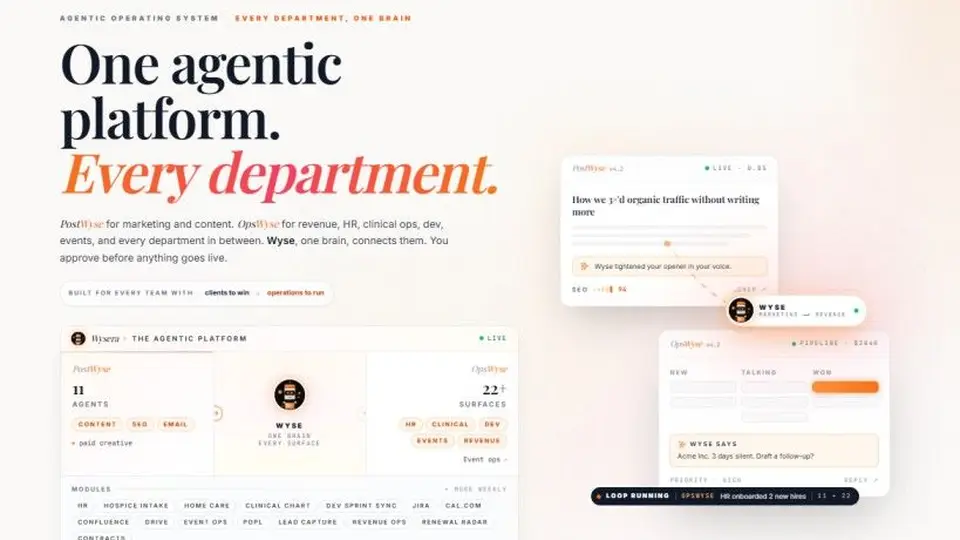
Drafting happens in PostWyse, the marketing workspace, which covers email outreach, social publishing, articles and website analytics in one place. The second element is grounding: Wyse, the agent running across the software, reads the record it is writing about. A reply to a prospect carries the history of that conversation, which deal it belongs to and what was discussed last, so a follow-up reads like a follow-up rather than a first contact — the specific failure, Wysera says, that makes automated outreach recognisable.
Nothing publishes without a human#
Wysera’s stated design principle is that nothing goes out on a company’s behalf until a person approves it. Drafts are queued for review, each one can be approved, edited or rejected, every action is written to the record, and changes can be rolled back. Autonomy can be increased one category at a time, once an operator has watched the system work on a given type of content — the deliberate opposite, the company says, of tools that publish on a schedule without review.
“Everyone solved the volume problem at the same time, which is why volume stopped working,” said Girish Kotte, founder and chief executive of Wysera. “The constraint now is producing a useful amount of writing that still sounds like the business it came from. That is a different engineering problem, and it is mostly about what the system knows before it starts drafting.”
The launch also reaches beyond conventional search. Alongside search engine optimization, Wysera says the software covers answer engine optimization and generative engine optimization — whether AI assistants such as ChatGPT and Perplexity can find, understand and cite a business accurately. Its position is that specific, verifiable, clearly attributed writing performs better with assistants for broadly the same reasons it performs better with people.
What is still unproven#
What the announcement does not contain is evidence of how well the agent writes. Wysera disclosed no performance benchmarks, and the only customer result in the release is a company-published statement: Biswajita, founder and chief executive of DentalPrice, said content planning time halved and that the drafts read like the team rather than like a machine. That is a testimonial selected by the vendor, not an independent test, and the 42-team figure is likewise company-reported.
On privacy, Wysera states that customer content and data are not used to train public models, that the agent learns only inside a given account, and that data can be exported or deleted on request. Encryption, role-based access control and audit logging are live, while a SOC 2 Type II audit and HIPAA readiness work are both in progress, with current status published on the company’s trust page. No pricing appears in the announcement. The marketing and brand products can be bought on their own or alongside Wysera’s customer relationship management and operations software, in which case content and customer records sit on the same database.
Wysera has separately announced Signal and Reach, a 512-page book by Kotte in 27 chapters with 52 diagrams, published by Blooms Publishers, with a waiting list open ahead of retail availability, and opened Wyse Room, a founders’ community at community.wysera.ai. For small teams, the question the launch actually poses is narrow: whether a versioned voice document plus a human approval step produces copy that still sounds like the business, at a volume a person could not write alone. The release makes the case; it does not yet prove it.
Sources: Wysera Launches an AI Agent That Writes Marketing Content in a Company’s Own Voice (Newsfile / Wysera announcement), November 1, 2026; Wysera Launches AI Agent for Brand-Voice Marketing (Wisevoter), November 1, 2026 — checked November 1, 2026.
Frequently asked questions
What did Wysera launch?
An AI agent that drafts email, social posts, articles and replies in a company’s stored brand voice. Announced on November 1, 2026, it is available to businesses worldwide from November 2026, and Wysera says 42 teams are already using it.
Does anything the agent writes publish automatically?
No. Every draft is held for a person to approve, edit or reject before anything publishes, with each action written to the record and changes that can be rolled back. A team can raise autonomy one content category at a time, after watching the system work on that type of content.
What has Wysera not shown yet?
No performance benchmarks were disclosed in the launch announcement, and a SOC 2 Type II audit and HIPAA readiness work are still in progress. Encryption, role-based access control and audit logging are live, and Wysera says customer data is not used to train public models.