Accelevation eyes a $5.4B Nasdaq IPO: the AI-infrastructure trade moves downstream to power and cooling
The Miamisburg, Ohio maker of power and cooling gear for data centers plans to raise up to $720 million under the ticker ACCV — the next test of how far public investors will chase the AI-infrastructure boom.
The most-watched AI company going public this fall doesn't build models, chips, or clouds. It builds the metal boxes that keep them all running.
Accelevation Holdings, a Miamisburg, Ohio manufacturer of power distribution, cooling, and modular infrastructure for data centers, filed to list on the Nasdaq under the ticker ACCV this week, targeting a valuation of up to $5.37 billion. The deal is the clearest sign yet that the AI trade is moving downstream — from the labs and hyperscalers to the industrial firms pouring the concrete the boom runs on.
The deal#
Accelevation and its backers plan to sell 30 million shares priced between $20 and $24 each, according to an amended SEC filing submitted on Tuesday. Roughly 8.6 million shares come from the company itself; the remaining 21.4 million come from selling shareholders, chiefly private-equity backer Olympus Partners, which acquired the firm in early 2025 and will keep majority voting control after the offering.
That works out to a raise of $600 million at the bottom of the range and $720 million at the top — about $660 million at the midpoint — with the top-end price implying a market value near $5.4 billion on the listed share count. Pricing is planned for September 29, with trading expected to begin September 30, according to investor materials reviewed by Bloomberg. Morgan Stanley and JPMorgan are running the deal, joined on the prospectus by Goldman Sachs, Barclays, and Bank of America.
From loss to profit in twelve months#
The filing shows a business that has grown up fast — and recently turned profitable. In the first half of 2026, Accelevation earned $18.8 million on $437.5 million of revenue; a year earlier it lost $8.7 million on $158.6 million of revenue. Signed contracts and purchase orders totaled roughly $1.1 billion at the end of June, a backlog figure that will be the centerpiece of every investor pitch.
There are real risks in the prospectus. Customer concentration is stark: two customers accounted for about 61% of direct revenue last year, a reminder that "AI demand" for one supplier can still mean one or two buyers. Still, the trajectory — revenue nearly tripling while margins flipped from red to black — is the kind of chart that has been selling industrial AI stories all year.
Downstream of the GPU#
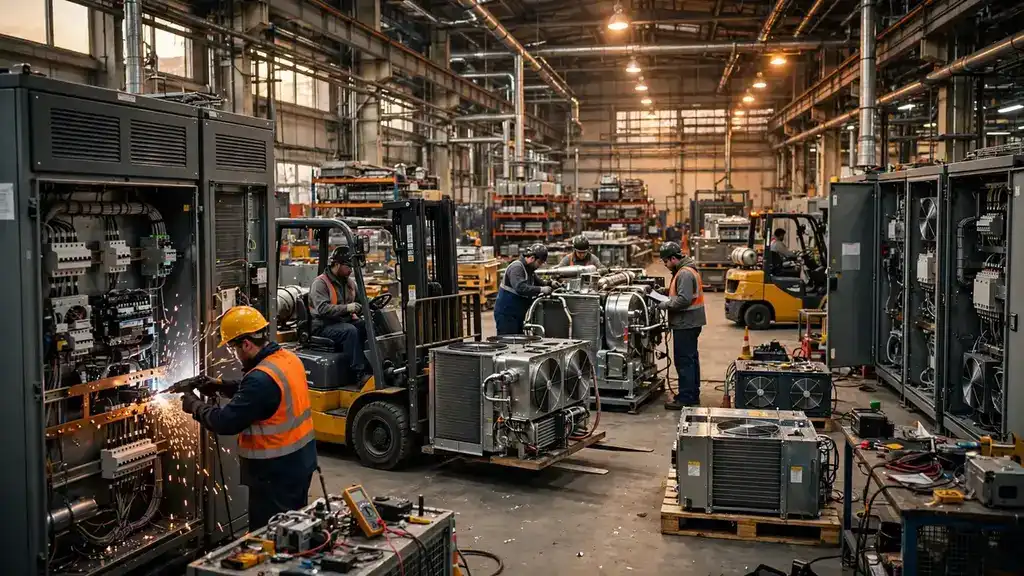
Accelevation doesn't sell to AI labs or cloud providers in the way most of this year's listings do. Founded in 2017 by Michael and Shawn Rubiera, it designs, manufactures, and installs the unglamorous equipment data center owners need to expand capacity quickly: power distribution, cooling systems, and modular electrical infrastructure. As AI workloads have pushed power density and cooling requirements through the roof, that once-commoditized gear has become a bottleneck business.
It is a crowded lane. The company competes with Vertiv, Schneider Electric, and Eaton — and with Forgent Power Solutions, which went public in February and has gained roughly 40% since, the yardstick every investor in this deal will be holding against it.

A crowded fall pipeline#
The timing is deliberate — and delicate. The fall IPO season opened tentatively, weighed down by surging bond yields and the first U.S. interest-rate hike in three years, conditions that typically push investors toward safer assets and away from richly priced growth stories.
But the AI listing pipeline is filling fast. Nvidia-backed neocloud Nscale filed for an IPO this month, smart-ring maker Oura launched its roadshow, and Anthropic is preparing what would be a blockbuster debut. On the infrastructure side, Innio and Madison Air Solutions each raised more than $2.5 billion earlier this year, while SB Energy, Aggreko, and CoVolt Power have all filed in recent weeks.
That crowding is changing how buyers evaluate these deals. As research firm IPOX's Kat Liu told Reuters, investors are looking past the AI label to the basics: where a company sits in the value chain, the quality of its backlog, and whether strong demand actually turns into revenue, margins, and cash flow. In that frame, Accelevation's $20–$24 range is a stress test: a picks-and-shovels business with real profits and real concentration risk, asking the market to pay up anyway.
What to watch#
- September 29 pricing. Whether the deal prices at the top of the range, gets clipped, or is downsized will tell you more about AI appetite than a dozen think pieces.
- The two customers. If Accelevation's 61% concentration includes any of the hyperscalers, the stock's fate is tied to their capex guidance.
- Forgent as the comp. A 40% post-IPO run for the closest peer sets the bar — and the floor — for ACCV's reception.
- Backlog conversion. That $1.1 billion in orders is the pitch; the next earnings report is the proof.