Baseten ships Bison-1 and Groundhog-1: open-weight decision models that top the Artificial Analysis index
Baseten’s two new decision models run on Google’s Gemma 4, take 128,000 tokens of context, and put bison-1 at No. 1 on Artificial Analysis’ Decision Index — with open weights and prices from $0.035 per million tokens.
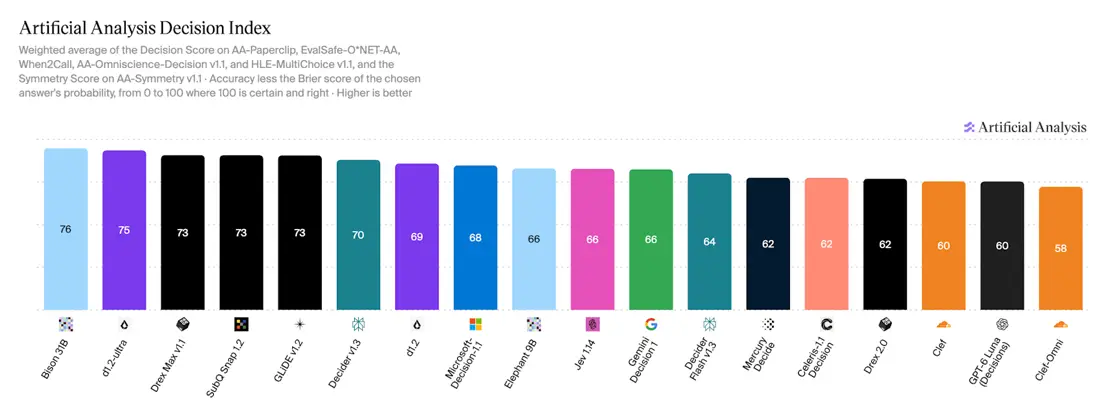
- Bison-1 takes the top spot: 76 on Artificial Analysis’ Decision Index v2.1, first of 19 decision models, ahead of Liquid AI’s d1.2-ultra (75) and Baseten’s own mammoth-1 (71).
- Two sizes, one family: bison-1 is a dense 31B model at $0.10 per million tokens; groundhog-1 is a 26B mixture-of-experts model with about 4B active parameters at $0.035.
- Eight times the context: both models take 128k tokens, up from 16k on Baseten’s previous decision models, and accept text and image input.
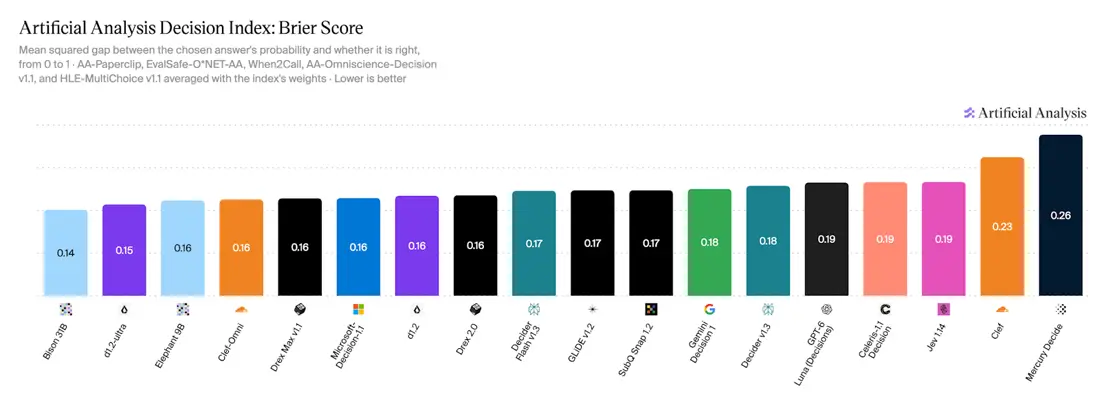
- Best calibration on the index: bison-1’s Brier score of 0.14 beats d1.2-ultra’s 0.15 — its stated confidence tracks how often it is actually right.
- Open weights, same API: both models are live on Baseten Model APIs and their weights are published on Hugging Face; switching from an older Baseten decision model means changing the model name.
Baseten released two new decision models on November 20, bison-1 and groundhog-1, built on Google’s Gemma 4. The headline number is bison-1’s 76 on Artificial Analysis’ Decision Index v2.1, the best score of the 19 models on the leaderboard — one point ahead of Liquid AI’s d1.2-ultra and five ahead of Baseten’s own mammoth-1. Both models are open-weight, take 128,000 tokens of context, accept text and images, and are already live on Baseten’s Model APIs.
It is the second release in two months for Baseten’s Base Labs team, and the first built on a Western base model. Mammoth-1 and elephant-1, released last month, were built on Qwen backbones. The new pair keeps the same pricing and the same API — the choice between them, Baseten says, comes down to the decision at hand.
What a decision model is — and why it isn’t a chatbot#
A decision model does not write essays or hold conversations. It answers one fixed question with a calibrated probability: is this support ticket urgent, is this message spam, should this request go to a human. The output is a number, not prose — and the number has to mean what it says. A model that claims 83% confidence should be right about 83% of the time.
That is what makes the category different from chat models, and why it has quietly become infrastructure. Decision models sit behind the routing, triage, guardrail and moderation layers of agent systems, making the call in milliseconds for a fraction of a cent. The work is unglamorous, but it is where agent reliability is decided — a wrong routing call sends a customer to the wrong queue, and a miscalibrated safety gate either blocks legitimate work or waves through something it should have caught.
The numbers behind the top ranking#
On the Decision Index, bison-1 leads a crowded field. The index is a weighted average across several evaluations — including When2Call, AA-Omniscience-Decision and HLE-MultiChoice — so the top score is not a single-benchmark fluke. Baseten says its model family now sits on the Pareto frontier for accuracy against time per task: at each size, no other model is both faster and more accurate.
| Model | Size | Backbone | Context | Price per 1M tokens |
|---|---|---|---|---|
| bison-1 | 31B dense | Gemma 4 31B | 128k | $0.10 |
| groundhog-1 | 26B MoE, ~4B active | Gemma 4 26B-A4B | 128k | $0.035 |
| mammoth-1 | 27B | Qwen | 16k | $0.10 |
| elephant-1 | 9B | Qwen | 16k | $0.035 |
The context jump matters more than it looks. Decision models read policies, conversation histories and case files before they decide, and the detail that changes the answer is often buried far from the question. Baseten’s own example: an invoice can look ready for payment until an earlier email shows the order was cancelled. At 16k tokens, teams had to excerpt or summarize that history before handing it to the model; at 128k, the full history goes in.
Calibration is the real story#
The ranking gets the headline, but the more interesting number is bison-1’s Brier score of 0.14 — the lowest on the index, ahead of d1.2-ultra at 0.15. The Brier score measures the gap between a model’s stated confidence and whether it was right; lower is better. A model can top an accuracy ranking while still being badly calibrated — confident when it is wrong, hesitant when it is right — and for a decision model, that is the failure mode that matters.
Baseten credits part of the gain to the Gemma base, and part to scaling up “soft labels” in training: teaching the model that an answer is “83% A, 17% B” rather than “100% A.” Train the model to express uncertainty the way the world actually distributes it, and the calibration numbers follow.
An American backbone, on purpose#
Baseten is explicit about why the backbone matters. Mammoth-1 and elephant-1 were built on Qwen, a Chinese base model; bison-1 and groundhog-1 run on Google’s Gemma 4, and the company frames the switch as giving teams a reason to choose American models on performance rather than preference alone. The pricing is deliberately unchanged — bison-1 costs what mammoth-1 cost, groundhog-1 what elephant-1 cost.
There is also a practical pitch underneath the positioning: the new models use the same API as the older ones, so existing users switch by changing a model name. And Baseten expects groundhog-1, which has no official index score yet, to match mammoth-1 once it is evaluated.
What to watch#
First, whether groundhog-1’s expected score materializes. Baseten’s expectation is its own; the official number will come from Artificial Analysis.
Second, how crowded this category gets. Liquid AI’s d1.2-ultra sits one point behind bison-1, and the gap between the top five models on the index is now five points — close enough that the next release from any of them reshuffles the board. Salesforce and Google have both shipped decision-flavoured products of their own in recent weeks, which suggests the big platforms see the same opening.
Third, whether 128k context changes what teams hand to decision models. Longer context is only useful if the extra history actually improves the decision, and that will show up in production error rates rather than in benchmark tables. The index tells us bison-1 is the most accurate decision model measured so far; the next few months will tell us whether it is also the most useful one.
Baseten’s bet is that the boring part of AI — the small, fast calls behind every agent — is where reliability is won or lost. Bison-1 now leads the leaderboard for that bet. The question is how long the lead lasts.
Sources: Baseten, “Meet bison-1 and groundhog-1, frontier American decision models” (20 Nov 2026); MarkTechPost, “Baseten Releases Bison-1 and Groundhog-1, Topping Decision Model Index” (20 Nov 2026); Unite.AI, “Baseten Extends Decision Models to 128K Context and Image Input” (20 Nov 2026). Our earlier coverage: Salesforce’s Koa decision model and Kakao’s Kanana-2-V Decide.