Salesforce Koa Decisions: a Gemma-based decision model that answers in milliseconds
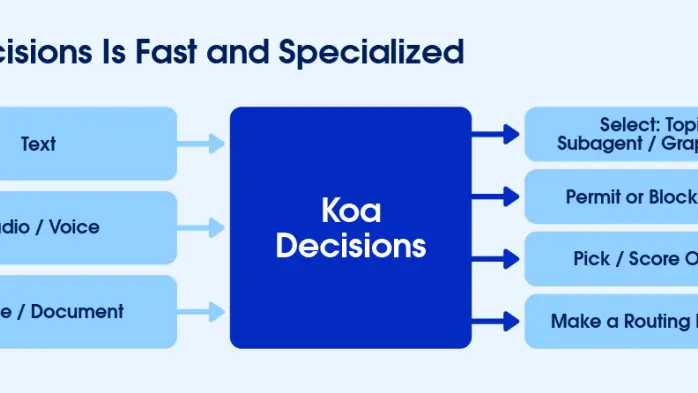
Salesforce introduced Koa Decisions on November 6, 2026, a decision model that trades paragraphs for verdicts: give it a request and a list of categories, and it returns a choice, a yes-or-no, or a score — in milliseconds, and in a single step. It is the next version of HyperClassifier, the routing model already working inside Agentforce, rebuilt on Google’s open-weight Gemma with image and audio support added.
- Who: Salesforce, introducing Koa Decisions. The product lead is Darvish Shadravan, Senior Director of Product Management.
- What: Koa Decisions, the next version of the HyperClassifier decision model, built on Google’s open-weight Gemma.
- When: Introduced November 6, 2026.
- Inputs and outputs: Reads text, images, and audio, plus a user-defined list of categories; returns a choice, a yes-or-no, or a score, with a confidence score.
- Speed: Salesforce measured HyperClassifier routing at roughly 26 milliseconds, against about 1,446 milliseconds for a general-purpose LLM. The team’s preprint reports about half-second responses and median speed up to about 7.5 times faster than the frontier models tested.
- Access: A demo is open to anyone with a free Trailhead account. Planned extensions include flows, Apex, prompt templates, and a developer API.
Decision models are having a moment. In mid-September, TypeSafe AI came out of stealth with Jev, a model built to pick from a set of options. A month later, OpenAI made its Decisions API generally available. Now Salesforce has joined in with a model of its own — and unlike the startups, it already has a decision model running in production to build on.
Salesforce has used decision models for years, including HyperClassifier, which routes requests inside Agentforce, sending each inquiry to the part of the agent built to handle it. On November 6, 2026, the company introduced Koa Decisions, the next version of that model. It keeps the routing job, but expands where a decision model can be used across Salesforce — and it is the second decision model to land in a single day: Kakao released Kanana-2-v-decide hours earlier, a 3.67B model that answers in probabilities rather than prose.
What Koa Decisions does
Koa Decisions reads a request and a list of categories you define, then makes a decision in a single step, in milliseconds. The answer is a selection, a yes-or-no, or a score — often a single token, with a confidence score attached. Salesforce built it by applying novel training techniques to Google’s Gemma, an open-weight model, and the new version adds multimodal support: it can take images and audio as well as text.
The distinction from a general-purpose language model is how the answer is produced. An LLM generates text token by token, each new token based on the ones before it. A decision model reads the whole request at once and emits its answer in one step. A short answer takes less computing to produce, and other software can act on it right away — which is the whole point when an agent’s job is mostly making choices: which team gets a request, which workflow runs next, whether an action is permitted.
Salesforce’s example is a customer typing “I can’t log in to my account” into a chat window. Should the request go to engineering, accounts, or sales? A general-purpose LLM can interpret the question, but it takes more than a second to work through it. A decision model identifies “accounts” in milliseconds and returns the answer with a confidence score.
The numbers, with the fine print
Salesforce’s headline speed figure comes with an attribution worth keeping straight. When the company measured routing requests in Agentforce, it found its decision model took roughly 26 milliseconds, compared with about 1,446 milliseconds for a general-purpose LLM. That measurement belongs to HyperClassifier, the predecessor already in production — not to Koa Decisions itself.
For Koa Decisions, the published evidence is the team’s research preprint, which formulates classification, semantic endpointing, Boolean checks, and scoring as constrained generation with single-token outputs. The authors report 85.5% accuracy on a production intent-routing benchmark, responses in about half a second, and median speed as much as approximately 7.5 times faster than the frontier models tested under identical serving conditions. HyperClassifier, for its part, was fine-tuned on GPT-OSS-20B, classifies across as many as 200 labels, and became the default intent-detection and routing model for Agentforce Service and Employee Agent templates in Spring 2026.
The honest read: the architecture is proven in production through HyperClassifier, and the preprint numbers are strong, but Koa Decisions’ own production performance has not been published yet. What is verifiable today is the design — single-step, single-token answers on an open-weight base — and the demo.
No retraining to add a category
Anyone can try the model, even without being a Salesforce customer: sign up for a free Trailhead account and run the Koa Decisions demo. The demo routes a support request to engineering, accounts, or sales and shows a confidence score for each option — then lets you add a fourth option, like “Returns,” and watch it route a returns request there immediately, with no retraining.
That is the practical pitch. Software has classified requests for decades, but it used to take a custom predictive machine-learning model: define the outcome, gather and label data, train, check accuracy, repeat. For many enterprise customers, getting from idea to production took months. A decision model starts from a language model that has already learned how “send back the order” relates to “returns,” so a team can add the category and sometimes reach production in hours.
Where it goes next
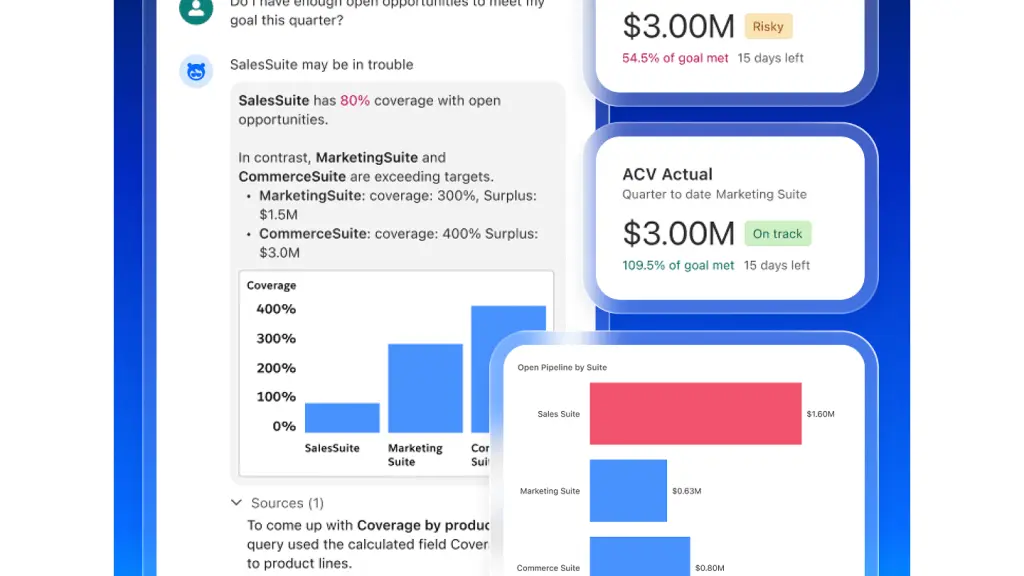
Salesforce plans to extend Koa Decisions well beyond routing, into flows, Apex, and prompt templates for Salesforce builders, plus an API for developers. Koa Decisions joins the Koa family of Salesforce models, which also includes a separate reasoning model built with NVIDIA — the one Salesforce unveiled at Dreamforce as its first CRM reasoning model, already in pilot with customers and planned for general availability in the US in winter 2026.
The division of labor is the story here: decision models handle the routing, checks, and scoring, while large language models handle explanation and reasoning. Salesforce is also pushing the same split into the product surface around Agentforce — it expanded Agentforce Coworker on November 5, bringing agentic help to teams at $50 per user. The caveat, stated in Salesforce’s own post: pricing and packaging are subject to change, availability may vary by region, and access is governed by customer agreements. The demo is real today; how far the integrations travel beyond it is the thing to watch.
Frequently asked questions
What is Koa Decisions?
Koa Decisions is Salesforce’s decision model, introduced November 6, 2026, and the next version of HyperClassifier, the routing model inside Agentforce. Built on Google’s open-weight Gemma, it reads a request and a list of categories you define, then returns a choice, a yes-or-no, or a score in a single step, in milliseconds.
How is a decision model different from a regular LLM?
A large language model generates text token by token, each new token based on the ones before it. A decision model reads the whole request at once and emits a compact answer — often a single token — in one step, with a confidence score. That takes less computing, and other software can act on the answer right away.
Can I try Koa Decisions without being a Salesforce customer?
Yes. Sign up for a free Trailhead account and run the Koa Decisions demo, which routes a support request and lets you add categories like “Returns” with no retraining. The planned integrations into flows, Apex, prompt templates, and a developer API are not all generally available yet — availability varies by region and is governed by customer agreements.