Chalmers' AI scientist runs its own biology lab: LLM hypotheses, robot experiments — and new discoveries in yeast
Researchers at Chalmers University of Technology have wired large language models into a closed-loop robotic laboratory that dreams up hypotheses, runs experiments on brewer's yeast, and interprets the results with minimal human involvement. The peer-reviewed work, published in the Journal of the Royal Society Interface, is one of the clearest demonstrations yet of a self-driving laboratory doing real science.
AI agents are supposed to write your code and answer your emails. At Chalmers University of Technology in Gothenburg, one is doing something stranger: running a biology lab.
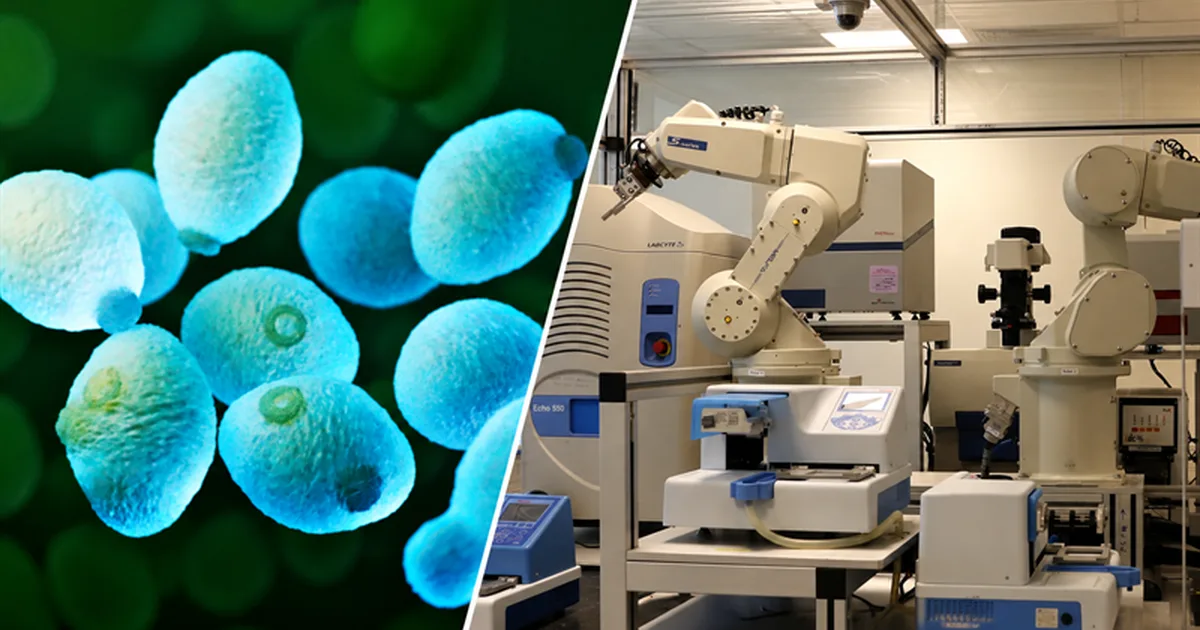
Researchers there have built a closed-loop AI scientist that identifies promising biological questions, recommends experiments to test them, evaluates the outcomes, and iteratively refines its understanding — with minimal human intervention. The system works on brewer's yeast, Saccharomyces cerevisiae, fed with the organism's genome, its metabolism, and the body of prior research as its starting knowledge.
The closed loop#
The trick is the combination. Large language models supply the thinking; automated reasoning keeps that thinking logically coherent; laboratory automation gives it hands. Most AI-for-science systems to date stop at analysis — they read data or propose ideas, and a human does the bench work. Here, hypotheses flow straight into robot-run experiments, and the results flow back into updated hypotheses without a scientist in the middle of every step.
"It is too much information for a human to analyse, but our AI scientist could identify promising biological questions, recommend experiments to test them, evaluate experimental outcomes and iteratively refine its understanding based on new evidence," says Ievgeniia Tiukova, a postdoctoral researcher in Chalmers' Department of Life Sciences and one of the study's authors. "Rather than serving solely as decision supporting tools, the AI scientist actively generates new scientific knowledge."
Tiukova compares the development to self-driving cars, where AI also processes information, draws conclusions, and takes action — except here the road is a yeast genome and the driving is the full cycle of scientific method.
What it found#
This wasn't a simulation or a toy benchmark. The study, titled Agentic AI integrated with scientific knowledge: laboratory validation in systems biology, reports the system identifying novel interactions in yeast — including a glutamate-induced synergistic growth inhibition in spermine-treated cells, and aminoadipate partially rescuing yeast from formic-acid stress. Every hypothesis, experiment, and data point was captured in a graph database using controlled vocabularies, so the whole discovery trail is machine-readable and reproducible by construction.
The work comes from Daniel Brunnsåker, Alexander H. Gower, Prajakta Naval, Erik Y. Bjurström, Filip Kronström, Ievgeniia A. Tiukova and Ross D. King, affiliated with Chalmers, the University of Gothenburg, and the University of Cambridge. It was funded by the Wallenberg AI, Autonomous Systems and Software Program (WASP), the UK Engineering and Physical Sciences Research Council, the Chalmers AI Research Centre, and Sweden's Formas research council.
Eve's lineage#
The hardware has a pedigree. Senior author Ross King was the first to develop the concept of a general-purpose robot scientist; his first robot scientist, Adam, was designed to autonomously carry out experiments and generate new knowledge, and he later built a second, Eve, specifically for drug discovery. This new work takes that lineage and adds the missing piece: the modern language model as a reasoning engine, scaffolded by symbolic relational learning and structured vocabularies so the agent's outputs stay logically coherent instead of drifting into incoherence.
That scaffolding is the paper's real contribution on the AI side. LLMs perform well across diverse tasks but struggle with logical structures; coupling them to laboratory automation through a logical scaffold "reduces output incoherence and improves reliability in automated workflows," the authors write. The agent doesn't just talk about biology — it acts on it, under constraints it can't hand-wave away.
Why it matters#
Self-driving laboratories are having a moment — Anthropic unveiled a similar push this month with 950 Claude agents combing DNA databases for novel enzyme systems — but most headline results so far live in silico or in a narrow assay. A closed loop that spans hypothesis generation, physical experiment, and interpretation on a model organism, published in a peer-reviewed journal, is the field's stated endgame happening in miniature.
King is careful about what it replaces: nothing, for now. "Human scientists remain essential for defining research priorities, interpreting broader scientific significance and ensuring ethical oversight," he says. "Future generations of autonomous discovery systems will become increasingly capable of collaborating with human scientists, becoming valuable partners in addressing some of the most challenging questions in biology and medicine." But the routine cycles — hypothesis, test, revise — are increasingly the machine's job. The scientist's job is to decide which questions are worth asking, and what the answers mean.
Sources
- Chalmers University of Technology — "AI scientist autonomously generates and validates new biological discoveries" (September 30, 2026)
- Cision — Chalmers press release with images, published September 30, 2026
- Journal of the Royal Society Interface — "Agentic AI integrated with scientific knowledge: laboratory validation in systems biology" (paper cited via the Chalmers announcement)