FF unveils OmniMind, one AI brain for every robot, as Faraday Future’s robotics arm becomes a Nasdaq pure-play
- Who: FF EAI Robotics Ecosystem Inc. (Nasdaq: FFR), a U.S. embodied-AI company now trading as a pure-play humanoid and bionic robotics company after acquiring Faraday Future’s robotics business.
- What: FF OmniMind, the brand name for its unified AI brain — foundation models, motion control and skills — built to work across robot forms, tasks and scenarios under the philosophy “One Brain, All Robots; Multi-Forms, Multi-Capabilities.”
- When: Unveiled October 26, 2026, at FFR’s first Investor Day in New York; the acquisition it completes closed October 23, 2026.
- Sales momentum: October sales and shipments expected to exceed 300 robots, a new monthly record for the acquired business, with cumulative shipments above 1,100 by the end of October, at positive unit gross margins.
- Guidance: First full-year 2026 guidance of approximately 2,000 robot sales and shipments for the acquired business on a standalone basis, also at positive unit gross margins.
- Five-year outlook: 2027 revenue of approximately $45.2 million and about 7,400 device units; cumulative five-year revenue of approximately $1.98 billion and about 133,000 device units — projections the company flags as uncertain, not guarantees.
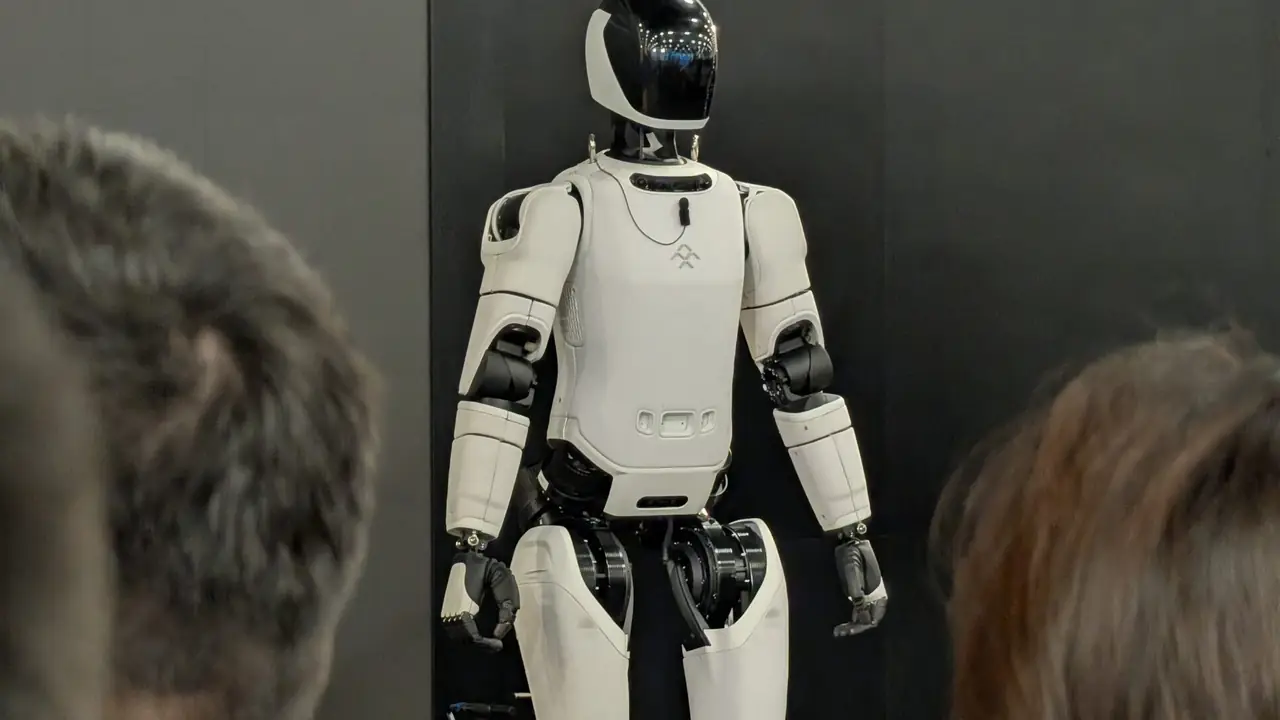
FF EAI Robotics Ecosystem (Nasdaq: FFR) has given its robot brain a name. Unveiled on October 26, 2026, at the company’s first Investor Day in New York, FF OmniMind is the brand for what FFR calls its unified AI brain — foundation models, motion control and skills, combined into one system designed to work across robot forms, tasks and scenarios. The pitch is a shift from robots that do one job well to robots that generalize: from task-specific autonomy toward general-purpose autonomy, with the same brain driving humanoids, bionic machines and whatever forms come next.
The unveiling did not arrive alone. It was packaged with the completed acquisition of Faraday Future’s robotics business, a new board, first-ever full-year guidance, and three partnerships — a coming-out event for a company that wants to be read as a pure-play Physical AI stock rather than a Faraday Future spinoff. FFR now trades on Nasdaq as a humanoid and bionic robotics company built around what it calls a “Four-Core Full-Stack AI” ecosystem.
What OmniMind actually is
OmniMind is not a single model but a stack: foundation models for perception and reasoning, motion control for moving a body through the world, and skills — reusable capabilities that let one brain pick up different jobs. FFR says the combination is what lets the same brain power different forms, and it organizes the work across four industry ecosystems: Education and Research; Security and Inspection; Industrial and Logistics; and Commercial and Services.
The four cores behind it are the EAI Brain and Developer Platform, EAI Devices, Industry Productivity Solutions, and the EAI Data Factory. The devices core is where the near-term numbers sit: FFR expects October sales and shipments to exceed 300 robots, a new monthly record for the acquired business, with cumulative sales and shipments above 1,100 by the end of October — all at positive unit gross margins, a detail the company repeats because hardware margins are where robotics startups usually bleed. Its security and inspection solution has entered proof-of-concept with an initial group of customers and partners, and the Data Factory continues to deliver egocentric robot data — and get paid for it — including large-scale deliveries to leading AI and robotics customers.
The deal, the board, and the guidance
The acquisition closed October 23, 2026. FFR issued common shares and non-voting convertible preferred shares to Smart Technology Holdings Ltd., a Faraday Future subsidiary, as consideration, and the robotics business and its assets transferred to FFR. The board reshuffle that came with it names YT Jia as Global CEO, Jerry Wang as Executive Chairman, Chen Shi as Lead Independent Director, and Jason E. Dodier as independent director. Jia, notably, chose not to increase his cash compensation in the new role — a gesture the company frames as alignment with stockholders.
FFR also issued full-year 2026 guidance for the first time: approximately 2,000 robot sales and shipments for the acquired business on a standalone basis, at continued positive unit gross margins. The fine print matters: the standalone figure includes periods before the acquisition, and FFR consolidates the acquired business only from the October 23 closing date, so it is not FFR’s reported 2026 result. The five-year outlook is bolder still: 2027 revenue of approximately $45.2 million — $32.5 million from devices and $12.7 million from the other three cores — on about 7,400 device units, building to cumulative five-year revenue of approximately $1.98 billion and about 133,000 device units. The company itself stresses those projections are subject to significant uncertainties and are not guarantees of future performance.
Three partnerships — and the federal angle
At the event, FFR announced three partnerships aimed at distribution rather than technology. The first, with California professional-services firm KYA GROUP, targets U.S. federal government and large institutional markets: third-party data cited by FFR credits KYA with more than 1,000 government procurement-related records in California involving more than 200 public agencies, and a KYA affiliate holds a U.S. General Services Administration Multiple Award Schedule contract covering 23 procurement categories. The second, with California Science and Technology University and Boston International Business School, establishes the BIBS-FF-CSTU Joint Robotics Lab. The third, with Pinnacle, a leading Southern California real estate brokerage, covers B2B real estate brokerage and B2C home-security solutions.
What to watch
The story FFR is telling is coherent: one brain, many bodies, sold into schools, warehouses, inspection sites and homes, with a data flywheel — its RoboShare platform, which it says is becoming North America’s robot-sharing platform with the largest fleet and widest variety — feeding the brain. But nearly every load-bearing number in the announcement is the company’s own: the “No. 1 in K–12 robotics education in the U.S.” claim is stated as FFR’s belief, the 2,000-unit guidance is its first attempt at one, and the five-year outlook is explicitly uncertain. The October record — 300-plus robots in a month — is modest in absolute terms, and the real test is whether a unified brain actually transfers across forms or whether each robot still needs its own tuning. FFR’s stated five-year goal is to rank among the top three companies in Physical AI overall. OmniMind is the name it will have to live up to.
Sources: FF EAI Robotics Ecosystem announcement (PR Newswire), TipRanks.
Frequently asked questions
What is FF OmniMind?
The brand name for FF EAI Robotics Ecosystem’s unified AI brain, announced October 26, 2026: foundation models, motion control and skills designed to work across robot forms, tasks and scenarios, moving from task-specific autonomy toward general-purpose autonomy.
What else did FFR announce at its Investor Day?
The completed acquisition of Faraday Future’s robotics business, closed October 23, 2026; a new board led by YT Jia as Global CEO; three strategic partnerships; and first full-year 2026 guidance of approximately 2,000 robot sales and shipments for the acquired business.
What are FFR’s sales figures and outlook?
October sales and shipments are expected to exceed 300 robots, a monthly record, with cumulative shipments above 1,100 by month-end. Its five-year outlook projects 2027 revenue of about $45.2 million and cumulative five-year revenue of about $1.98 billion — projections the company says are subject to significant uncertainties and are not guarantees.