Gallium Defense emerges from stealth: €7.1M seed for an AI-native radar that spots drones 10km away
Gallium Defense, a Paris startup founded in April 2026, emerged from stealth on November 2 with a €7.1 million seed round behind an affordable drone-detection radar. Its GDS-10 is designed to spot small and FPV drones up to 10 kilometres away — a capability the company says most critical sites still lack at a price they can deploy at scale.
- Who and when: Paris-based Gallium Defense, founded in April 2026 by Eric Fournier, Florian Lemoine and Robin Mandel, emerged from stealth on November 2, 2026, as European Defence Week 2026 (November 2–6, Paris) opened.
- Funding: €7.1 million seed round led by Keen Venture Partners and 360 Capital, with participation from Omnes Capital and Polytechnique Ventures (Vestbee also notes strategic partners).
- Product: The GDS-10, an X-band AESA radar with a software-defined, AI-native architecture, in two versions: one for critical infrastructure operators and one for armed forces.
- Specifications: Designed to detect Class 1 and FPV drones at up to 10km, with 360° azimuth and 90° elevation coverage, tracking multiple drones simultaneously, including within a swarm, day and night and in all weather conditions.
- Progress: First open-air field trials four months after the seed round closed; monthly demonstrations for civil and military operators underway; orders planned to open in the first quarter of 2027.
- Not disclosed: No unit price, named customers, contracts or independent test results were published with the announcement.

Gallium Defense emerged from stealth on November 2, 2026, with a €7.1 million seed round behind an affordable drone-detection radar. The Paris-based startup, founded in April 2026, says its flagship product, the GDS-10, is designed to detect small drones — including first-person-view (FPV) drones — at distances of up to 10 kilometres. The announcement coincided with European Defence Week 2026, held from November 2 to 6 in Paris.
The seed round was led by Keen Venture Partners and 360 Capital, with participation from Omnes Capital and Polytechnique Ventures, according to Vestbee, which also notes strategic partners took part. “Great defence starts with superior visibility. Gallium Defense has the team, the industrial partners and the cost model to make drone detection a standard layer at every critical site,” said Alexander Ribbink, general partner at Keen Venture Partners. Gallium pitches itself as a sovereign European answer for drone detection at scale — a claim about where the capability is built, not a test result.
Built to meet 80% of the need at 20% of the price#
Gallium’s pitch starts with a gap it says legacy radar leaves open. The company says more than 80% of critical infrastructure sites and military assets remain exposed to modern drone threats because affordable, field-ready radars are not available at scale. That figure is the company’s own assessment, not an independently published count — but it frames the design brief: build something cheap enough to deploy widely, rather than a more capable system few sites can afford.
“As drones proliferate, traditional radars are reaching their operational and economic limits,” said Eric Fournier, Gallium’s chief executive and co-founder. “At Gallium Defense, we started from a blank sheet with a simple question, asked by operators in the field: how do you meet 80% of the need at 20% of the price? Our answer: a radically rethought AESA radar architecture that makes extensive use of commercial off-the-shelf components and the power of embedded computing.” The “20% of the price” is a design target expressed by the founder, not a published unit price — no price for the GDS-10 was disclosed.
Fournier founded Gallium in April 2026 with Florian Lemoine and Robin Mandel, now chief operating officer. Fournier spent 17 years advising defence and aerospace leaders at Boston Consulting Group; Lemoine has more than 15 years in defence and served as a former adviser to NATO SACT; Mandel brings more than 15 years across industry and consulting through roles at Thales, BCG and Safran.
What the GDS-10 is designed to do#
The GDS-10 is an X-band AESA (active electronically scanned array) radar with a software-defined, AI-native architecture. It comes in two versions: one for critical infrastructure operators and one for armed forces. Gallium says the system is designed to detect Class 1 and FPV drones at a range of 10km, with 360° azimuth coverage and 90° elevation coverage, tracking multiple drones simultaneously — including within a swarm — day and night and in all weather conditions.
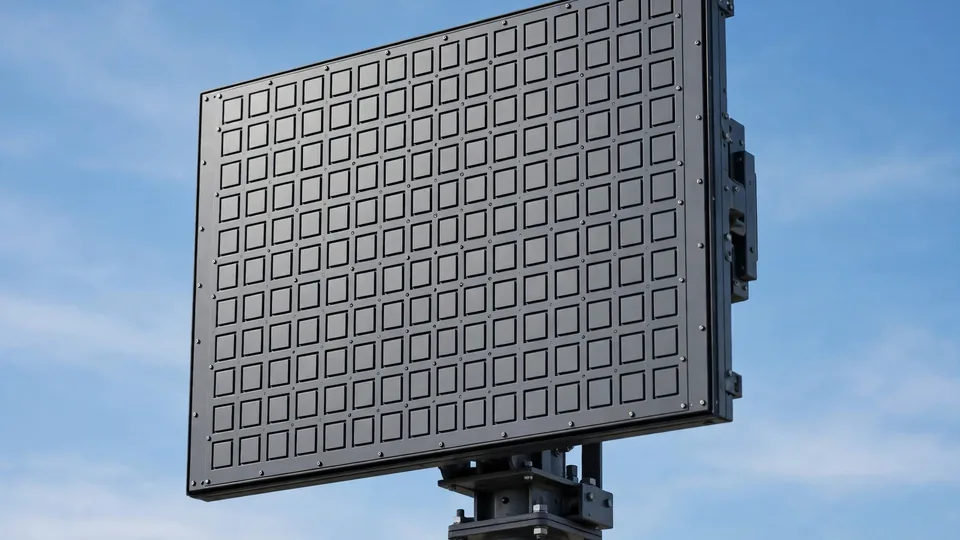
Because the radar is software-defined, Gallium says its capabilities can evolve as new threats emerge, without replacing the hardware. That matters for drone defence in particular: the threat changes faster than procurement cycles, as new drone types, swarm tactics and countermeasures appear. A system that can be updated in software has a longer useful life than one frozen at the point of manufacture — provided the updates arrive and are validated, which is still to be demonstrated for the GDS-10.
Field trials done, orders still months away#
The company conducted its first open-air field trials four months after closing its seed round — so the round itself closed months before today’s public announcement. Monthly field demonstrations for civil and military operators are now underway, and the funding is being used to industrialise production, strengthen the team, train AI models and run those demonstrations.
“Our radars are designed to be manufactured and deployed by the hundreds, not one at a time,” said Mandel. That manufacturing claim is the other half of the affordability argument: a radar built from commercial components on a scalable production line can, in principle, reach the many sites the company says are currently exposed. Whether Gallium can manufacture at that volume, and at what unit cost, has not yet been shown publicly.
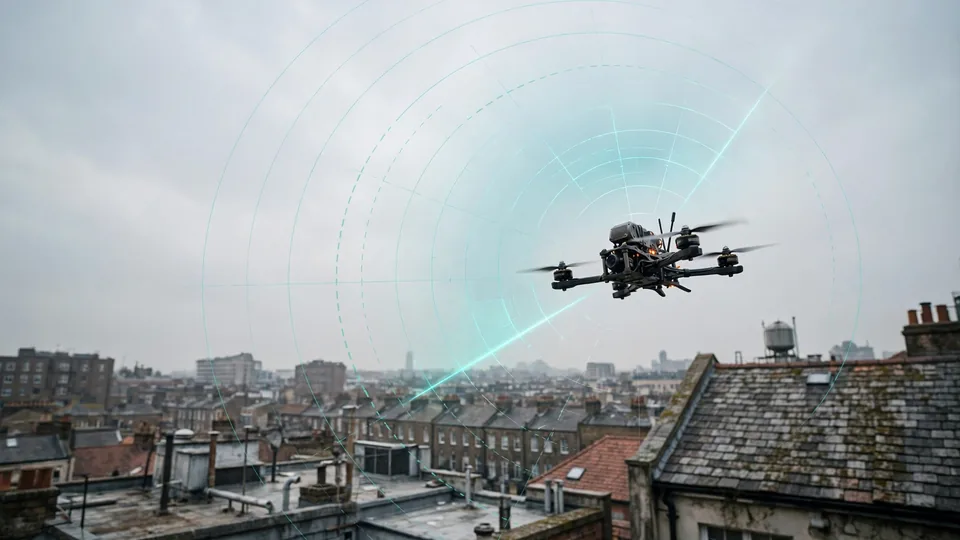
Gallium plans to open orders for the GDS-10 in the first quarter of 2027. Until then, operators cannot buy the system — they can only watch the demonstrations and wait for pricing and delivery terms that have not yet been published.
What is not yet shown#
Everything public about the GDS-10’s performance so far comes from the company and the two reports of its emergence from stealth. No independent test results have been published, no named customers or contracts were announced, and no unit price was disclosed. The 10km detection range, swarm-tracking and all-weather claims are design specifications as reported by the company, not verified measurements from an outside evaluator.
That is normal for a stealth emergence — and it is also the limit of what today’s announcement proves. The evidence to watch for next is concrete and boring: published results from the field trials, a price list, and the first orders when they open in early 2027. Until then, Gallium has shown that investors will back a cheaper, AI-native approach to drone detection. It has not yet shown that the radar works at the range and scale it claims, in the hands of the operators who would rely on it.
Frequently asked questions
What is Gallium Defense’s GDS-10?
The GDS-10 is an X-band AESA radar with a software-defined, AI-native architecture, built by Paris-based Gallium Defense in two versions — one for critical infrastructure operators and one for armed forces. It is designed to detect Class 1 and FPV drones at up to 10km, with 360° azimuth and 90° elevation coverage, tracking multiple drones including swarms.
Who backed the €7.1 million seed round, and when did Gallium emerge from stealth?
Gallium Defense emerged from stealth on November 2, 2026, coinciding with European Defence Week 2026 in Paris. Its €7.1 million seed round was led by Keen Venture Partners and 360 Capital, with participation from Omnes Capital and Polytechnique Ventures; Vestbee also notes strategic partners took part. The company was founded in April 2026 by Eric Fournier, Florian Lemoine and Robin Mandel.
When can operators buy the GDS-10, and what has not been shown yet?
Gallium plans to open orders for the GDS-10 in the first quarter of 2027. No unit price, named customers or contracts were disclosed, and no independent test results have been published for the 10km detection range or swarm-tracking claims. The company has run open-air field trials and holds monthly demonstrations for civil and military operators.