Safeworld exits stealth with a $12M+ seed to stress-test gen-AI robots in simulation
Safeworld emerged from stealth on October 5 with more than $12 million in seed funding led by Shine Capital and a16z Speedrun. Its bet: as generative AI takes the controls of humanoid robots, somebody has to independently prove they won't hurt people.
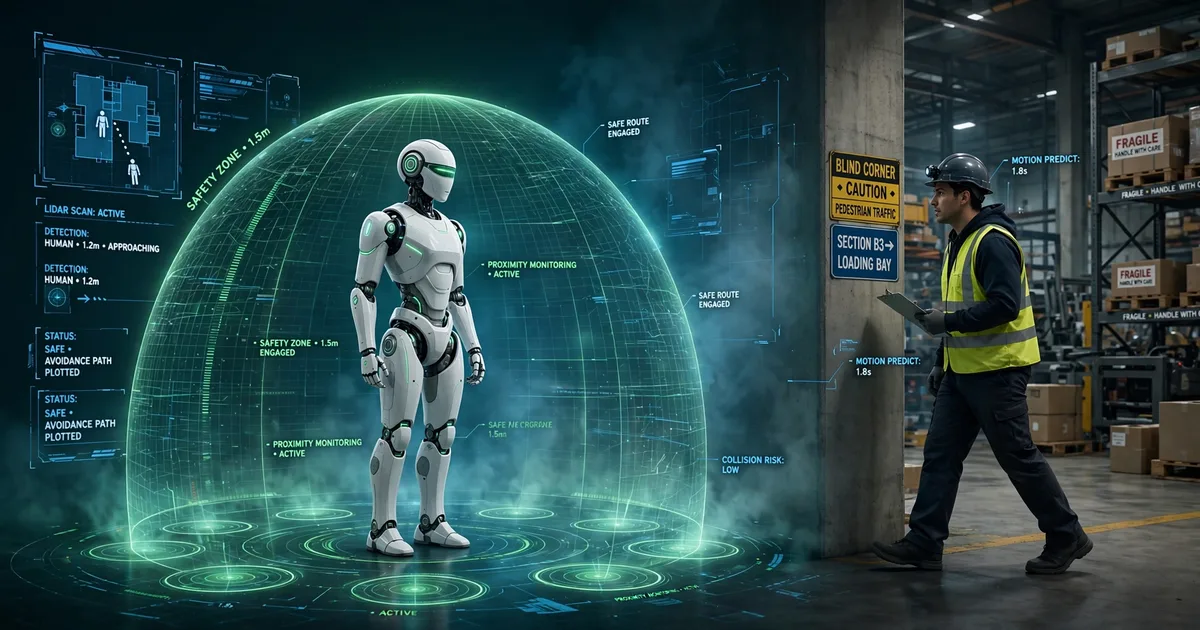
Safeworld is emerging from stealth today with a seed round of more than $12 million, and it wants to answer the robotics industry's hardest new question: when a humanoid is driven by a generative AI model — probabilistic and unpredictable by nature — how do you prove it won't hurt anyone? TechCrunch broke the news this morning.
The round is led by Shine Capital and a16z Speedrun, with Box Group, the Carnegie Mellon University Endowment, Innovation Endeavors, and SV Angel also in. The founder pedigree is the point: Dr. Ding Zhao, who directs the Safe AI lab at Carnegie Mellon University and has spent his career on this exact problem, founded the company with veteran startup executive Kyle Wong and machine learning engineer Simo Rachidi.
Probabilistic machines, probabilistic risk
"The safety challenge that we're talking about is a combination of, one, really advanced generative AI probabilistic evals — how do you underwrite the risk of a probabilistic system?" Zhao told TechCrunch. "The second part that's really hard is the trust part, and you need both to deploy a robot."
The big trend in robotics right now is handing the keys to a generative model. That buys flexibility, but it kills the predictability that traditional control algorithms offered — and you can't certify what you can't predict. Safeworld's answer is third-party simulation testing: evaluate a robot's control system, running its real software, inside digital worlds populated with realistic human models.
Thousands of scenarios, zero bruises
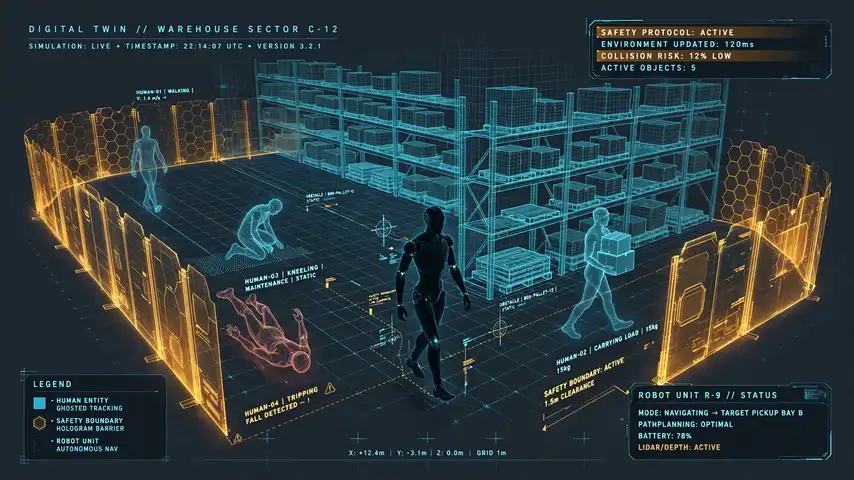
The pitch is disarmingly concrete. Take the blind corner in a factory: what speed or stopping distance guarantees the robot won't collide with a human rounding it? Safeworld builds a digital version of that corner in a simulator like Genesis or MuJoCo, inserts a simulation of the robot driven by its actual software, and runs thousands of scenarios where human models encounter it — walking, carrying boxes, kneeling, running, even tripping and falling. "Otherwise, you would have to go and trip and fall for the robot, which is like a hard thing to be doing all the time," co-founder Wong said.
The problem is harder than the self-driving equivalent, Zhao argues. Cars operate in a structured world with relatively uniform rules; humanoids will work in unstructured environments where every facility has different safety standards — and people, unlike traffic, are profoundly unpredictable.
Why a third party?
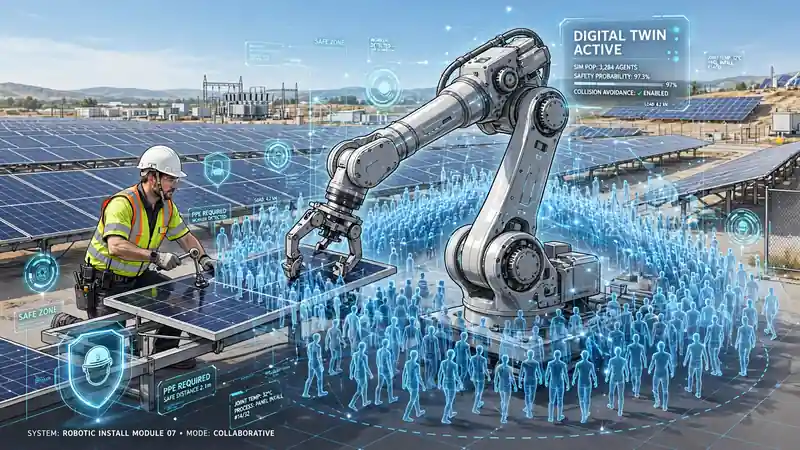
Robot makers already build internal test rigs, and Safeworld admits its platform resembles tools they use internally. The bet is that builders will still pay an outsider to validate their work — partly for credibility, partly to share safety cases between competitors. The team claims one design win already: Gritt Robotics, whose CTO Vishal Dugar is developing the AI brain for robots that help workers install photovoltaic panels at industrial-scale solar farms, is partnering with Safeworld as it builds its safety simulations. "The difficulty with most of our systems is it's very hard to formally prove it by doing some math... It necessarily has to be done empirically," Dugar said.
The timing thesis is blunt. "The time to build an industry safety standard is now while robots are being designed and deployed," said Jonathan Lai, partner at a16z Speedrun. "By the time you have robots in households colliding with kids and causing safety incidents, that's way too late."
First profitable company in the field?
Zhao isn't shy about the economics either: "We'll probably be the first profitable company in this field, because if anyone wants to deploy, they need to pay us to handle the situation." It's early days, though — the company is still deciding whether the product becomes a platform for external users or a services-based approach.
The context is a robotics sector suddenly flush with capital and inching toward real deployments — this site covered FieldAI's $700M round at a $10B valuation just last week, and humanoids are moving from factory pilots toward wider use. Money is solving the model problem; Safeworld is betting the next bottleneck is the one nobody wants to think about — the audit that proves the machine won't hurt the person standing next to it.