GenesisL1 launches GL1F Crypto: a no-code ML studio with verifiable on-chain inference
GenesisL1 launched GL1F Crypto today, a decentralized on-chain machine learning studio that puts a full no-code AI quant lab in any web browser. The headline claim: every model it produces is deployed as a Model NFT whose inference is verifiable on-chain — reproducibility baked into the monetization.
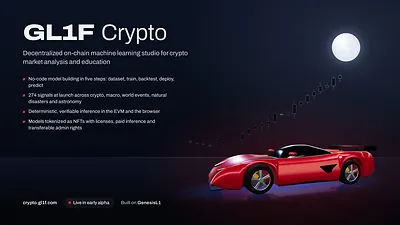
GL1F Crypto puts a full-scale AI quant lab in any web browser, on desktop or phone, with no code and nothing to install. The pitch: build models in five guided steps — dataset, train, backtest, deploy and predict — draw on a signal library that launches with 274 signals, and deploy each finished model as a Model NFT with inference verified on-chain. The studio is live today in early alpha at crypto.gl1f.com.
What it actually does
The studio runs on GL1F, GenesisL1’s decentralized AI protocol, and the software is open source, with protocol details published in the GL1F whitepaper. The signal library spans crypto markets, traditional markets, world events, natural disasters and astronomy, and each signal carries years of history built only from data available at the time — the point-in-time discipline that separates a real backtest from a lookahead fantasy. That detail matters: a no-code quant tool is only as honest as its backtests.
“Machine learning just left the hedge fund,” said founder Mikhail Fedorov in the launch release. “GL1F Crypto is the world’s first data science and machine learning educational dApp. It gives anyone the lab to search for an edge and the discipline to test whether it holds up.” The company’s framing is deliberately educational: a lab to learn quantitative methods on real signals, not a promise of returns.
Models become NFTs — with verifiable receipts
The twist isn’t the no-code builder; it’s what happens at the end. Each deployed model becomes a Model NFT stored on-chain. Inference runs inside the EVM and in the browser with bit-for-bit identical outputs, and every run ships a verifiable receipt. Creators set their own licenses and monetize through inference plans, per-call fees, or by selling the Model NFT itself — which transfers admin rights to the buyer.
That verifiable-inference claim is doing the heavy lifting in the announcement. On-chain execution means anyone can check that a model’s outputs match its advertised behavior: reproducibility as a feature, not a footnote. Whether quant-model marketplaces need on-chain verification, rather than a good audit trail, is the open question — but it’s a genuinely different answer to the old “trust me, my backtest is real” problem.
The economics — and the fine print
The suite is fueled by L1, the native coin of GenesisL1: deployments, storage and transactions are paid in L1, and model creation and storage fees are burned. Standard protocol-token mechanics — fees as the sink, usage as the demand.
The release also carries the disclaimers that count. GL1F Crypto is experimental software for education and research, not investment, financial or trading advice. And L1 is described as the native protocol resource for fees, execution, staking, governance and settlement — not equity, not a revenue claim, not a promise of return. Worth remembering before anyone mistakes a Model NFT for a fund.
Why this launch is worth watching — and what to verify
Two things make GL1F Crypto more interesting than the average launch-day PR. First, point-in-time data discipline is the single hardest thing to get right in a retail quant product — the announcement explicitly says signals are built only from data available at the time, which is exactly the promise you’d want audited before trusting any backtest it produces. Second, verifiable inference receipts attack a real problem: in a world of AI-generated everything, proving a model actually produced a given output is becoming as valuable as the output itself.
The caveats are equally real. This is early alpha: the on-chain inference claims, the 274-signal library, and the EVM/browser parity are all stated in the company’s own release, and none is independently verifiable from the announcement alone. The open-source code and the whitepaper are where those claims can be checked — that’s the next story to write, not this one. And the “world’s first” framing is marketing until someone audits it.
For now, the launch is a data point in a real trend: machine learning tooling keeps sliding down the skill ladder, from PhD labs to hedge funds to — if GenesisL1’s bet pays off — anyone with a browser. The Morningstar republication of the release is here; the code and whitepaper are the places to kick the tires.
GenesisL1 itself, per the release, is a live, public, permissionless EVM-compatible Layer 1 for scientific data, deterministic models, programmable rights, autonomous software and community governance. Decentralized Science Labs LLC and Bioinformatics LLC contribute research and software but do not own or control the network. The bet, in one sentence: that no-code quant workflows plus verifiable on-chain inference are enough to pull machine learning out of the hedge fund and into the browser. Early alpha starts today.