Globant launches Glob.AI OS: an operating system for enterprise AI, routing work to 320+ models
Globant expanded its Glob.AI platform on October 27, 2026, with Glob.AI OS, a unified governance layer that routes each task to the most cost-efficient of 320+ AI models from 25+ providers, with budgets, audit trails and human-supervised AI Pods — and charges for outcomes, not hours or seats.
- Who: Globant (NYSE: GLOB), a global AI-native services company present in more than 30 countries.
- What: Glob.AI OS, a unified layer to govern and adopt AI across the enterprise, expanding the Glob.AI platform.
- When: announced October 27, 2026, from New York via PR Newswire.
- Scale: the Intelligence Hub connects 320+ open-source and closed models from 25+ providers.
- Controls: the Token Vault adds budgets, cost attribution, an auditable record of AI activity and real-time visibility.
- Pricing: enterprises pay for outcomes or consumption, not hours or seats; cited gains include up to 7× faster legacy modernization and 3× faster product discovery.

Globant expanded its Glob.AI platform on October 27, 2026, with Glob.AI OS, a unified layer meant to govern and scale AI across the enterprise. The pitch is aimed at a familiar problem: most large companies already use AI in many places at once — several models, teams building their own agents, tools plugged into sensitive data, and spending spread across vendors. Globant argues the bottleneck is no longer capability, but turning that scattered access into production outcomes with governance, accountability and security.
Glob.AI OS is the governed foundation underneath every AI call, in Globant's framing: it supports identity, agent lifecycle management, cost visibility and auditability. The company positions it as the complement to its AI Pods, the human-supervised delivery units that do the actual work, and says the two pillars together move enterprises from experimentation to production-ready outcomes.
Four hubs under one roof#
The system is built from four components. The Intelligence Hub connects more than 320 open-source and closed models from over 25 providers and routes each task to the most cost-efficient option, optimizing token consumption across AI Pods and everyday work. The Corporate Hub connects AI to the company's data, systems, identity and industry knowledge, so context does not have to be rebuilt every time something new starts. The Agentic Hub refines and tests agentic solutions before deployment and orchestrates their execution with runtime governance. And the Token Vault governs who uses AI, what they can do and how it operates, with budgets, cost attribution, an auditable record of AI activity and real-time visibility into where the investment lands.
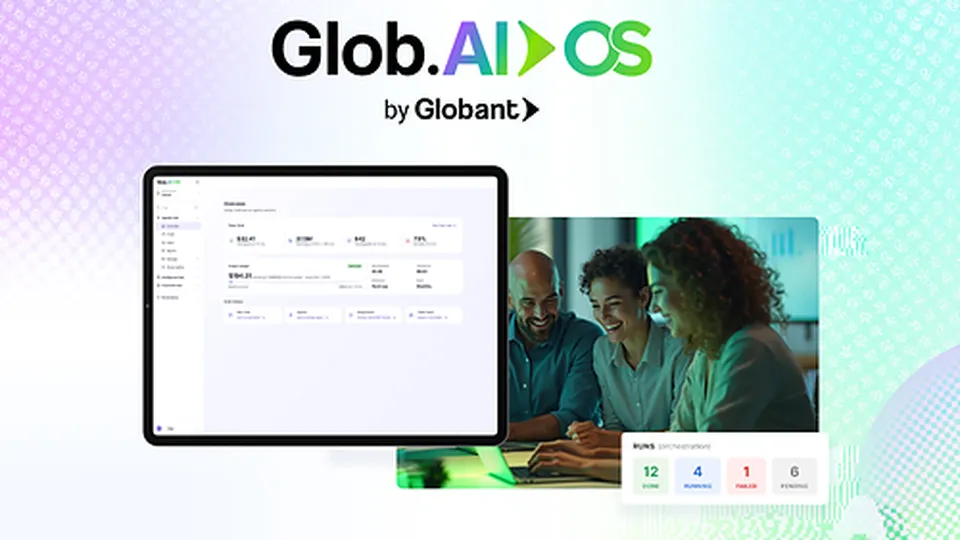
On top of that sits Glob.AI Apps, which brings governed AI into everyday work: people get answers, delegate tasks, build software with any coding agent and use specialized agentic solutions from Globant and its partners, while teams scope and run projects with AI Pods from the same place. Glob.AI OS runs as SaaS or in the client's own cloud, and is accessible through chat, web, desktop, command-line interfaces or headlessly via MCP. Client data stays their own, Globant says, and never trains anyone's model.
AI Pods and the outcome-pricing bet#
AI Pods are the other pillar. They are human-supervised delivery units that combine documented workflows, AI agents and expert supervision from Globant, including Forward Deployed Engineers. Agents handle execution-heavy tasks while experts supervise outputs and remain accountable for delivery. Each Pod addresses a specific business challenge, from software development and testing to application modernization and ongoing operations, and runs on Glob.AI OS, so every Pod inherits the same governance, security and institutional knowledge as the rest of the organization's AI.
The commercial bet is as notable as the architecture. Enterprises pay for outcomes or consumption rather than hours or seats, Globant says — a direct challenge to the traditional services model organized around team size and capacity. Globant claims its AI-native services engagements have delivered up to seven times faster legacy modernization and three times faster product discovery. The release publishes no price list, so what an outcome actually costs a given customer remains a sales conversation, not a public fact.

The customer numbers Globant cites#
Globant says AI Pods are already in use by several Fortune 500 organizations across media, entertainment, professional services and finance, and it attaches numbers to four of them. FIFA achieved a 20% increase in throughput efficiency while maintaining or improving quality rates. YPF reduced contract timelines by up to 40%. PharmaMar gained insights 15 times faster in oncology research. And a leading commercial bank, unnamed in the release, completed its COBOL migration in two months, compared with the 14 months projected using a traditional approach. These are company-reported results, not independently verified benchmarks — but they are the evidence Globant is choosing to lead with, and they all point the same way: the selling point is speed on unglamorous enterprise work, not model capability.
What to watch#
The open question is whether a governance layer is enough of a moat. Every major platform vendor is adding its own routing, cost controls and agent governance, and Globant's answer is that its layer comes bundled with people accountable for outcomes — the Pods — rather than as tooling alone. The release directs interested companies to Glob.AI for early access. Watch for named enterprise deployments beyond the four cited customers, and for any public pricing that would let buyers compare an outcome-priced Pod against a traditional engagement.
Frequently asked questions
What is Glob.AI OS?
Glob.AI OS is a unified layer Globant launched on October 27, 2026, to govern and adopt AI across the enterprise, making AI controllable, contextual and scalable. It is the governed foundation underneath every AI call, supporting identity, agent lifecycle management, cost visibility and auditability.
How does Glob.AI OS choose which AI model to use?
Its Intelligence Hub connects more than 320 open-source and closed models from over 25 providers and routes each task to the most cost-efficient option, optimizing token consumption across AI Pods and everyday work.
What are AI Pods, and how does Globant charge for them?
AI Pods are human-supervised delivery units that combine documented workflows, AI agents and expert supervision from Globant, including Forward Deployed Engineers. Enterprises pay for outcomes or consumption rather than hours or seats.