Google launches Guided Learning in Classroom worldwide, pilots it in Search — and turns school AI off by default
Google announced on November 3, 2026 that Guided Learning is now globally available in Google Classroom, with a Search pilot starting in select U.S. schools later this month — and that Gemini, Gemini Notebook, Gemini in Classroom and Google Search will be off for K-12 student accounts until administrators turn them on.
- Who and when: Google announced the changes on November 3, 2026, in posts by Chris Phillips, VP and General Manager, Education, and by Sofie Cornelis and Asha Johnson.
- Classroom: Guided Learning is globally available in Google Classroom starting November 3, 2026, as a teacher-led tool anchored in class material, with real-time insights for teachers.
- Search: Guided Learning capabilities come to Search for student accounts via a pilot in select U.S. schools later in November 2026, expanding to other districts in the coming months.
- Tokyo trial: More than 300 University of Tokyo students, half a day on a statistics lesson: 5.3 percentage-point improvement with standard tools alone, 8.1 points with Guided Learning — 1.5x the gain.
- Ark pilot: A four-week pilot across three UK secondary schools and four subjects shaped the Classroom version, adding educator insights and anchoring to uploaded curriculum.
- Controls: Gemini, Gemini Notebook, Gemini in Classroom and Google Search will be entirely off for K-12 student accounts until school administrators explicitly turn them on; specifics follow in the coming months.
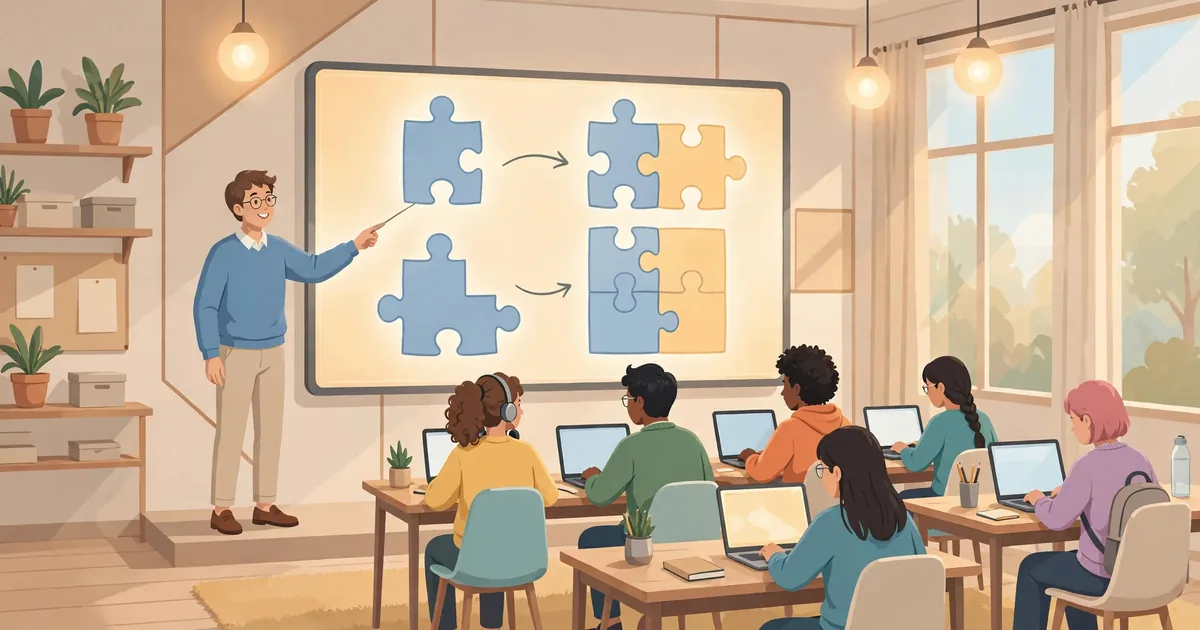
Google announced the changes on November 3, 2026, in a post by Chris Phillips, its vice president and general manager of education, alongside a second post sharing new Guided Learning research. The headline move is the Classroom rollout: starting today, Guided Learning is globally available in Google Classroom. When a student starts an activity their teacher assigned, it works like a one-to-one study tool anchored in class material, and gives the teacher real-time insight into where the class might need extra support.
Guided Learning is the mode inside Gemini that coaches a student through a problem instead of handing over the answer: open-ended questions, step-by-step breakdowns, practice quizzes and visual aids. Google calls the idea “productive struggle” — keeping students actively challenged without letting them get so overwhelmed they give up. The question behind the whole announcement is the one Phillips opens with: when a student uses AI for schoolwork, are they actually learning, or just finding a shortcut?
Classroom first, tested with teachers
Before the global rollout, Google tested the Classroom version with schools. It partnered with Ark, a UK education charity, and ran a four-week pilot across three UK secondary schools, with teachers using Guided Learning in Google Classroom across four subjects. Teachers reported that it handled students’ initial questions during independent work, leaving them more time for targeted one-to-one help. The majority of surveyed students said they felt comfortable asking Gemini for help when stuck, and over half said it helped them solve problems on their own.
Teachers also asked for more. Some wanted clearer visibility into how students were engaging with the course materials; others wanted to keep students focused on specific assignments and cut distractions. Google says it acted on both: the Classroom version now adds insights for educators showing how students interacted with Guided Learning, and stronger anchoring of conversations to uploaded curriculum. Teachers assign the experience, choose how and when it is used, and track progress with what Google calls actionable insights — the control stays with the teacher, not the tool.
Search is next — a pilot, not a launch
The Search move is narrower, and Google is careful to frame it that way. Guided Learning capabilities are being built into Search for student accounts, so that when its systems understand a student is looking for certain types of homework help, Search walks them through the topic step by step. Google’s example: a student pastes a complex physics problem, or asks for help writing a book report, and sees prompts to think critically and work through the concepts, without going directly to the answer.
That starts as a pilot in select U.S. schools later this month, to gather and incorporate educator feedback before expanding to other school districts in the coming months. Google has not named the pilot schools, and has not given a date for wider availability. The distinction matters: Classroom is live worldwide today; Search is an experiment in a handful of schools, with the rollout decision still to come.
The evidence Google is leaning on
Alongside the rollout, Google published two studies. The stronger of the two is a randomized controlled trial with more than 300 students at the University of Tokyo. All students had half a day to study a statistics lesson independently using standard online resources; half also had access to Guided Learning in the Gemini app. Students using only standard tools improved their pre- to post-test scores by 5.3 percentage points. Students with Guided Learning improved by 8.1 percentage points — 1.5 times the gain.
Read that number with its limits attached. It is one half-day session, one subject, and Google’s own study, reported by Google. A 2.8-point difference over a single study session is encouraging, not proof that the effect holds across a school year or every subject. What the trial does show is how students used the tool when left to it: instead of hunting for quick answers, they frequently asked for practice quizzes, step-by-step help and custom visual aids — the behaviours the tool is designed to encourage.
Off by default — and the Search catch
The second half of the announcement is about control. After listening to schools, teachers, researchers and policymakers, Google says it is updating its approach to school controls for Gemini, Gemini Notebook, Gemini in Classroom and Google Search. Access to those products “will be entirely off for K-12 student accounts until school administrators explicitly turn them on.” Google says it will share more specifics with schools in the coming months, ahead of the changes rolling out, so administrators have time to prepare.
That default has a sharp edge that Google’s own post does not spell out. 9to5Google, citing Google’s comments to The New York Times, reports that Search and AI are now so deeply integrated that students in schools with AI features turned off “will not have access to search” at all. The same reporting says two options will be available to schools in early 2027: one with AI Overviews and other AI features turned on, the other with Guided Learning in their place. On that account, schools get a choice between AI flavours — not a choice between AI and no AI with Search intact. Google has not, in the posts published today, confirmed the early-2027 options itself, and the controls change is announced rather than already in force. Administrators should watch for the specifics Google promises in the coming months before treating either version as settled.

Put together, the announcement is two bets at once. The first is pedagogical: that an AI which withholds the answer and coaches instead will produce more learning than one that just answers — and that the Tokyo trial and the Ark pilot are early signs it can. The second is institutional: that giving schools an explicit off switch, and teachers control over how the tool is used, will earn the trust that earlier AI pushes into schools did not. The first bet now has classroom data behind it, however early. The second will be decided by the details Google has yet to publish — and by whether schools read the Search catch as a fair trade or a forced choice.
Frequently asked questions
What did Google announce on November 3, 2026 about Guided Learning?
Guided Learning is globally available in Google Classroom from today, as a teacher-led tool anchored in class material, and Guided Learning capabilities are coming to Google Search for student accounts, starting with a pilot in select U.S. schools later this month.
What evidence does Google cite that Guided Learning helps students learn?
A randomized controlled trial with more than 300 University of Tokyo students studying a statistics lesson for half a day: students with standard online resources improved by 5.3 percentage points, while students who also had Guided Learning improved by 8.1 percentage points — 1.5 times the gain, in a single study session, according to Google.
What changes for K-12 student accounts, and what is the catch around Search access?
Access to Gemini, Gemini Notebook, Gemini in Classroom and Google Search will be entirely off for K-12 student accounts until school administrators explicitly turn them on. 9to5Google, citing Google’s comments to The New York Times, reports that because Search and AI are deeply integrated, students at schools that keep AI features off will not have access to Search at all; Google says it will share more specifics with schools in the coming months.