HiringDesk's Ava: an AI hiring assistant that screens applicants, texts candidates and books interviews
HiringDesk.ai has launched Ava, an AI hiring assistant built for local employers: it reads incoming applicants, scores them 1–10 against a role’s rubric, texts the qualified ones, collects short video intros and books interviews — with plans starting at $199 a month.
- The launch: HiringDesk.ai announced the expanded release of Ava, its AI hiring assistant, on November 7, 2026. The company is based in Royal Oak, Michigan.
- What it does: Ava screens and scores applicants 1–10 against a role-specific rubric, texts qualified candidates, collects short video intros and books interviews with reminders.
- Pricing: Starter $199 a month (2 roles, 300 applicants worked); Core $499 (5 roles, 1,200 applicants); Growth $999 (15 roles, 4,000 applicants). Every plan includes a 14-day free trial and unlimited locations.
- Who it is for: local employers, staffing agencies and service businesses — salons, restaurants, home services, auto dealers, hospitality, and mortgage and lending firms.
- The pitch: founder Chad Buchanan says local businesses have “a follow-up problem,” not a hiring problem — applicants are there, but nobody has time to call them all back.

Small employers lose hires in the gap between “apply” and “interview.” Applications pile up across job boards, inboxes and websites, and by the time someone calls back, the candidate has taken another job. HiringDesk.ai’s answer is Ava, an AI hiring assistant the Royal Oak, Michigan company launched in expanded release on November 7, 2026: it works the applicants the moment they apply, so owners walk into the week with interviews already on the calendar.
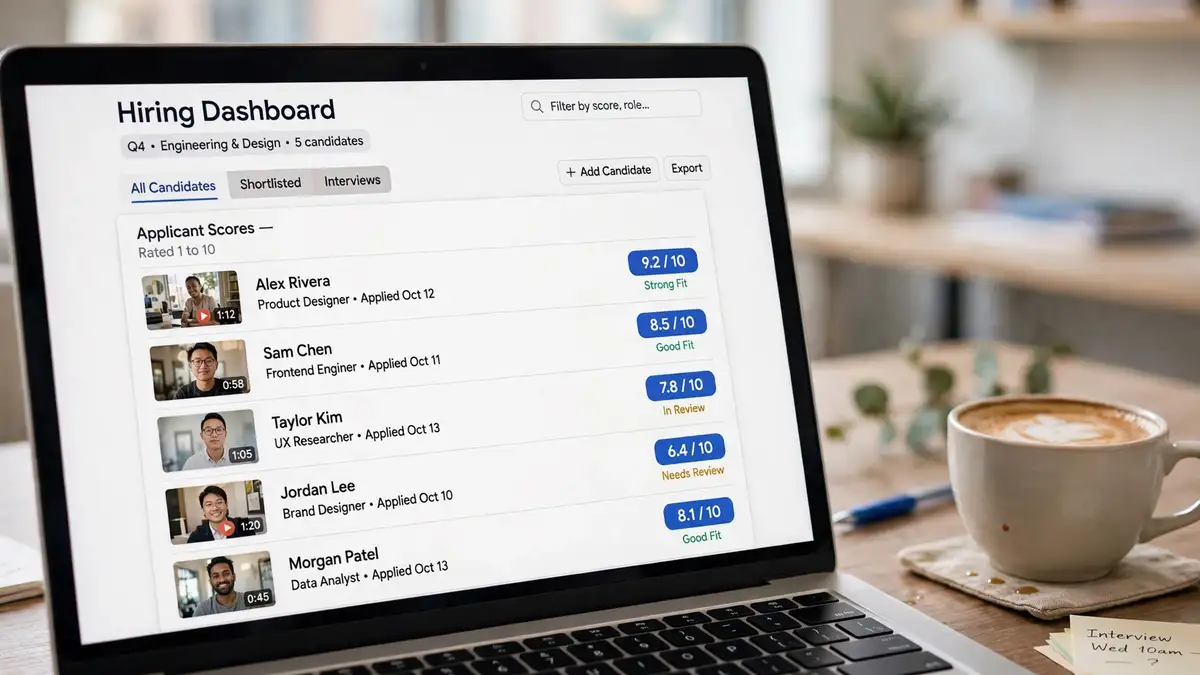
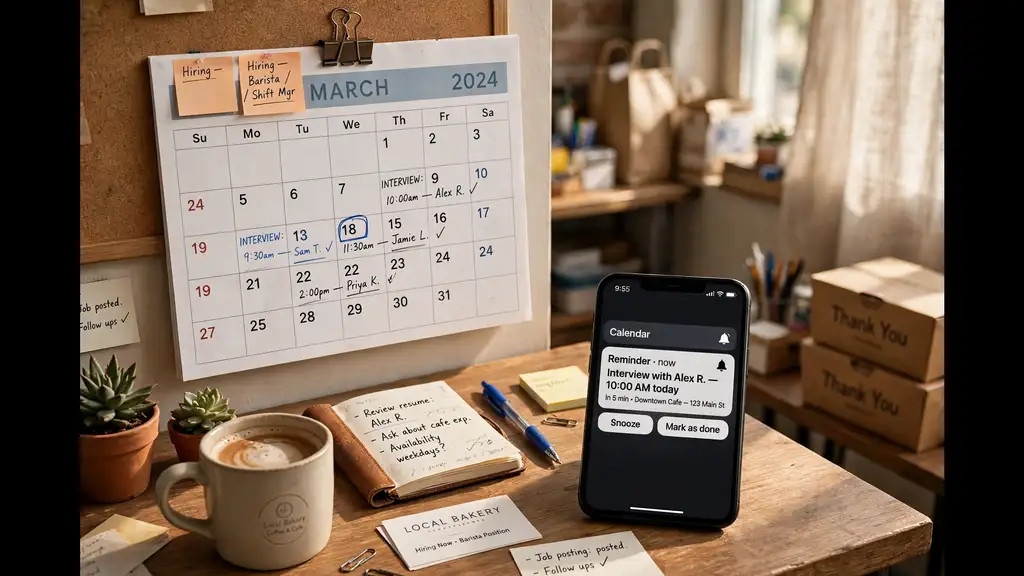
Ava runs the whole path from applicant to booked interview. It reads incoming applications, scores each one 1–10 against the role’s rubric — with reason chips showing why a candidate scored the way they did — then texts the qualified candidates, collects short role-specific video intros, answers next-step questions and books the interview, with reminders to cut no-shows. Scheduling is native: it works even if the business never connects a calendar.
What Ava does#
The flow has three steps. First, applicants arrive from every source at once — website hiring widgets, branded careers pages, application screenshots, email intake, job boards and HiringDesk Boost ad campaigns — and land in a single pipeline. Second, Ava texts and screens: text messaging, explainable AI scoring, video intros and optional AI voice screens move qualified applicants forward automatically. Third, interviews get booked, with automated reminders and rescheduling handled in the same flow.
The voice screening is aimed at roles where how someone sounds matters. For those, Ava asks consistent phone-screen questions and summarizes the factual answers, rather than leaving each hiring manager to improvise a call. And the scoring is deliberately transparent: every 1–10 score comes with reason chips tied to the role-specific rubric, so a manager can see the factors behind a number instead of taking a black-box ranking on trust.
The extras: rehire pool, ads and measurement#
Around the core assistant, HiringDesk bundles three more pieces. A Rehire Pool groups past applicants by person, so an employer can re-engage warm candidates when a matching role reopens instead of starting from zero. Boost runs self-serve Facebook and Instagram hiring campaigns, built and run by the HiringDesk team, with funnel reporting inside each role. And instead of testimonials, the platform reports its own numbers: each role’s dashboard tracks text reply rate, time from application to first interview, interview show rate and source attribution, so employers can see which job boards, ads and careers pages actually produce interviews.
It is a crowded corner of the market. Enterprise hiring agents already exist — Fusemachines’ HireFoundry turned one agent into a full hiring platform in October — and AI resume screeners have been audited for bias and accuracy, which is exactly the kind of scrutiny a scoring system like Ava’s 1–10 rubric invites. What sets Ava apart is the audience: it is built for the local operator, not the enterprise TA team. The ready-made hiring flows cover barbershops and salons, restaurants, mortgage and lending companies, home services businesses, auto dealers, hospitality operators and staffing agencies, and recruiters can manage multiple clients and roles from one desk.
Pricing and availability#
HiringDesk.ai is available now with a 14-day free trial. Pricing is based on applicants worked rather than store count, and every plan includes unlimited locations: Starter is $199 a month for 2 roles and 300 applicants worked, Core is $499 for 5 roles and 1,200 applicants, and Growth is $999 for 15 roles and 4,000 applicants.
“Most local businesses don’t have a hiring problem, they have a follow-up problem,” said Chad Buchanan, founder of HiringDesk.ai. “The applicants are there, but nobody has time to call every one of them back. Ava is built to follow up with applicants as soon as they apply, so owners and managers walk into their week with interviews already on the calendar.”
What to watch#
Two caveats. First, everything here is the company’s own description: the release is an “expanded release,” which means Ava existed in some form before today, and HiringDesk publishes no customer count, no hiring outcomes and no independent test of its scoring — the dashboard metrics are measured inside its own platform. Second, the small-business angle is also the risk: a $199-a-month tool lives or dies on whether local owners actually hand their first impression of a candidate to an AI text thread. Small-business AI agents are multiplying fast; the ones that stick will be the ones whose scores and texts survive contact with real applicants.
Sources: HiringDesk.ai, press release, November 7, 2026; HiringDesk.ai, product site. Cover and inline images: AI-generated editorial illustrations.