IBM and Microsoft launch Imagine Enterprise: 6,000 prebuilt AI agents for regulated industries
IBM and Microsoft launched Imagine Enterprise on November 10, 2026, an agentic platform that pairs more than 6,000 prebuilt IBM agents with Microsoft’s AI, data and security stack — and its first named test case is SEI, a financial firm overseeing roughly $2 trillion in assets. The pitch is aimed squarely at regulated industries: agents that run real business processes, with governance built in from the start.
What we checked: Microsoft’s announcement, published November 10, 2026 at 13:00 UTC, cross-checked against IBM’s newsroom release the same day. No pricing, customer deployment figures or benchmarks were disclosed.
- What: Imagine Enterprise, an agentic platform from IBM and Microsoft for building, running and governing AI agents on industry-specific processes.
- When: announced November 10, 2026, by IBM and Microsoft.
- Scale: more than 6,000 prebuilt AI agents and assets from IBM Consulting, built on IBM Consulting Advantage.
- Industries first: financial services, insurance and retail; manufacturing, energy, public sector and mobility are slated as follow-ons.
- Governance: controls, observability and AI-compliance support, aimed especially at regulated industries.
- How to get it: engage IBM Consulting to deploy and operate it, or co-innovate on enterprise-scale implementations; self-management options also exist. No pricing was disclosed.
- First named customer: SEI, a financial-technology and asset-management firm that manages, advises or administers about $2 trillion in assets (as of September 30, 2026).
SEI oversees roughly $2 trillion in assets. Its chief AI strategist, Sneha Shah, describes the firm’s approach in plain terms: apply AI “with intention in ways that strengthen trust, enhance human decision-making and create meaningful value.” On Tuesday, SEI became the public face of IBM and Microsoft’s answer to the question every regulated enterprise is now asking: how do you put AI agents to work on real business processes — the kind with auditors, regulators and client money attached — without losing control of them?
The answer, announced November 10, is a joint platform called Imagine Enterprise. It is not a model launch. It is a services-led bundle: IBM’s agents and consulting muscle, wrapped around Microsoft’s AI and cloud stack, sold as a way to go from AI experiments to agents running inside the business.
What IBM and Microsoft actually announced#
Imagine Enterprise is designed to help organisations build, run and govern AI agents that execute industry-specific processes — not generic chatbots, but agents wired into a company’s data and daily workflows. The announcement frames it around three advantages: start with prebuilt agents instead of building from scratch, fit the platform to the enterprise you already have, and put the business’s own knowledge behind both people and agents.
| Who | Brings | The tech underneath |
|---|---|---|
| IBM Consulting | More than 6,000 prebuilt AI agents and assets, plus industry expertise | IBM Consulting Advantage: Process Studio, Context Studio and Advantage Core |
| Microsoft | The AI, data, cloud and security foundation | Microsoft Foundry, GitHub Copilot, Microsoft Copilot Studio; Fabric, Microsoft 365, Entra, Purview, Defender and Azure |
| Both | Forward-deployed engineers for qualifying engagements | Help moving customers from experimentation to production |
The split of labour is the story in miniature. IBM brings the headcount and the prebuilt pieces — 6,000 agents and assets is a consulting inventory, not a model catalogue — while Microsoft brings the platform the agents run on: Foundry and Copilot Studio to coordinate them, Fabric for data, Entra and Purview for identity and governance, Defender and Azure underneath. IBM’s own tooling, Process Studio, Context Studio and Advantage Core, is the layer that shapes those agents to a specific client’s processes.
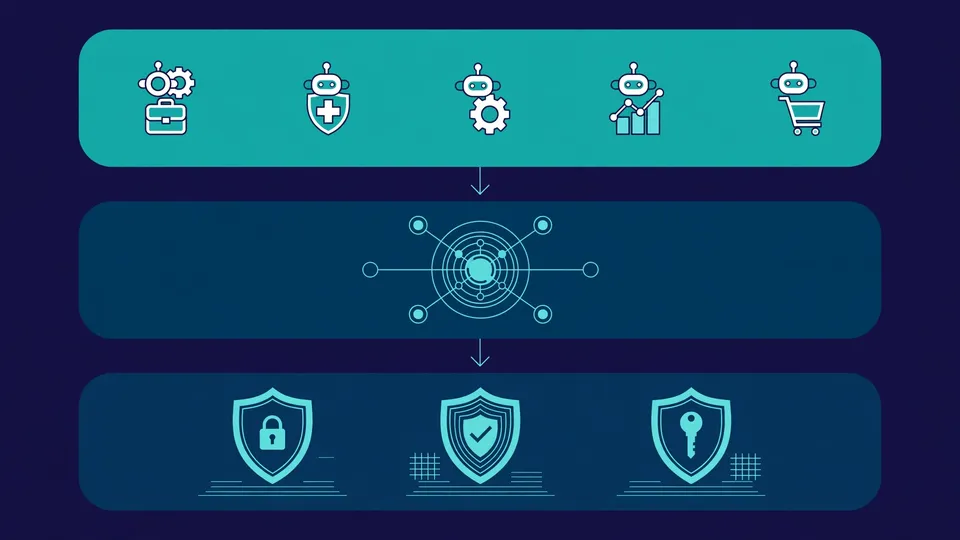
Governance is the explicit selling point, and the announcement says so twice over: the platform is built to help organisations govern agents with controls, observability and AI-compliance support, and it is aimed “especially in regulated industries.” That is the pitch to a bank or insurer that already has a model-risk committee: the agents arrive with the audit trail attached.
Why it matters#
The enterprise agent race has spent the year moving from models to managed stacks. OpenAI launched Frontier in September as its bid to run the enterprise agent stack, and Globant followed in October with Glob.AI OS, routing work across 320-plus models. Imagine Enterprise is the incumbent-vendor version of the same bet: instead of a new model, sell the integration, the governance and the people who install it.
That framing fits where the money already is. Enterprise AI spending hit $176.8 billion in 2026, up 5.4x, and agents now generate 80% of model tokens — the spend has already shifted from chat demos to agents doing work. IBM and Microsoft are arguing the next bottleneck is not capability but deployment: getting agents past procurement, security review and compliance into production, in industries where a wrong autonomous action is a regulatory event, not a bug report.

SEI is the proof point on offer — and it is carefully worded. The firm is “looking to advance its enterprise transformation by exploring emerging and agentic technologies” with IBM Consulting and Microsoft support, not announcing a deployment. Shah’s quote keeps the same cautious register: the work is about exploring “how emerging capabilities could support critical processes and be responsibly scaled over time.” A $2 trillion asset overseer lending its name to an exploration is still a signal, but it is a signal about intent, not results.
IBM’s own language gives away the target. “Clients are no longer looking for AI that simply helps people do the same work a little faster. They want to build an agentic business,” said Mohamad Ali, senior vice president and head of IBM Consulting. Microsoft’s Rodrigo Kede Lima, president of Microsoft Frontier Company, put the same idea in plainer commercial terms: “Enterprise AI will be won by organizations that can turn their data, industry expertise and AI into action.”
What’s next — and what’s missing#
The first frameworks cover financial services, insurance and retail, with manufacturing, energy, public sector and mobility named as the repeatable blueprint’s next stops. Availability is engagement-led: clients work with IBM Consulting to deploy and operate the platform or co-innovate on enterprise-scale implementations, with self-management options also available. What the announcement does not contain is a price, a benchmark, or a customer running the platform in production — the three numbers that would let a buyer compare it with anything else.
That is the honest read on day one: Imagine Enterprise is a credible package for a real problem — regulated enterprises need governed agents, and the two vendors best placed to sell governance have now packaged it together — but it is a consulting engagement with a platform attached, not a product you can try this afternoon. The test is the same one facing every enterprise agent stack this year: whether SEI, or the next named customer, moves from exploring to running it on a process that matters, and says so in public.