Kimi Hosted Agents: Moonshot AI turns the agent harness into a managed cloud service
Moonshot AI formally launched Kimi Hosted Agents on November 5, 2026, a managed cloud service that runs AI agents for enterprises and developers without asking them to build or maintain the agent framework underneath. The service packages the “harness” — sessions, tool execution, sandboxes and failure recovery — as a hosted product, built for long-running work and teams of agents.
- Who: Moonshot AI, the Beijing lab behind the Kimi chatbot and the Kimi model family.
- What: Kimi Hosted Agents — a managed cloud service that runs AI agents, packaging the agent harness as a hosted product (Harness as a Service) on the Kimi API Open Platform.
- When: Formally launched November 5, 2026, after a beta listed in September 2026 for domestic enterprise-verified users.
- What it includes: More than 140 skills and more than 30 plugins, plus 12 official agent templates — eight financial templates and four more for game development, player advising, SRE incident response and Discord community operations.
- Pricing: Pay as you go: sandbox runtime at ¥0.072 an hour (about one US cent), model inference at the selected model’s token rates, and plugin charges by call count and unit price.
- Controls: Isolated sandboxes, network-access controls, session interruption and audit export; the optional Kimi Inference Hook inspects task inputs and tool returns before each model call, for enterprise-verified users.
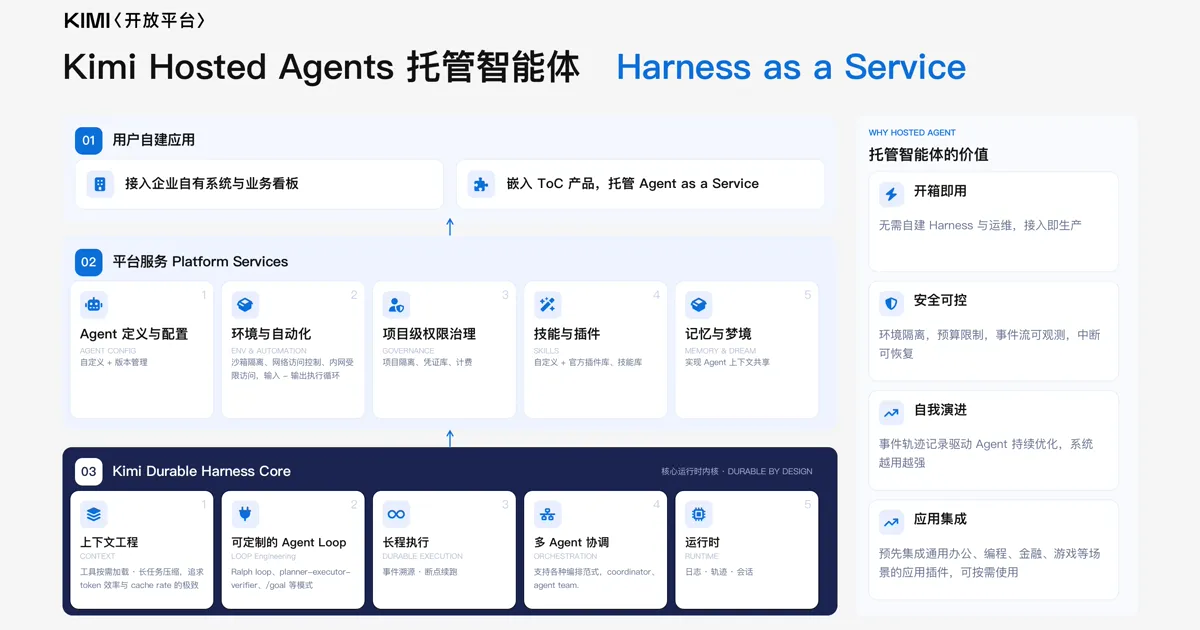
Moonshot AI formally launched Kimi Hosted Agents on November 5, 2026, giving enterprises and developers a managed cloud service for long-running agent tasks and multi-agent collaboration. The pitch is aimed squarely at the unglamorous layer every production agent needs: instead of spending months building a harness — the code-execution environment, session and context management, tool calling, permission controls and failure recovery — teams get it as a hosted service on the Kimi API Open Platform, and Kimi maintains the runtime underneath. Kimi’s own product documentation describes the service the same way: Harness as a Service, with a 24/7 hosted environment for long-horizon and asynchronous work.
The launch follows a beta that opened in September 2026 for domestic enterprise-verified users, so the November announcement formalises a service that had already been running in tested form. Kimi positions it two ways: for internal business use — business monitoring, research analysis and operations response — and embedded in customer-facing products, such as an investment-research assistant inside an app or a strategy adviser inside a game. It arrives in the same week Moonshot released the open weights for Kimi K3.1 Pro, its roughly 3-trillion-parameter flagship: the lab is moving from supplying models to operating the environment those models’ agents run in.
What the harness covers
Hosted Agents is a prebuilt, configurable service running on Kimi’s infrastructure. The platform stores complete session history as events, runs built-in tools in isolated cloud sandboxes, and handles execution retries and scheduling. If the platform fails mid-task, Kimi says it automatically takes over and resumes execution, with behaviour consistent with its pre-interruption state; custom tools continue to run on the customer’s client. Developers work through a web console, a REST API or the kha command-line interface, and the service is stateful: session history, sandbox state and output files persist on the server, the event stream supports resumption with a Last-Event-ID header after a disconnected client reconnects, and delivered files can be listed and downloaded as artifacts.
For multi-agent work, a coordinator agent delegates subtasks to child threads within the same session. A delegation configuration can contain between one and 20 agent entries; synchronous delegation waits for a child thread to report, become idle or terminate, while asynchronous delegation returns as soon as the child starts, with the report delivered later. Child threads cannot create another level of child threads or communicate directly with one another, and each thread keeps separate status, history and event streams, so individual subtasks can be inspected and audited.
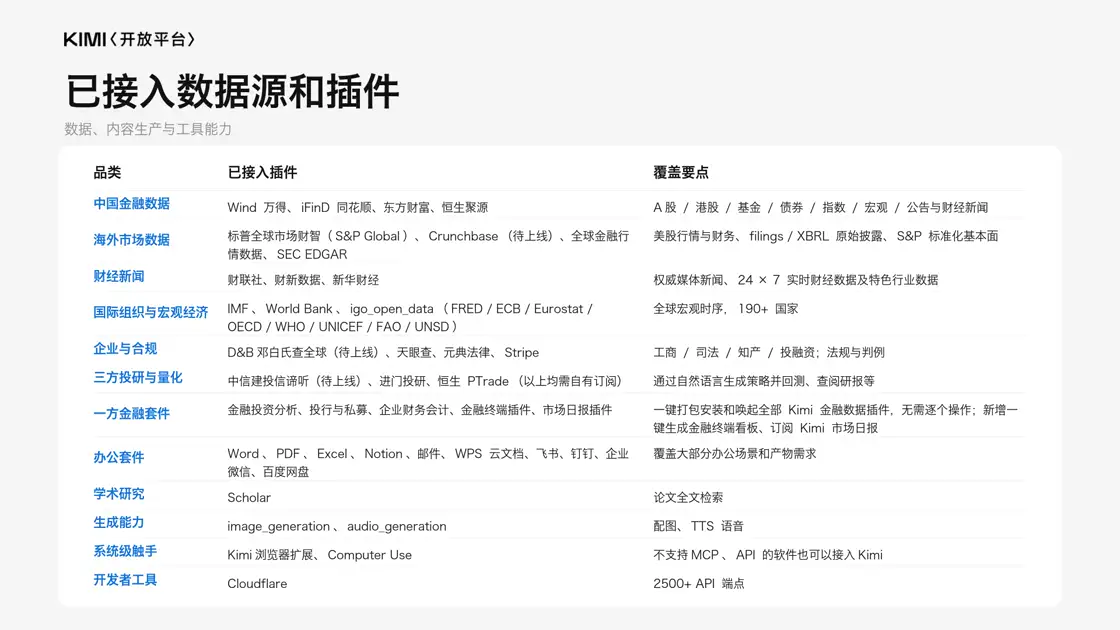
140 skills, 30 plugins, 12 templates
Kimi says Hosted Agents includes more than 140 skills and more than 30 plugins covering web retrieval, professional data queries, office-document processing and content generation, and enterprises can add custom skills, plugins, MCP services and tools to connect their own systems and data sources. The documentation lists 12 official agent templates: eight financial templates — covering work including modelling, deep research, morning reports, IPO tracking and portfolio reviews — plus game-development, player-advisor, SRE incident-response and Discord community-operations examples. Enterprises can copy them into their own projects and connect internal systems and private databases.
The safety hook — and the self-hosting boundary
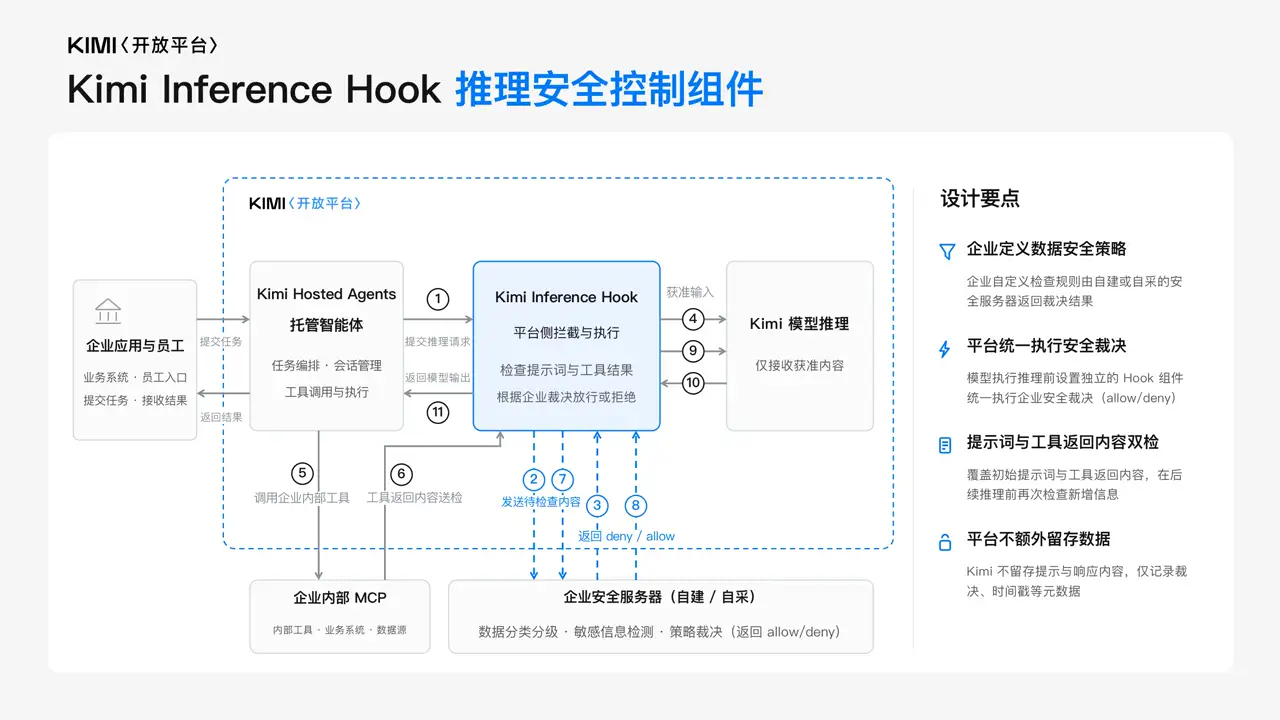
Independent sandboxes, network-access controls, configurable operating boundaries, session interruption, execution records and audit export form the service’s control layer. The Kimi Inference Hook can connect to enterprise-built or purchased security services and inspect task inputs and tool returns before each model inference: the enterprise defines the rules, and the hook allows or rejects the content. Kimi is offering the hook selectively to enterprise-verified users.
There is also a self-hosted environment option, which moves sandbox tool execution to a customer-managed host while Kimi’s platform continues to handle model calls, agent orchestration and session management. Kimi is explicit that this is not equivalent to private deployment, because tool inputs and execution results still pass through the platform’s model-inference interface — and the self-hosted version does not support IPython, image-search tools or save_artifact. Uploaded files, skills and memory are not mounted on the worker host, and platform web search remains platform-executed and chargeable.
Pricing, and the trade-off
Hosted Agents pricing combines three components: sandbox runtime at ¥0.072 per hour, model inference charged at the selected model’s token rates, and plugin charges based on call counts and each plugin’s unit price. Usage reports are designed to show resource consumption and costs by agent project. That makes the central trade-off concrete: Kimi takes on the harness and the managed infrastructure, while custom execution, security policy, data paths and continuing usage charges remain part of the customer’s operating design.
Why it matters
The race has moved from the model to the machinery around it. The same day, Salesforce expanded Agentforce Coworker across Teams, email and mobile, and Moonshot’s own Kimi K3 — a 2.8-trillion-parameter model — was shown running on a single air-cooled server. Hosted Agents is Moonshot’s bid on the other side of that shift: not a bigger model, but the runtime that lets agents run for hours, recover from failures, and be audited afterwards. Whether enterprises buy in depends on the details Kimi has not yet published for general access — which tiers get the Inference Hook, how the self-hosted option is priced, and how the per-call plugin charges add up on long-running tasks. For now, the harness is the product.
Frequently asked questions
What is Kimi Hosted Agents?
Kimi Hosted Agents is a managed cloud service from Moonshot AI, formally launched on November 5, 2026, that runs AI agents for enterprises and developers. It packages the agent harness — sessions, tool execution, sandboxes and failure recovery — as a hosted service on the Kimi API Open Platform, so teams do not have to build or maintain that framework themselves.
How much does Kimi Hosted Agents cost?
Pricing is pay as you go across three components: sandbox runtime at ¥0.072 per hour (about one US cent), model inference charged at the selected model’s token rates, and plugin charges based on call counts and each plugin’s unit price. Usage reports show resource consumption and costs by agent project.
What is the Kimi Inference Hook, and can agents run on my own servers?
The Kimi Inference Hook is an optional safety component that connects an enterprise’s own security service to inspect task inputs and tool returns before each model call; the enterprise defines the rules, and the hook allows or rejects the content. It is offered selectively to enterprise-verified users. A self-hosted environment option moves sandbox tool execution to a customer-managed host, but model calls, orchestration and session management stay with Kimi — and Kimi states this is not equivalent to private deployment, since tool inputs and results still pass through its model-inference interface.