Larridin raises $30M Series A to measure whether enterprise AI spending actually pays off
Larridin raised $30 million in Series A funding on November 2, 2026, led by Pelion Ventures. Its pitch: counting who uses AI tools is no longer enough — enterprises need proof the spend produces work worth the bill.
- Who and when: Larridin, Inc., founded in 2024 in South San Francisco, announced the round on November 2, 2026.
- The round: $30 million Series A led by Pelion Ventures; existing investors Andreessen Horowitz and Gradient Ventures participated, with new investors GFT, W23, Thayer, DG Daiwa Ventures, Alumni Ventures and Cougar Capital. Total funding: $47 million.
- Scale claimed: More than 2 billion AI sessions measured and more than 82,000 workflows tracked end to end, according to Larridin.
- Company-reported outcomes: 47% average increase in measurable team output and a median $2.4 million in AI spend optimized within the first year, across its customer base.
- Q3 2026 report: Drawing on more than 1,000 engineers, AI-assisted pull requests rose from 35% in April to 62% in September, while median waits for an initial human code review rose 50%.
- Use of funds: Accelerate product development and expand teams. No valuation disclosed.

Larridin announced on November 2, 2026 that it has raised $30 million in Series A funding, led by Pelion Ventures, bringing its total funding to $47 million. The South San Francisco company, founded in 2024, sells measurement: a platform that connects what enterprises spend on AI — licences, tokens, cloud-model costs — to the work produced by people and software agents, so leaders can see where the money is paying off and where it is not.
Existing investors Andreessen Horowitz (a16z) and Gradient Ventures joined the round, alongside new investors GFT, W23, Thayer, DG Daiwa Ventures, Alumni Ventures and Cougar Capital. Larridin said the funding will accelerate product development and expand its teams. No valuation was disclosed.
What Larridin measures
Larridin describes itself as an enterprise-wide AI measurement and intelligence platform. It links AI adoption and application data with productivity and spend data, mapping cost to departments and workflows and comparing the work produced against that investment. The point, in the company’s framing, is to move past adoption counts: knowing that engineers opened an AI tool says little about whether the output justified the bill.
That distinction matters because AI spend has moved, in chief executive Russ Fradin’s words, “quickly from innovation budget to financial accountability.” Fradin said investors share the conviction that companies must be able to prove tangible business value from “skyrocketing AI spend.” Larridin reports that across its customer base, measurable team output rose 47% on average and a median $2.4 million of AI spend was optimized within the first year. Both figures are company-reported, drawn from Larridin’s own customer data, and have not been independently verified.

The example that makes the case
Larridin’s announcement leans on two customer examples, reported by the company without naming the customers. At one customer, 92% of engineers were active AI users, yet a single engineer accounted for roughly 65% of the team’s entire AI spend in one week. At another, Larridin found a 66-fold difference in cost per shipped engineering change between two AI tools doing comparable work, uncovering what it called tens of thousands of dollars in reducible spend.
Neither example is independently auditable from the announcement, and the company does not say how typical either case is. Taken as illustrations, though, they show the failure mode Larridin is selling against: a flat adoption rate can hide wildly uneven cost, and two tools that look interchangeable can cost very different amounts per unit of finished work.
More code, slower reviews
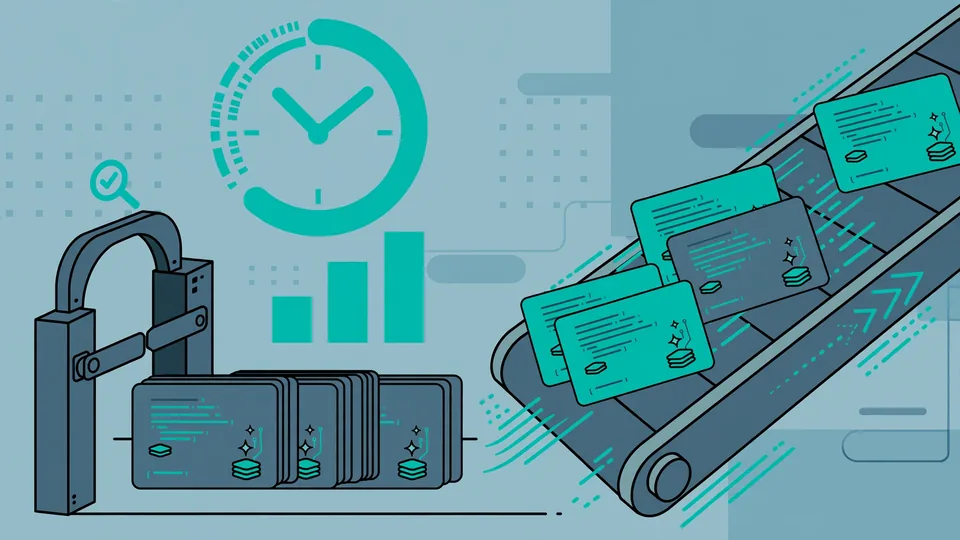
Alongside the funding, Larridin introduced a quarterly Engineering AI Impact Report. The first edition, covering the third quarter of 2026, draws on proprietary data from more than 1,000 engineers across its customer base. Its headline finding is a tension: AI-assisted pull requests rose from 35% of merged pull requests in April to 62% in September, while median wait times for an initial human code review increased by 50% over the same period.
In other words, AI helped engineers produce more code, and human review became the bottleneck. Larridin’s conclusion is that enterprises need to measure cost, quality and efficiency together as AI use scales, not just output volume. The report describes Larridin’s measured cohort; it is not a census of engineering teams generally, and coverage of the announcement notes the same caution.
What the money is for
Larridin names customers including SurveyMonkey, Vertiv, Klaviyo, Gainsight, Globality, TigerConnect, EcoVadis and Sundt, which it says use the platform to measure, manage and optimize AI adoption, productivity and spend across teams. Pelion general partner Jeff Kearl said the platform gives executive teams “real transparency into AI” by tying “every dollar spent directly to measurable business outcomes.” Alex Rampell, general partner at a16z, said Larridin has “truly defined the standard for enterprise AI measurement.”
To date, the company says it has measured more than 2 billion AI sessions and tracked more than 82,000 workflows end to end. The Series A will fund product development and team expansion, building out what Larridin calls the industry’s most complete AI intelligence platform. Whether measurement becomes a durable enterprise category — or a feature that larger observability and finance platforms absorb — is the question the next two years of customer growth will answer. For now, the round is a bet that proving AI’s return is becoming a budget line of its own.
What the announcement does not establish
The release discloses no valuation, no revenue figure, and no customer count. Its headline performance claims — the 47% output increase, the $2.4 million median optimization, the 2 billion sessions — are Larridin’s own measurements of its own customers, reported without a methodology detailed enough for an outsider to reproduce. The Q3 report’s review-delay finding is likewise drawn from Larridin’s customer cohort. None of that makes the claims false; it means they should be read as the company’s case for itself, not as independently audited results.
Frequently asked questions
What does Larridin measure?
Larridin connects AI adoption and application, productivity, and spend data to the work of people and agents across a business, mapping AI cost to departments and workflows and comparing the work produced against that investment.
Who led the $30 million round, and what is Larridin’s total funding?
Pelion Ventures led the Series A. Existing investors Andreessen Horowitz (a16z) and Gradient Ventures participated, alongside new investors GFT, W23, Thayer, DG Daiwa Ventures, Alumni Ventures and Cougar Capital, bringing Larridin’s total funding to $47 million.
Are the 47% output increase and $2.4 million optimization figures independently verified?
No. They are company-reported figures from Larridin’s customer base, published in its funding announcement without an independently audited methodology. The Q3 2026 report behind the review-delay finding draws on more than 1,000 engineers across Larridin’s customers.