Lunit's AI joins Summit's ivonescimab program: SCOPE IO to read tumor microenvironments from routine pathology slides
- Who: Lunit Inc. (KRX: 328130) and Summit Therapeutics Inc. (NASDAQ: SMMT), announcing on October 24, 2026.
- What: a research agreement to evaluate Lunit SCOPE IO, an AI-powered pathology platform, for tumor microenvironment analysis.
- How: SCOPE IO analyzes hematoxylin and eosin (H&E) whole-slide images, aiming for scalable assessment of tumor microenvironment features without additional stains or assays.
- The drug: ivonescimab, a novel, potential first-in-class investigational PD-1 / VEGF bispecific antibody (SMT112 in Summit's territories, AK112 elsewhere), invented by Akeso.
- Scale: 17 Phase III ivonescimab studies announced, ongoing or completed — 5 Summit-sponsored global, 2 cooperative-group, 10 conducted by Akeso in China; 5 have read out, all with positive data.
- Limits: no clinical outcome data are being announced; Lunit SCOPE products are for research use only, and ivonescimab is investigational and not approved in Summit's territories, including the United States and Europe.
Lunit and Summit Therapeutics announced a research agreement on October 24, 2026, to evaluate Lunit's AI-powered pathology platform, SCOPE IO, for tumor microenvironment analysis in support of Summit's immuno-oncology development programs with ivonescimab. The work starts from the most routine material in cancer care — standard hematoxylin and eosin (H&E) stained whole-slide images — and asks whether AI can turn those slides into scalable biomarker insight.
The companies aim to explore how AI-powered pathology analysis can support biomarker discovery, patient stratification or selection, and a deeper biological understanding of response to ivonescimab therapies. “Understanding the tumor microenvironment is increasingly important as immuno-oncology moves beyond single-axis checkpoint inhibition toward more complex mechanisms and combinations,” said Allen Yang, MD, PhD, Chief Research and Development Strategy Officer of Summit. Lunit CEO Brandon Suh said SCOPE IO extracts “quantitative, spatially resolved immune and tumor microenvironment features from standard H&E slides” to help partners understand which patients may benefit from immuno-oncology therapies, and why.
What SCOPE IO reads in a slide
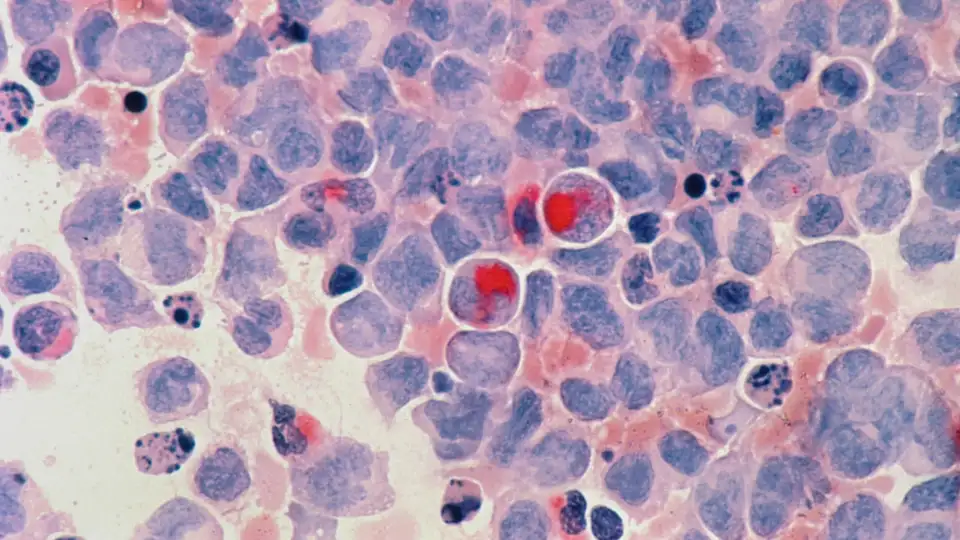
Routine H&E slides contain rich information about tumor architecture, immune infiltration, stromal organization, and spatial interactions within the tumor microenvironment, the companies said. Traditional manual assessment can be difficult to scale and may not fully capture the quantitative and spatial complexity of the tumor-immune interface. AI-powered analysis, in their framing, offers the potential to convert these routinely generated pathology images into reproducible, high-dimensional biomarker data — without requiring additional stains or assays.
Why ivonescimab is the test case
Ivonescimab is a novel, potential first-in-class investigational bispecific antibody combining immunotherapy via blockade of PD-1 with the anti-angiogenesis effects of blocking VEGF in a single molecule. Known as SMT112 in Summit's license territories — North America, South America, Europe, the Middle East, Africa, and Japan — and as AK112 elsewhere, it was invented by Akeso Inc. Its engineered tetravalent structure, four binding sites, is designed for cooperative binding, with multifold higher affinity to PD-1 when in the presence of VEGF; its half-life runs 6 to 7 days after the first dose, rising to approximately 10 days at steady-state dosing, according to Zhong et al., iScience, 2025, as cited in the announcement.
The trial footprint behind the agreement is large: 17 Phase III studies of ivonescimab are announced, ongoing, or completed. Five are Summit-sponsored global studies — in non-small cell lung cancer (HARMONi, HARMONi-3, HARMONi-7), colorectal cancer (HARMONi-GI3), and urothelial carcinoma (HARMONi-GU1) — two are cooperative-group studies in head and neck squamous cell carcinoma (ILLUMINE) and biliary tract cancer (EA2251), and 10 are being or have been conducted in China by Akeso. Five Phase III trials have read out to date, all five with positive data: four in non-small cell lung cancer and one in biliary tract cancer, including a statistically significant overall survival benefit in all four single-region China studies. Akeso notes more than 5,000 patients treated with ivonescimab in clinical studies globally, and more than 100,000 when counting commercial use in China.
What this agreement is — and is not
This is a research agreement, not a readout. The companies expect the work to generate tumor microenvironment insights that may inform future translational research, exploratory biomarker strategies, and clinical development planning — and they state explicitly that no clinical outcome data are being announced as part of the release. Lunit SCOPE products are for research use only, not for use in diagnostic procedures or decisions. And ivonescimab itself remains investigational: it is not approved by any regulatory authority in Summit's license territories, including the United States and Europe, though it was initially approved for marketing authorization in China in May 2024.
The pairing also reflects the companies' scale. Lunit, founded in 2013 and headquartered in Seoul, sells an FDA-cleared breast-health suite and uses its SCOPE platform in research partnerships with global pharma and laboratory leaders; it says it is trusted by more than 10,000 sites in more than 65 countries. Summit, founded in 2003 and headquartered in Miami, is listed on Nasdaq as SMMT. If SCOPE IO delivers on the pitch — reproducible tumor-microenvironment data from slides that already exist — the payoff is not a new drug, but a sharper map of who a drug like ivonescimab is actually helping, and why.
Sources: PR Newswire — Lunit and Summit Therapeutics announce agreement (October 24, 2026); Kalkine — Summit Therapeutics partners with Lunit on ivonescimab pathology study; Morningstar / PR Newswire — Lunit and Summit Therapeutics announce agreement.
Frequently asked questions
What will Lunit SCOPE IO actually do in this agreement?
It will be applied to hematoxylin and eosin (H&E) whole-slide images to characterize tumor microenvironment features, with the aim of supporting biomarker discovery, patient stratification or selection, and a deeper biological understanding of response to ivonescimab therapies — scalably, and without requiring additional stains or assays.
What is ivonescimab, and how far along is it?
Ivonescimab is a novel, potential first-in-class investigational PD-1 / VEGF bispecific antibody, known as SMT112 in Summit's territories and AK112 elsewhere. Seventeen Phase III studies are announced, ongoing, or completed, and five have read out to date, all with positive data — four in non-small cell lung cancer and one in biliary tract cancer. It is investigational and not approved in Summit's territories, including the United States and Europe.
Does this announcement include new clinical results?
No. The companies state explicitly that no clinical outcome data are being announced as part of the release. This is a research agreement whose insights may inform future translational research, exploratory biomarker strategies, and clinical development planning, and Lunit SCOPE products are for research use only.