Meta completes Prometheus phase one: the gigawatt supercluster that trained Muse Wonder
- Who: Meta’s infrastructure team — the post “Inside Prometheus: Meta’s Journey to a Gigawatt-Scale Supercluster” is by Kevin Lee, Yashar Bayani, Ahmed Sharif and Yee Jiun Song, published October 19, 2026.
- What: The first phase of Prometheus, Meta’s gigawatt-scale AI supercluster in New Albany, Ohio, is complete. The company is scaling toward roughly 1 million GPUs functioning in lockstep as a single machine.
- Proof: Phase one trained the Muse family of foundation models, including Muse Wonder — Meta’s new frontier models, launched October 12.
- Catalina: NVIDIA GB200 NVL72 in the “Ariel” two-rack variant: 72 Blackwell GPUs, 13.4 TB of HBM3e (192 GB/GPU), 720 peak PFLOPS of FP8 training compute (1,440 at FP4), 130 TB/s NVLink bandwidth, ~120 kW.
- Clemente: NVIDIA GB300 NVL72: 72 Blackwell Ultra GPUs, 20.7 TB of HBM3e (288 GB/GPU, 1.5x), over 1 exaFLOP of peak FP4 compute, 5–10% faster than the GB200 NVL72, packed into a single rack at ~135 kW.
- Reliability: Over 85% goodput on pre-training and over 90% on reinforcement learning for Muse Wonder; mean time between interruptions ~47,000 GPU hours, now above 54,000 after firmware fixes; interruptions down 99% from the mid-2025 peak.
From web traffic to a single machine
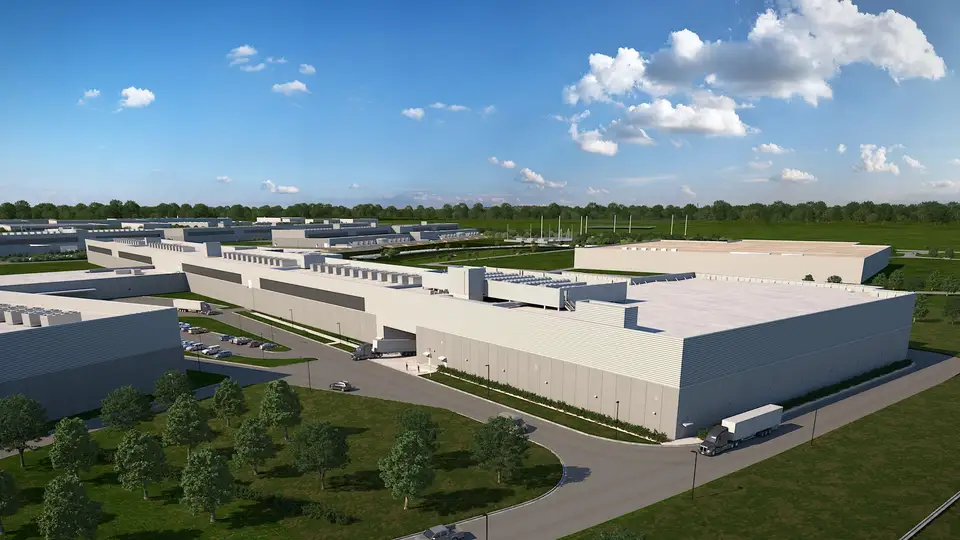
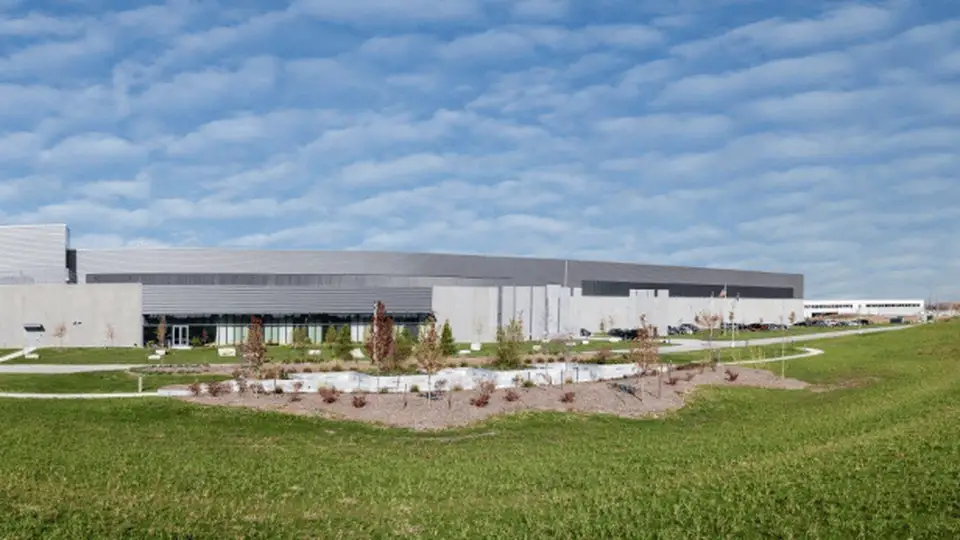
Meta has completed the first phase of Prometheus, its gigawatt-scale AI supercluster in New Albany, Ohio, the company said Monday in an engineering post — the infrastructure that trained the Muse family of foundation models, including Muse Wonder. Two years ago, New Albany was a conventional data center site serving web traffic; Meta says the site has been rebuilt in phases into training infrastructure, with phase one now finished and expansion continuing toward roughly one million GPUs "functioning in lockstep."
Today Prometheus comprises "hundreds of thousands of GPUs" across multiple interconnected buildings — traditional and AI-optimized data center halls plus rapid-deployment structures — held together by millions of miles of fiber strand, tens of thousands of switches and millions of optical parts, per the post. Meta calls the project its most ambitious AI infrastructure undertaking to date.
Catalina and Clemente: the two rack platforms
Two NVIDIA GPU platforms are deployed today, with a third — a platform Meta calls San Miguel, based on NVIDIA's Vera Rubin NVL72 — planned for Prometheus. The first, Catalina, uses the GB200 NVL72 in what Meta calls the "Ariel" variant: a two-rack configuration with 36 GPUs per rack joined over NVLink into a unified 72-GPU domain. The per-domain specs: 72 Blackwell GPUs with 13.4 TB of HBM3e (192 GB per GPU), 720 peak PFLOPS of FP8 training compute (1,440 at FP4), 130 TB/s of NVLink bandwidth, 576 TB/s of aggregate memory bandwidth — at roughly 120 kW across the two-rack pair. Each Blackwell GPU is paired with a Grace CPU and two ConnectX-7 400G NICs for 800G of I/O per GPU, a deliberate choice: Meta says the GB200 scaled up nearly every dimension over the H100 while scale-out bandwidth per GPU would have stayed at 400G, an imbalance it expected to cost performance.
Clemente steps to the GB300 NVL72: 72 Blackwell Ultra GPUs with 20.7 TB of HBM3e — 288 GB per GPU, 1.5x the GB200 — delivering over 1 exaFLOP of peak FP4 compute and a 5–10% performance improvement over the GB200 NVL72. ConnectX-8 SuperNICs deliver 800G per GPU natively, and a 2:1 GPU-to-CPU ratio packs the full 72-GPU domain into a single rack at about 135 kW. Clemente can deploy with Meta's modular air-assisted liquid cooling or with facility liquid cooling in the newly designed data centers.
The network: 20,736 GPUs per building, links spanning 100 km
A training run at this scale needs GPU-to-GPU communication with high bandwidth and tight, lockstep coordination, so Meta runs a second dedicated Ethernet network — the Back-End network — alongside the standard data center network. Each building-level fabric interconnects up to 20,736 GPUs through a high-bandwidth, low-latency multi-layer topology; the Backend Aggregation (BAG) hub-and-spoke network then links building fabrics across distances from 2 km to more than 100 km, built with Arista 7800-series chassis running Broadcom Jericho3 silicon and delivering multiple petabits per second of bandwidth per region pair. Meta says running pre-training across links at that scale required a dedicated optimization effort with Meta Superintelligence Labs — at 100 km, the speed of light itself becomes a design constraint.
The 64-of-72 trick behind 85% goodput
The move from the H100 generation's NVL8 architecture to NVL72 expanded the NVLink scale-up domain from 8 GPUs to 72 — increasing the fault blast radius 9x. Meta's answer: each NVL72 domain runs a 64-GPU slice and holds the remaining eight GPUs as in-rack spares. When a GPU fails, a spare takes its place immediately and the job restarts from its last checkpoint instead of waiting on hardware repair; roughly 2% of racks are held in additional reserve for whole-rack faults. For a 32,768 active-GPU training run, that means provisioning 523 NVL72 racks — 37,656 GPUs, about 13% above the active footprint — most of it geometry from the 64-of-72 slice rather than a reliability tax. The post also describes parallelism-aware fault tolerance, which takes a single faulty data-parallel replica offline while the rest of the cluster keeps training, and distributed delta checkpointing to shrink recovery time.
The headline reliability figures: more than 85% goodput on Muse Wonder pre-training runs, more than 90% on reinforcement-learning runs, with wall-clock mean time between interruptions of about 47,000 GPU hours — now above 54,000 after fleet-wide firmware fixes. Engineer Kevin Lee, one of the post's authors, says interruptions fell 99% from their mid-2025 peak; StorageReview's read of the post puts Meta's stated target at two interruptions per 8,000 GPUs per day — roughly 100,000 GPU hours between interruptions. NVIDIA engineers were embedded on-site at New Albany, the post says, running joint triage sessions on every interruption.
Why phase one matters
Meta ties phase one directly to what's next: Prometheus is being scaled with the next frontier models from Meta Superintelligence Labs in mind. The milestone is less about concrete poured and more about the reliability curve — 85%+ goodput, 54,000+ GPU-hour mean time between interruptions — which is the evidence that a million-GPU machine can actually be trained on, not just built. And the two-generation rack mix shows Meta's refresh cadence in plain sight: GB200 today, GB300 taking over, Vera Rubin next.
Frequently asked questions
What is Meta's Prometheus?
Prometheus is Meta's gigawatt-scale AI supercluster in New Albany, Ohio. Meta announced on October 19, 2026 that its first phase is complete: the site already runs hundreds of thousands of GPUs as a single machine and will scale to roughly one million. Phase one trained the Muse family of foundation models, including Muse Wonder.
What hardware runs inside Prometheus?
Two NVIDIA platforms are deployed: Catalina, based on the GB200 NVL72 in the Ariel two-rack variant (72 Blackwell GPUs, 13.4 TB of HBM3e, 720 peak PFLOPS of FP8 training compute, ~120 kW); and Clemente, based on the GB300 NVL72 (72 Blackwell Ultra GPUs, 20.7 TB of HBM3e, over 1 exaFLOP of FP4 compute, ~135 kW, 5–10% faster than the GB200 NVL72). A third platform, San Miguel, based on NVIDIA's Vera Rubin NVL72, is planned.
How does Meta keep a cluster this size training reliably?
By treating reliability as an engineering discipline: more than 85% goodput on pre-training and more than 90% on reinforcement learning for Muse Wonder; mean time between interruptions of about 47,000 GPU hours, now above 54,000 after firmware fixes; a 64-of-72 sparing scheme in which each NVL72 domain runs 64 GPUs and holds eight in-rack spares, plus roughly 2% spare racks; interruptions down 99% from the mid-2025 peak; and embedded NVIDIA engineers running joint triage on every interruption.