METR: Anthropic's AI progress doubled in a year — and AI did most of the work
Anthropic is now improving its AI models about twice as fast as it did before late 2025 — and most of that speedup likely comes from its own AI doing the research. That is the verdict of METR, the nonprofit AI evaluator, in an independent assessment published November 5, 2026, after eleven weeks inside Anthropic with access to the lab's internal data.
- Who: METR, the nonprofit AI evaluator, assessed Anthropic's AI research and development process.
- What: Anthropic is likely improving its models' capabilities at around twice the rate it did between March 2024 and October 2025.
- When: The assessment was published November 5, 2026, after an 11-week evaluation from August 12 to October 29, 2026, staffed at 2.5 full-time equivalents.
- The number: Benchmark scores (AECI, Anthropic's version of the Epoch Capabilities Index) have grown at an estimated 1.9x the pre-October 2025 rate (95% confidence interval: 1.5–2.8x), rising from 15 to 29 points per year.
- Attribution: METR estimates a majority — perhaps about 80% — of the current acceleration is due to AI, with substantial uncertainty; it is confident the speedup was not caused by faster training-compute scaling.
- The caveat: Anthropic redacted a majority of the evidence METR found most informative, so the public must largely take METR's judgment on trust.

Anthropic is now improving its AI models about twice as fast as it did before late 2025 — and most of that speedup likely comes from its own AI doing the research. That is the verdict of METR, the nonprofit AI evaluator, in an independent assessment published November 5, 2026, after eleven weeks inside Anthropic with access to the lab's internal data.
The question METR set out to answer is the one hanging over the whole field: is AI starting to accelerate its own development? If systems meaningfully speed up further AI research, METR warns, it could lead to a sudden emergence of extreme and risky capabilities. Its answer, in short: the acceleration is real, it is probably mostly AI-driven, and nobody outside Anthropic can fully check the work.
Two years of progress in one
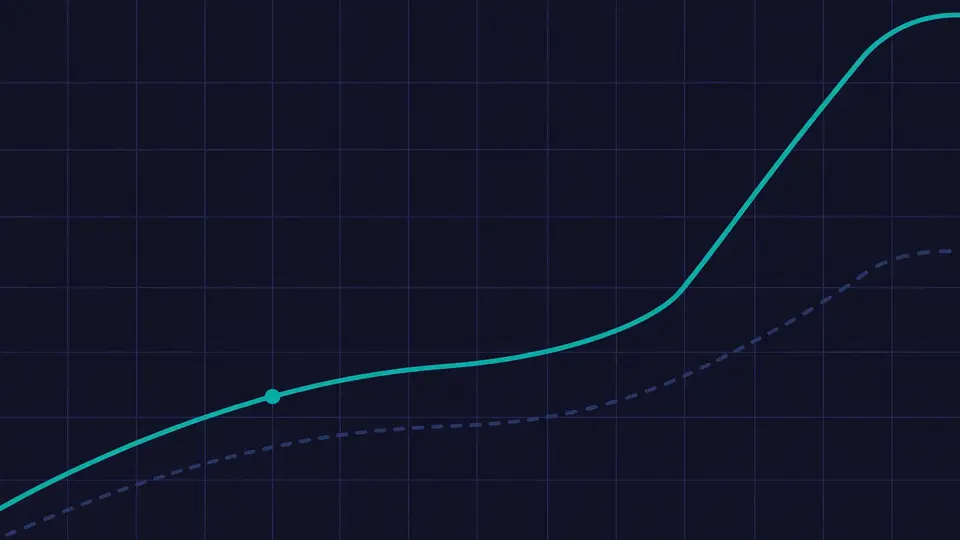
The headline number comes from AECI, Anthropic's version of the Epoch Capabilities Index, which rolls benchmark scores into a single measure of capability. Since October 2025, AECI scores for Anthropic's models have grown at an estimated 1.9 times their pre-October 2025 rate, with a 95% confidence interval of 1.5 to 2.8 times. The trend steepened from about 15 points a year to about 29 points a year — which METR frames as roughly two years of historical progress packed into a single year, about the distance from Claude 2.1 to Claude Sonnet 4.5.
The estimate is higher than the 1.7x figure in the Claude Haiku 5.5 system card, mainly because METR counted three unreleased models trained since July. Its robustness checks, varying benchmark inclusion, model dating, and saturation assumptions, produced acceleration estimates between 1.1x and 2.9x. METR says it would be surprised if the true figure showed no acceleration, or acceleration above 3x.
The newest internal system in the data, called Model 4, scored 178.6 on AECI — 179.7 when three benchmarks METR flagged as potentially saturated are excluded — and scored above 50% on all 15 benchmarks it was tested on. Nine months earlier, the then-frontier Opus 4.6 still scored below 50% on many of them.
AI is doing most of the work — probably
METR's subjective estimate is that a majority of the current acceleration — perhaps about 80% — is due to AI, though it stresses the substantial uncertainty. The estimate rests on interviews with Anthropic researchers, self-reported uplift figures, headcount and experiment data, and qualitative reflections from leadership. Researchers interviewed by both METR and Anthropic gave a wide range of estimates, centered around a doubling. In Anthropic's own Slack polls, staff self-reported speedups from the latest model reaching 12x by October 2026.
One thing METR says it could determine confidently: the acceleration was not caused by an acceleration in the scaling of training compute. The supporting evidence for that conclusion was redacted. METR also notes that researchers told it R&D is being accelerated primarily through AI assistance rather than fully autonomous contributions — but there are signs fully autonomous contributions will play a larger role soon.
No bottlenecks in sight — and that's the worry
METR found no evidence of significant bottlenecks that would prevent further capability progress over the next 12 months — not in algorithmic progress, training compute, experiment compute, or data. It is careful about that finding: its understanding of the different bottlenecks changed several times as it received more detailed information, so it says it is not confident in the assessment.
The implication is the uncomfortable one. Without clear bottlenecks or steep diminishing returns, there is a significant risk that further capability progress leads to even faster acceleration over the coming year — models getting better, then using that improvement to get better faster.

The redactions are the story too
Anthropic had the right to redact any non-public information in the report, and used it. METR says Anthropic "redacted a majority of the evidence we found most informative for these conclusions," describing the redactions as aimed at removing confidential information that could accelerate other AI developers. METR took no payment for the assessment, though it worked on Anthropic devices and used free tokens.
The result, METR says plainly, is that the public has to rely on its judgment much more than would be ideal, given the weight of the questions. The report does not achieve what METR calls "transparency about evidence."
The same tension shows up in METR's companion review of the automated R&D section of Anthropic's August 2026 Risk Report, published alongside the assessment. METR agrees the risk from models as of July 15 was low, but says Anthropic's claim that it had not crossed its "2x Acceleration Threshold" — an early-warning marker in its Responsible Scaling Policy — rests on "contestable judgment calls," that it is plausible the threshold had already been crossed, and that the public report "overall understates the level of acceleration that was occurring."
What happens next
The engagement grew out of an arrangement announced October 15, under which METR researchers were given employee-like access to Anthropic's systems, with the right to publish what they find. This assessment is the first published test of that arrangement — and of how much of it survives Anthropic's redaction rights.
The stakes are not abstract. Anthropic itself lists AI R&D acceleration as a key risk indicator in its Responsible Scaling Policy, and METR's framework treats a doubling of the pace as the point where the field should start worrying about losing control of the trajectory. On METR's numbers, Anthropic is already there — or close enough that the difference is a matter of judgment calls and redacted evidence. The open question now is whether other labs show the same pattern, and whether anyone will get to see the evidence.
METR's full assessment is on its site. Reuters covered the findings, and Unite.AI has a summary of the benchmark evidence.
For context, Anthropic also launched Personal Finance in Claude today, and earlier opened a Cyber Verification Program for vetted defenders and authorized hackers. OpenAI's own safety-model news today — GPT-6 Cyber — shows the other major lab is racing in the same direction.
Frequently asked questions
What did METR find about AI progress at Anthropic?
METR estimates Anthropic is improving its models' capabilities at around twice the rate it did between March 2024 and October 2025. Benchmark scores measured by AECI have grown at an estimated 1.9 times the pre-October 2025 rate (95% confidence interval: 1.5–2.8x), implying roughly two years of historical progress in a single year.
How much of the acceleration is caused by AI itself?
METR's subjective estimate is that a majority — perhaps about 80% — of the current acceleration is due to Anthropic's extensive use of AI to do R&D, though it stresses substantial uncertainty. It is confident the acceleration was not caused by faster scaling of training compute.
Why can the public not check the evidence?
Anthropic had the right to redact any non-public information in the report, and METR says it redacted a majority of the evidence it found most informative. METR took no payment for the assessment, but worked on Anthropic devices and used free tokens, so readers must largely rely on METR's judgment.