Mobilint is building an on-device AI chip platform for humanoid robots — LG will validate it
- Who: Mobilint, a South Korean AI semiconductor company; Park Joo-hyun, head of its research planning division.
- What: an on-device AI computing platform for humanoid robots — a co-designed NPU, compact accelerator module and software stack that runs vision-language (VLM), vision-language-action (VLA), object recognition, navigation, safety assessment, and voice/sensor processing models simultaneously inside the robot.
- When: announced Thursday, October 22, 2026.
- Program: Mobilint is the lead R&D institution for the subproject "Development of On-Device AI Accelerators for Humanoids" under South Korea's Ministry of Trade, Industry and Energy K-On-Device AI Semiconductor Technology Development Program; the Korea Evaluation Institute of Industrial Technology (KEIT) is the managing agency.
- Validation: the platform will be validated in stages against LG Electronics' humanoid operating scenarios — testing control latency with several AIs running, battery power consumption and heat, long-duration operating stability, and module reliability against vibration and shock; functional safety and cybersecurity are built in from the development stage.
- Roadmap: Mobilint plans to extend the technology to service robots, autonomous mobile robots, smart home appliances and AI cameras.
Korean AI semiconductor company Mobilint said on Thursday it is developing an on-device AI computing platform for humanoid robots — a computing stack that runs the many AI models a humanoid needs inside the robot itself and links them directly to physical control. (Seoul Economic Daily)
The bet is that robots cannot wait for the cloud. A humanoid moving through the same spaces as people must judge a situation and act on it within milliseconds, so Mobilint is co-designing its neural processing unit (NPU) and software together to allocate compute efficiently when multiple models run at the same time — and to get an AI judgment to the robot's actuators as fast as possible.
One robot, many models
Mobilint's starting point is that a single AI model is not enough for a machine to perceive, judge and act on its own in shared spaces. Beyond vision-language models (VLM), which interpret visual information and language together to assess situations and tasks, and vision-language-action models (VLA), which translate those judgments into robot movement, a humanoid needs a stack of other AI functions running concurrently: object recognition, navigation, safety assessment, and the processing of voice and various sensor inputs.
The hard part is running all of that at once in a machine with limited battery capacity and physical space. Unlike a data center, a robot must also manage heat and power draw while guaranteeing that critical tasks are handled at the moment they are needed. That is the computing environment Mobilint says it is building: one that reliably handles the required calculations even when different AI models operate simultaneously.
A single stack: NPU, module and software

The platform goes beyond a chip. Mobilint is developing a high-performance, low-power NPU and a compact accelerator module to manage power consumption and heat inside humanoids, alongside a software environment so that AI models run efficiently within the robot. Functional safety and cybersecurity requirements are being incorporated from the development stage, the company said. (BigGo News)
The pitch to robot makers is integration relief: by bundling the NPU, hardware and software into one computing platform, Mobilint wants to reduce the burden of separately connecting and optimizing chips, AI models, hardware and software every time a new AI feature is added to a product.
The LG validation gauntlet
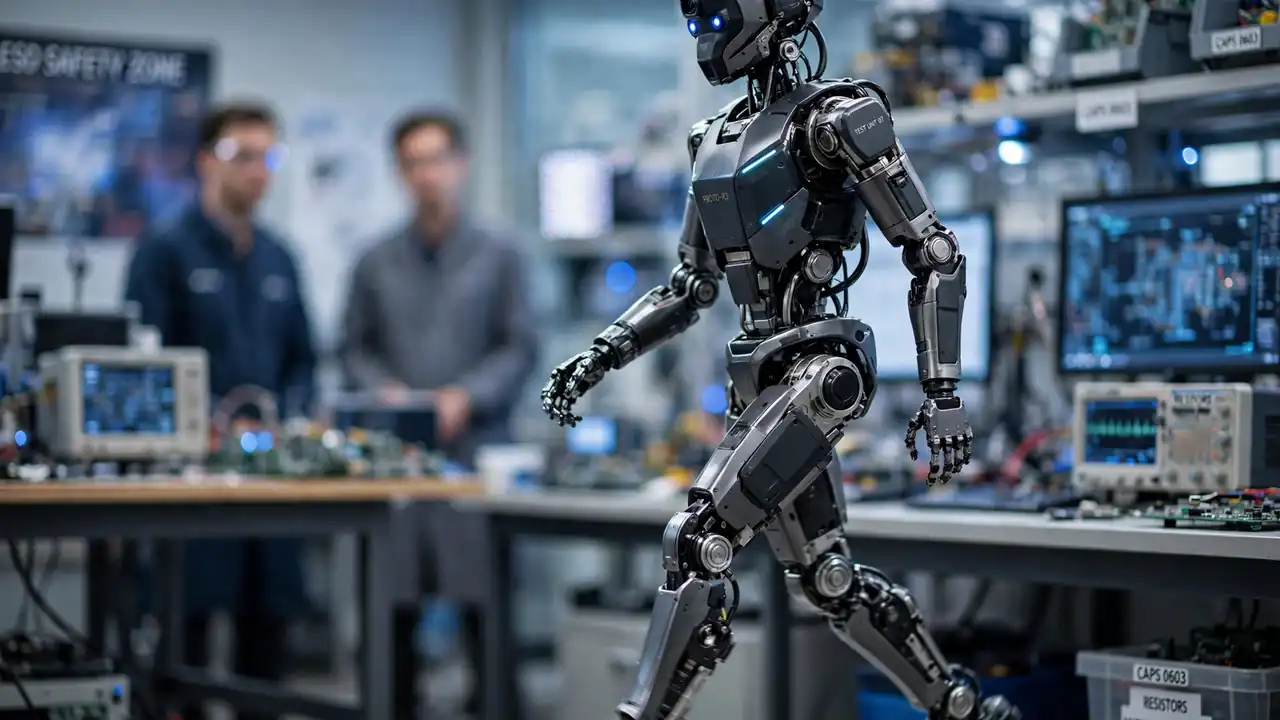
The platform will later be validated in stages against LG Electronics' humanoid operating scenarios and system environment for everyday spaces. The validation items read like a real-world stress test: control latency when multiple AIs run concurrently, power consumption and heat under battery conditions, long-duration operating stability, and module reliability against vibration and shock. Mobilint plans to feed the validation results back into refining the platform.
"In physical AI, what matters is not only the computing performance of an AI model but whether the AI runs reliably inside an actual product and whether its judgments can feed quickly into the movement of the machine," said Park Joo-hyun, head of Mobilint's research planning division. "We will verify real-world applicability in connection with LG Electronics' humanoid environment and build a foundation for expanding into a variety of physical AI products."
Part of a state-backed chip push
The project is part of South Korea's Ministry of Trade, Industry and Energy K-On-Device AI Semiconductor Technology Development Program. The Korea Evaluation Institute of Industrial Technology (KEIT) serves as the managing agency, and Mobilint is the lead research and development institution for the subproject on developing on-device AI accelerators for humanoids.
Mobilint plans to extend the technology secured through the project to a range of physical AI areas beyond humanoids, including service robots, autonomous mobile robots (AMR), smart home appliances and AI cameras. The broader state program already has multiple tracks running: Nota AI is leading the humanoid AI model optimization workstream, compressing vision-language-action models for Mobilint's NPU, and SEMIFIVE signed a turnkey contract with Mobilint to develop an AI chip for robotics applications under the same program.
Frequently asked questions
What exactly is Mobilint developing?
An on-device AI computing platform for humanoid robots: a co-designed neural processing unit (NPU), compact accelerator module and software stack that runs several AI models — vision-language, vision-language-action, object recognition, navigation, safety assessment, and voice and sensor processing — simultaneously inside the robot, linking AI judgments directly to physical control.
What will LG Electronics' validation test?
In staged validation against LG Electronics' humanoid operating scenarios and system environment for everyday spaces, the platform will be tested on control latency while multiple AIs run concurrently, power consumption and heat under battery conditions, long-duration operating stability, and module reliability against vibration and shock. Results will be fed back into refining the platform.
How does this fit into South Korea's chip program?
The project is part of the Ministry of Trade, Industry and Energy's K-On-Device AI Semiconductor Technology Development Program, managed by the Korea Evaluation Institute of Industrial Technology (KEIT), with Mobilint as the lead R&D institution for the subproject on on-device AI accelerators for humanoids. Mobilint plans to extend the technology to service robots, autonomous mobile robots, smart home appliances and AI cameras.