Six pallets of Nvidia AI hardware worth $11.4 million vanish on the road from Oakland to Texas
A truck picked up six pallets of Nvidia AI hardware in Oakland on August 29 and never reached Fort Worth. Two months on, police have no suspects and no recovered cargo — and the heist fits a pattern of AI hardware thefts that keeps getting bolder.
- Cargo: six pallets of Nvidia AI semiconductors and related hardware, valued at $11.4 million (about ₩15.4 billion in Korean reporting).
- Route: Oakland, California to Fort Worth, Texas. Picked up August 29; reported to Oakland police September 13.
- Status: investigation ongoing; no arrests, no named suspects, no recovered cargo, no chip models identified.
- The pattern: burglaries in Fremont and Union City in 2025 topped $7.5 million; in September 2026 thieves stole two Nvidia-branded trailers that turned out to hold 40,000 pounds of sand.
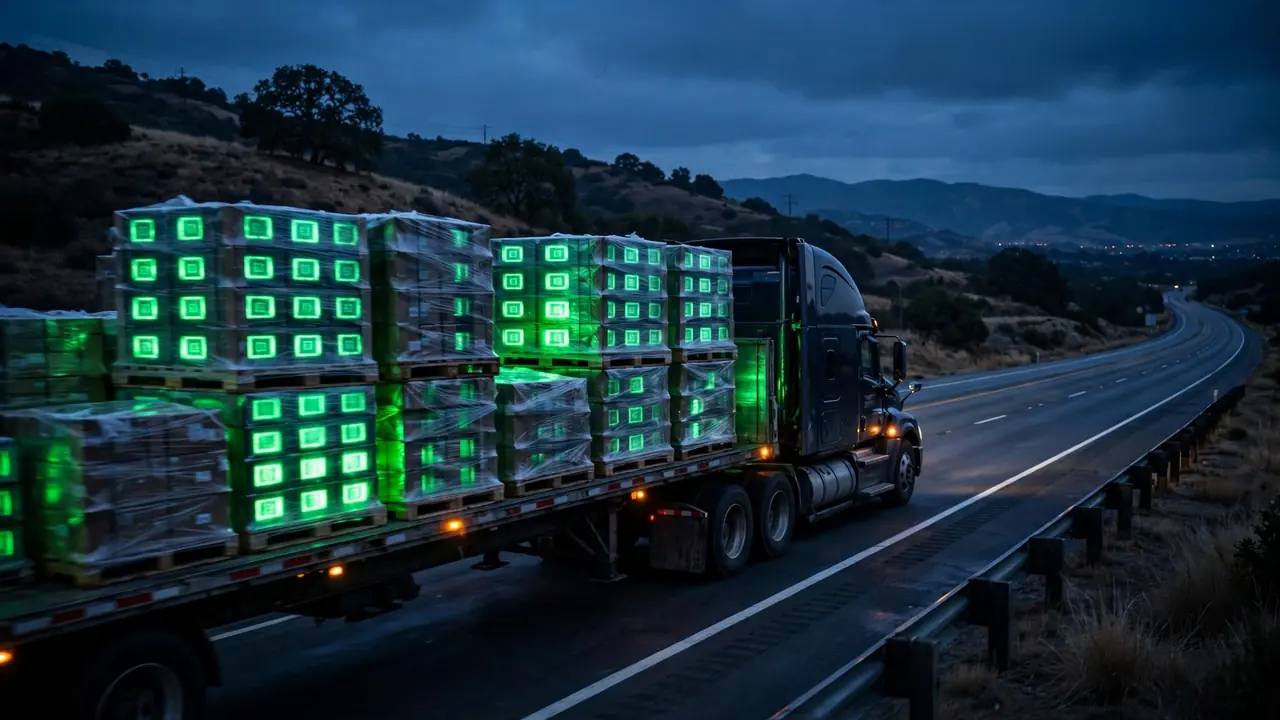
A truck left Oakland, California, on August 29 carrying six pallets of Nvidia hardware worth $11.4 million, bound for Fort Worth, Texas. It never arrived. More than two months later, Oakland police say they have no suspects, no recovered cargo, and no public answer to the simplest question in the case: what exactly was on those pallets.
The story surfaced this week as Bay Area News Group reporting, picked up by ABC7 News, spread across the tech press — and as a thread on r/LocalLLaMA, where readers did the grim arithmetic first: at that value, the cargo was almost certainly datacenter-class AI accelerators, not gaming cards.
The pickup that went as planned#
The pickup itself raised no alarm. A truck bearing the logo of a food-transport company collected the load as scheduled from a logistics facility in East Oakland, and nothing about it looked like it was carrying expensive electronics. Then the driver stopped answering dispatch as the truck headed south.
Investigators reconstructed the truck's movements and found it had made several stops along the way, each lasting multiple hours, before the trail went cold in San Bernardino County. The vehicle has not been located since.
The gap before anyone raised the alarm did not help. The buyers only confirmed the cargo was missing in early September, and Oakland police say the crime was reported to them on September 13 — fifteen days after pickup, a head start that gave whoever took the load ample time to move it. Police are reportedly weighing whether a professional theft ring was behind the job, and some of the suspects' vehicles are believed to have been obtained in Southern California, with the group travelling to the Bay Area to carry it out.
Why AI chips are worth stealing#
The motive is straightforward: scarcity plus resale value. Olaf Groth, a professor at UC Berkeley's Haas School of Business, told ABC7 that these chips can go for about double their US price abroad, giving the example of a chip costing around $550,000 selling for $1 million or more overseas. He described the chips as a national security asset that needs much tighter protection, and said nobody knows where stolen units end up, with China among the possibilities.
US export controls add to the premium. With Washington restricting sales of high-end AI hardware to China, accelerators that cannot be bought legally in some markets can be sold there at a steep markup — which is why experts quoted in the coverage frame these heists as a national-security problem, not just a logistics one.
The cargo is also, in practical terms, usable once stolen. Unlike a phone, there is no remote kill switch for a pallet of accelerators — a point readers on the r/LocalLLaMA thread made repeatedly. Serial numbers can be tracked if the hardware ever surfaces for registration or resale, as happened in an earlier Brazil case commenters recalled, but until then the load is simply gone.
Not an isolated job#
The Oakland heist is the largest in a run of California thefts targeting Nvidia hardware, and the crews behind them are getting more professional about it:
- 2025, Fremont and Union City: burglaries involving Nvidia cargo valued at more than $7.5 million.
- September 2026, Newark: thieves took two semi-trailers bearing Nvidia and PlusAI branding from a warehouse. They apparently expected AI chips; the trailers held 40,000 pounds of sand, used as a simulated load for PlusAI's autonomous-truck testing.
- August 2026: Wired reported on two California thefts in which staged collisions were used to disable the security vehicles escorting AI equipment from Silicon Valley to Southern California. Both trucks disappeared after their escorts were forced off the road.
- Federal case, last year: six Southern California men were charged over a string of thefts prosecutors say netted as much as $22 million in merchandise over five years, including $7 million of Nvidia chips from a Burlingame warehouse in December 2024.
The methods are consistent across the cases. Thieves have reportedly exploited trucking companies' business accounts and registration numbers to pose as legitimate carriers, sometimes disabling or spoofing GPS trackers along the way. Reported cargo thefts are said to have fallen 26% year on year last quarter — but the value of what was stolen more than doubled, which is what happens when the cargo is AI hardware.
What we still don't know#
One caution about this story: almost every detail in the coverage traces back to a single Bay Area News Group report, re-reported by a dozen outlets. Repetition is not corroboration. Police have not named the products, the shipper, the carrier, or a suspect, and no source has linked this load to any destination country — including China, despite the speculation that export controls invite.
What to watch: any arrest or recovery announcement from Oakland police; whether the investigation names the hardware, which would tell the industry exactly what is now worth stealing by the truckload; and whether shippers start treating AI accelerators like the high-value, high-risk cargo they have evidently become. The $11.4 million question is not just where six pallets went — it is how many more loads are on the road right now with the same thin protection.
Sources: eTeknix's November 6, 2026 report, here; OC3D's November 6, 2026 report, here; BigGo Finance's November 6, 2026 report, here; Hackster's report, here; the r/LocalLLaMA thread that surfaced the story, here. Cover and inline images are AI-generated editorial illustrations.