NVIDIA releases Nemotron 3.5 Transcribe: one open-weight model for 40-language transcription, translation, and speaker labels
NVIDIA released Nemotron 3.5 Transcribe on October 28, 2026, an open-weight, promptable speech model that transcribes 40 languages, translates 31 to or from English, and labels up to eight speakers — alongside Granary v2, an open speech-data pipeline covering 463,062 hours across 48 languages.
- Who: NVIDIA, via its Nemotron speech models.
- What: Nemotron 3.5 Transcribe, an open-weight, promptable speech model, plus Granary v2, its open data-curation pipeline.
- When: Released October 28, 2026, available on Hugging Face and ModelScope.
- Languages: Transcribes 40 languages, translates 31 to or from English, attributes speakers in 13 languages; recordings up to an hour, up to eight speakers.
- Size: 30 billion parameters total, about 4 billion active per token; runs on a single GPU from Jetson AGX Thor and DGX Spark to Blackwell chips.
- Benchmarks (vendor-reported): First among open-weight models on Hugging Face Open ASR English at 5.33% average word error rate; 2.8% AA-WER on Artificial Analysis; lowest diarization error rate, 18.26% across 21 languages, on David AI.
- Data: Granary v2’s public manifest covers 463,062 hours across 48 languages and 16 source corpora, up from 25 languages in v1.
What launched#
NVIDIA released Nemotron 3.5 Transcribe on October 28, 2026, an open-weight speech model that turns recorded audio into useful text — and, in the same release, Granary v2, the open data-curation pipeline behind it. Transcribe is a single promptable checkpoint that handles transcription, speaker attribution, translation, and audio question answering, rather than chaining separate models for each job. It is available now on Hugging Face and ModelScope, with hosted endpoints from Baseten, DeepInfra, and Simplismart.
The headline numbers, all from NVIDIA’s release: the model transcribes 40 languages, translates 31 of them to or from English, and attributes speakers in 13 languages. It handles recordings up to an hour long, labels up to eight speakers, and supports word-level timestamps, so a transcript can show not just what was said, but who said it and when.
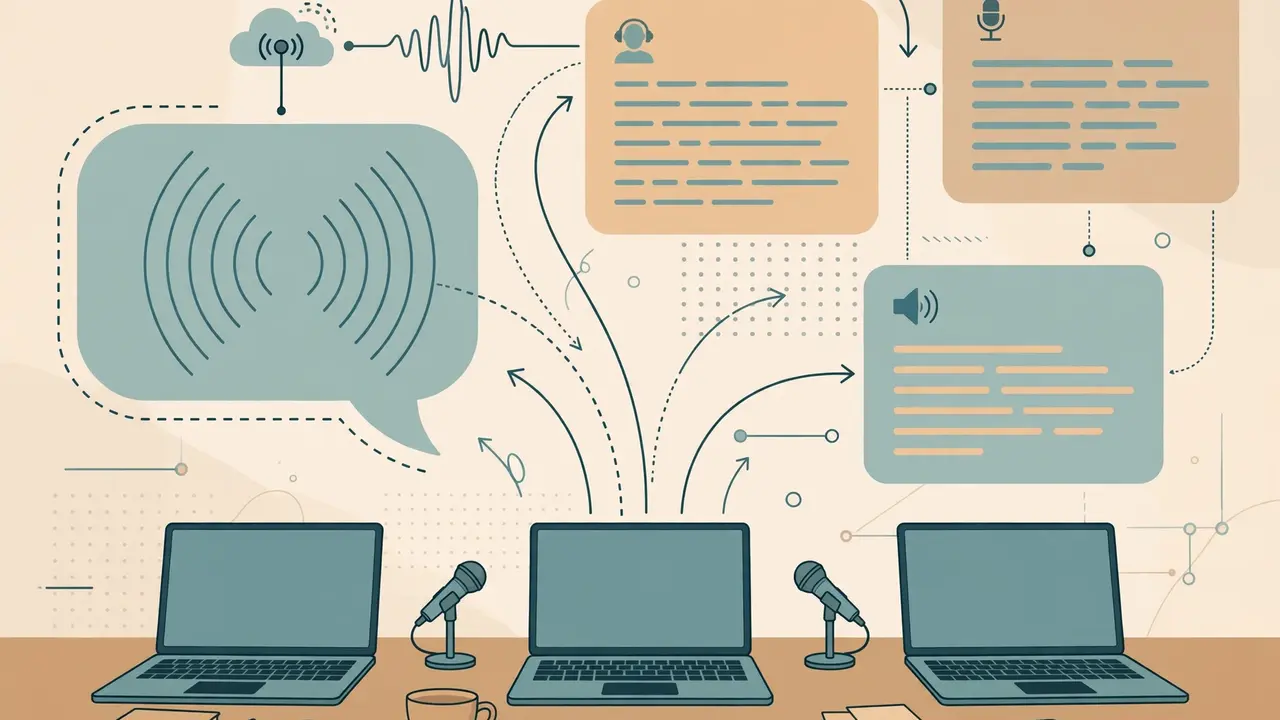
One model, four jobs — steered by prompts#
The practical pitch is prompt control. The same recording can be turned into different outputs depending on the instruction: “Transcribe this recording and label each speaker,” “Translate this audio into English,” or “What decisions were made in this meeting?” Prompts can also carry domain vocabulary and formatting rules — product terms, medical spellings, number formats — which matters most in exactly the fields NVIDIA is targeting: meetings, healthcare, financial services, and customer service.
That prompt layer is also where adaptation starts before any training. NVIDIA says naming the language and script in the prompt can cut error rates sharply on a development set, and its NeMo Speech fine-tuning workflow is there for the errors that remain. In a medical case study on recordings from Indian doctors and medical students, fine-tuning cut word error rate on held-out speakers by 45.8% relative to the best prompt alone. NVIDIA itself adds the usual caution: spot-check names, speaker changes, and answers against the recording.
The benchmark claims — and their limits#
On Hugging Face’s Open ASR Leaderboard, Transcribe ranks first among open-weight models for English, at 5.33% average word error rate, with 4.62% mean word error rate across seven languages in the multilingual track and 10.98% in the long-form track — the lowest among evaluated open-weight models in each case, according to NVIDIA’s comparison. On Artificial Analysis’s speech-to-text leaderboard it ties for first among open-weight models at 2.8% AA-WER, and on speaker attribution it posts the lowest diarization error rate, 18.26% across 21 languages, on David AI’s leaderboard, and leads VoiceArena’s 14-system comparison at 32.4% cpWER.
Two numbers explain the efficiency claim, and they resolve an apparent contradiction in early coverage: the model has 30 billion parameters in total, but only about 4 billion are active per token, because it pairs a speech encoder with a hybrid Mamba–Transformer mixture-of-experts language model. That is why NVIDIA describes it as running on a single GPU — from Jetson AGX Thor and DGX Spark up to Blackwell data-center chips — and why it can be served with vLLM or run locally with NeMo-Speech.cpp. NVIDIA also says one RTX PRO 6000 Blackwell Server Edition GPU processes 100 hours of audio in under three minutes with NVFP4 precision, measured on 30-second clips at high concurrency. These are vendor-reported leaderboard and speed figures, not independent tests, and real-world accuracy will depend on accent, overlap, and recording quality.
Granary v2: the data behind the model#
Granary v2 is the reusable pipeline that prepared much of Transcribe’s training data, built with NVIDIA’s NeMo Curator. Its public manifest covers 463,062 hours across 48 languages and 16 source corpora, up from 25 languages in Granary v1 — though NVIDIA notes these figures describe the dataset release, not the model’s full training mixture or sampling weights. The pipeline produces three transcript forms for each recording, plus captions, code-switching restoration, speech-grounded question-answer pairs, and translations with quality scores, and developers can run it on their own recordings or authorized public corpora.

What to watch#
The limits are stated plainly in the release, and they define the product. Transcribe is built for recorded audio, not live streaming — a real constraint for live captioning and real-time agents. Audio question answering is trained in English, and language support differs by task, so the “40 languages” headline does not mean every feature works in every language. The model also arrives in a crowded voice month, with Mistral’s Voxtral 3, ElevenLabs’ Realtime, and Salesforce’s Launa-Omni all landing recently, so the contest now is less about who can transcribe than whose transcripts hold up on messy, overlapping, domain-heavy audio — and whose model teams can actually run where their audio lives.
Sources: NVIDIA’s October 28, 2026 announcement via Hugging Face and NVIDIA’s blog, and coverage by TechCrunch.
Frequently asked questions
What did NVIDIA release on October 28, 2026?
Nemotron 3.5 Transcribe, an open-weight, promptable speech model, plus Granary v2, the open data-curation pipeline behind it. Transcribe handles transcription, speaker attribution, translation, and audio question answering in one checkpoint.
How many languages does it cover, and how long a recording can it handle?
It transcribes 40 languages, translates 31 to or from English, and attributes speakers in 13 languages. It handles recordings up to an hour long and labels up to eight speakers, with word-level timestamps.
Can it transcribe live audio?
No. Transcribe is built for recorded audio, not live streaming. Audio question answering is also trained in English, and language support differs by task.