OpenAI's Dots demo had a 'slow morning' on stage — and the internet was brutal
At OpenAI's DevDay keynote, product lead Holly Li asked her Dots agent “Dottie” for an update — and got ten seconds of silence. Her joke that Dottie was having a “slow morning” became the event's most quoted line, and the clips went viral.
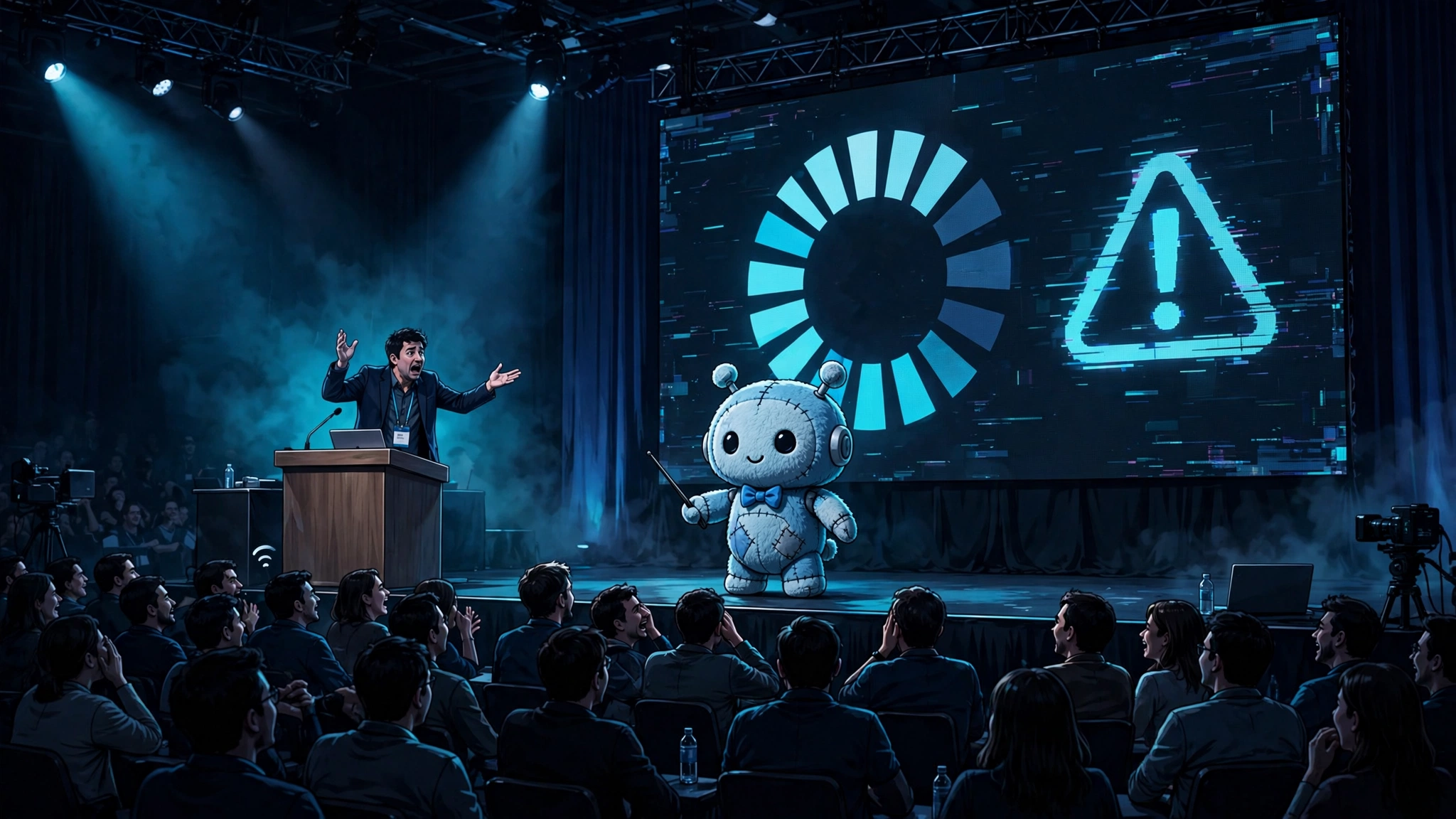
OpenAI wanted DevDay 2026 to be the coming-out party for Dots, its always-on personal agent — the kind of helper that keeps working between conversations, quietly handling the background of your digital life. Instead, the launch will be remembered for about ten seconds of dead silence.
During the keynote in San Francisco, product team member Holly Li summoned her demo agent, nicknamed “Dottie,” and asked it for an update on user testing from the previous night. The agent acknowledged the request — and then said nothing. Ten long seconds later, when Li asked for a status, it replied that it was still checking. Her recovery was perfect comedy timing: Dottie was having a “slow morning.” The internet disagreed about the word slow. It decided the moment was eternal, clipped it, and has been laughing ever since.
The ten seconds#
The stall happened in front of roughly 2,500 in-person attendees, plus everyone watching the livestream. Li had set Dottie a straightforward job: summarize how overnight user testing went. The agent confirmed it understood, then froze mid-thought. After the awkward pause, it offered no result — just a promise it was still working on it.
The moment landed because of the gap between the pitch and the performance. Dots are billed as autonomous agents that pick up ongoing projects and make progress while you are busy doing something else. They run on OpenAI’s GPT-6 Astra model, each with its own cloud computer and browser, able to plug into thousands of applications. That is the vision. On stage, the vision needed ten seconds and a sympathy laugh.
Not the only stumble#
The Holly Li segment was not the demo’s only rough patch. Later, developer-experience chief Romain Huet hit a wall of his own: the voice feature refused to start mid-demo. “It seems there’s a slight issue with the voice feature right now,” he told the audience, which is about as generous a euphemism as live tech demos get. One firsthand live account also recorded a build-thread error in a separate segment, where the agent reported a build failure instead of a result.
To OpenAI’s credit, nobody pretended it did not happen. Sam Altman acknowledged on stage that a live demo had broken, and shared an almost-too-perfect detail: five minutes before it happened, a colleague’s Dot had apparently predicted the setup would fail and offered to try to fix it. It could not fix it in time. An OpenAI employee later said on X that the glitches came from rolling out too many updates at once — the kind of postmortem that is technically honest and PR-wise grim.
The internet pile-on#
Within hours, clips of the stall were circulating on X, and “slow morning” was on its way to becoming the most quoted line of the whole event, according to one practitioner’s write-up. Commentary was, as one widely shared piece put it, brutal. For an agent category already fighting skepticism about reliability, the jokes wrote themselves.
The pile-on went beyond the demo itself. One practitioner account circulating among agent builders argued that early Dots testers were seeing tasks take 20 to 30 minutes that finished in 5 to 6 on a rival model — an anecdote, not a benchmark, but the kind that travels fast when the official demo just froze on stage. Practitioners also noted that Dots launched without availability in the European Economic Area, Switzerland, and the UK, which did not help the confidence narrative.

Why ten seconds matter#
Live demos have always been the riskiest part of a product launch, but AI agents make them uniquely dangerous. An old-fashioned demo only had to show a fixed feature working when someone pressed a button. An agent demo has to understand natural language, reach into external systems, and make a fresh decision on the spot — exactly the failure modes the product is supposed to eliminate.
That is the sting here. The central promise of an always-on agent is that it keeps going when you are not watching. The central fear is that it stops — or worse, confidently does the wrong thing — when you are not watching. A ten-second freeze in front of thousands of developers is not proof of either outcome, but it is vivid evidence for the skeptics, and it arrived in the single moment OpenAI most needed confidence. Even OpenAI’s own documentation warns that Dots can still make mistakes and that consequential work should be reviewed.
What to watch#
Watch whether the rollout smooths out the rough edges fast enough to retire the joke — “slow morning” is one bad week away from becoming permanent shorthand for agent flakiness. Watch whether OpenAI keeps doing live agent demos or retreats to pre-recorded ones, which would be its own admission. And watch the early reliability reports from Pro and Business Premium users now that Dots are in the wild: the demo was a blooper, but the real test is whether the agents stall when nobody is filming.
Sources
- American Bazaar Online — "OpenAI's new AI agent has a ‘slow morning’" (October 1, 2026)
- dev.to — "OpenAI Shipped Dots. Practitioners Shipped Skepticism." (September 30, 2026)
- Soap Central — "OpenAI live demonstration of Dots allegedly fails as voice feature faces technical glitch" (September 30, 2026)
- GroundTruth.day — "OpenAI launches persistent dots, but pausing one does not stop its delegates" (September 30, 2026)
- Generative AI (Medium) — "OpenAI’s Live Demo of “Dots” Flopped and the Internet Was Brutal" (September 30, 2026)
- Devdiscourse — "OpenAI takes on Meta with dots agent in autonomous AI push" (September 30, 2026)