AI runs on light: Tokyo team's optical deep-learning framework cuts compute by about 40%
Researchers at the University of Tokyo and NTT have built a deep-learning framework that runs on light instead of electricity. Published in Nature Computational Science on November 5, 2026, it matches conventional neural networks on standard image benchmarks while using roughly 40% less compute — a result that could cut the energy bill of AI if it scales to larger models.
- Who and when: A team led by graduate student Yongbo Zhang and associate professor Kohei Nakajima at the University of Tokyo, with NTT researchers, published the work in Nature Computational Science on November 5, 2026.
- What it is: A framework combining a training method called SS-DFA (state-skipping direct feedback alignment) with a simpler “single-map” network architecture, designed so physical systems can do the computing.
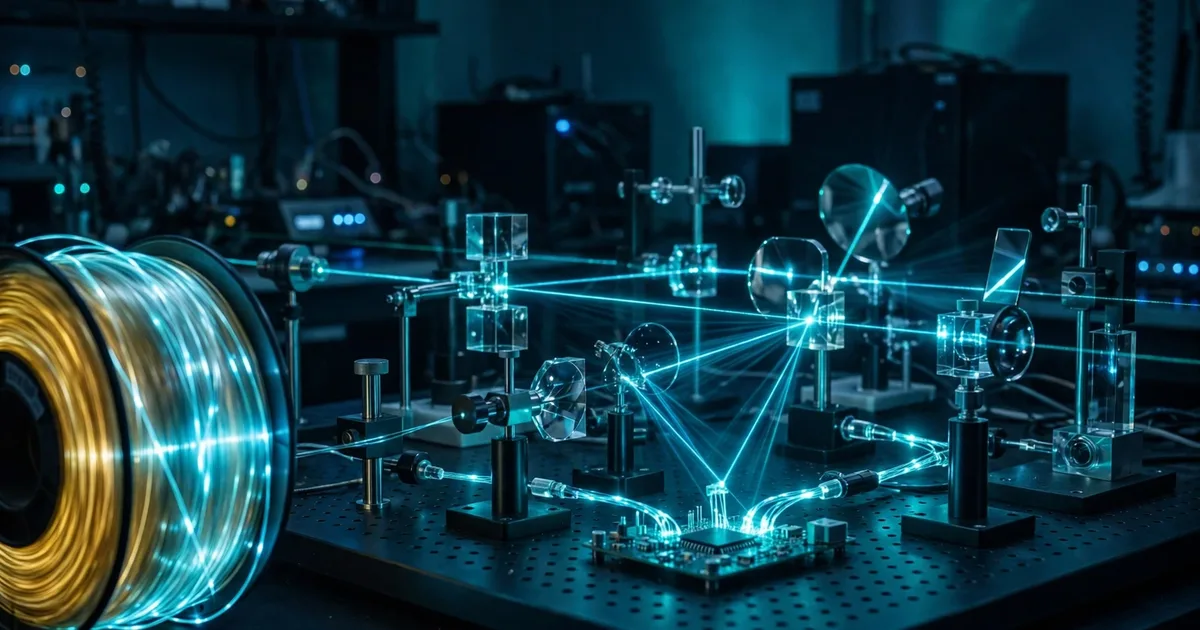
- The demo: Information is converted into an optical signal, processed as it passes through a 200-meter optical fiber loop, then converted back to an electrical signal — with only a small number of electronic components.
- The numbers: Built into modern architectures, the approach improved performance while using approximately 40% fewer computational resources; on its own it matched, and in some tests outperformed, more complex networks with far less computation.
- Tested on: Standard image-recognition benchmarks MNIST and CIFAR-10 — not yet on today’s largest language or multimodal models.
- Why it matters: Optical systems generate little heat, so the approach could lower the energy needed for computing and cooling in AI data centers — and, if miniaturized onto a chip, run AI inside phones, cameras, and self-driving cars.
The paper, published today in Nature Computational Science, is titled “Scalable physical deep learning using optical dynamics with state-skipping training and single-map architecture.” Its argument is simple: instead of building ever-larger models on ever-more power-hungry chips, rethink the learning process so a physical system — in this case, light travelling through fiber — can do the computation naturally. “Instead of continuing to build larger and more complicated models, we wanted to rethink the learning process itself so that physical systems can perform computation much more naturally,” said lead author Yongbo Zhang.
How it works
Conventional training works by measuring a network’s internal states as data flows through it, then backtracking through those measurements to work out what to change. That is hard to do on physical hardware, where every intermediate state has to be measured, recorded, and stored. The Tokyo team’s training method, SS-DFA, skips most of that: it guides learning from the final error together with information about the system itself, without needing access to most intermediate states. Paired with the single-map architecture — many units following the same simple rules instead of a web of complex internal connections — the result is a design that is far easier to run on real hardware.
The team proved it on an optical system: information is turned into an optical signal, processed as it passes through a 200-meter loop of optical fiber, and converted back into an electrical signal for analysis. Light can carry information extremely quickly and carry several signals at once, which is what makes optical computing attractive — but until now, training such systems has been the bottleneck.

What it achieved
Tested on the standard image-recognition benchmarks MNIST and CIFAR-10, the simplified design matched — and in some tests beat — more complex neural network architectures, while requiring far less computation. The paper reports that the approach “substantially reduces computational costs and training parameter count while achieving comparable performance” against conventional deep networks, and that integrating the scheme into modern architectures improved performance with an approximately 40% reduction in computational resources. The team also published its code, so other groups can try the method on their own hardware.
Why light, and why now
The energy cost of AI is the industry’s open wound: training and running large models consumes enormous electricity, and cooling the hardware consumes more. Optical systems generate little heat, so a framework like this could cut the energy needed for both computing and cooling — and the water used to cool data centers. The idea is already moving into industry: Marvell is buying Lumentum for $115 billion on a bet that AI data centers move from copper to light, and startups like Volantis are putting lasers inside AI memory. The Tokyo work attacks the other half of the problem — not just moving data with light, but learning with it.
What it cannot do yet
The honest limit is scale. “We have not yet tested it on today’s largest AI models, particularly language and so-called multimodal models, and this is an important direction for future research,” Nakajima said. The framework is modular and can be inserted as a computational block into existing networks, which gives it a route toward larger scales — but miniaturization, stability, and large-scale manufacturing all remain unsolved. Until then, this is a proof that light can learn, not a replacement for the GPU. Still, in a week when the labs are racing to secure gigawatts for their data centers, a credible path to 40% less compute is the kind of result that gets read twice.
Sources: the paper in Nature Computational Science (DOI: 10.1038/s43588-026-01075-w), TechXplore’s report, and the preprint abstract on Research Square.
Frequently asked questions
What is the optical AI framework?
It is a deep-learning method from the University of Tokyo and NTT that runs calculations with light instead of electricity, published in Nature Computational Science on November 5, 2026. It combines a training method called SS-DFA with a simpler single-map architecture, and was demonstrated on an optical system built around a 200-meter fiber loop.
How much compute does it save?
When built into modern architectures, it improved performance while using approximately 40% fewer computational resources. On its own it matched, and in some tests outperformed, more complex neural networks while requiring far less computation and fewer training parameters.
Will it replace GPUs or run large language models?
Not yet. The team has not tested it on today’s largest language or multimodal models, and miniaturization onto a chip, stability, and large-scale manufacturing remain future work. If it scales, it could cut the energy used for computing and cooling in AI data centers.