Physicl Studio generates synthetic training data for physical AI robots — $10M seed
A robot that gets it right nine times out of ten makes a great demo — and a product nobody can deploy. Paris startup Physicl launched Studio on November 6, 2026, an app that generates synthetic training data for exactly the rare situations where robots and world models fail, backed by a $10 million seed round led by Inovia Capital.
- Who: Physicl, a Paris startup founded by entrepreneur Alex de Vigan, with teams in Paris and the San Francisco Bay Area.
- What: Studio, Physicl’s first app, launched November 6, 2026 — it generates synthetic training data for physical AI.
- Funding: $10 million seed round led by Inovia Capital, with participation from US Venture Partners.
- Scale: 10,000 3D environments and 100,000 assets built from real geometry with known materials, with billions of possible scene variations.
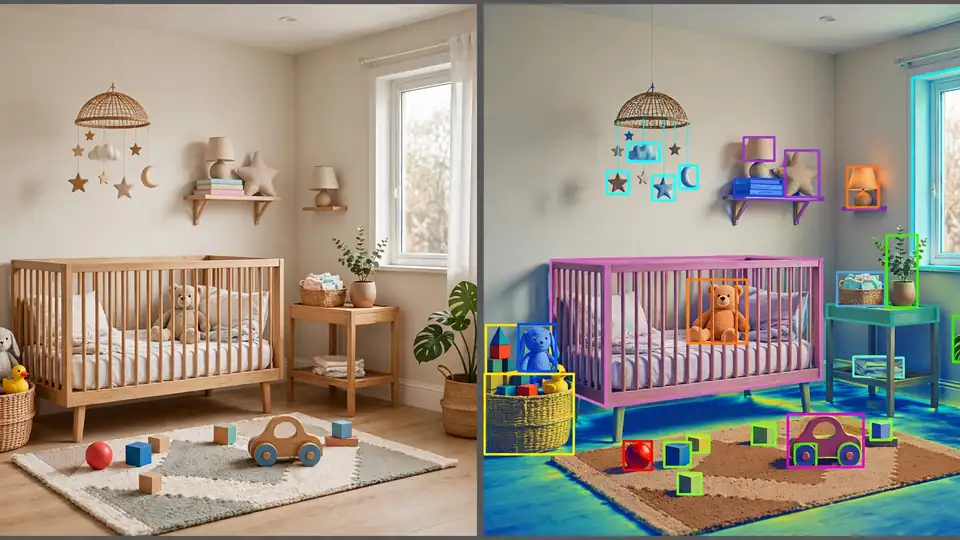
- Labels: Depth, normals, segmentation, boxes and camera pose come from the scene itself — exact by construction, not estimated afterwards.
- Early proof: World-model builder SpAItial more than halved its reconstruction error on real rooms after training with Physicl data.
Physical AI has a data problem that looks nothing like the one language models solved. Language models learned from the text of the internet; image models from billions of captioned photos. Robots, autonomous systems and world models that have to act in real space have no such corpus. As Physicl founder and CEO Alex de Vigan put it in the launch announcement, “the physical world does not come as a dataset.”
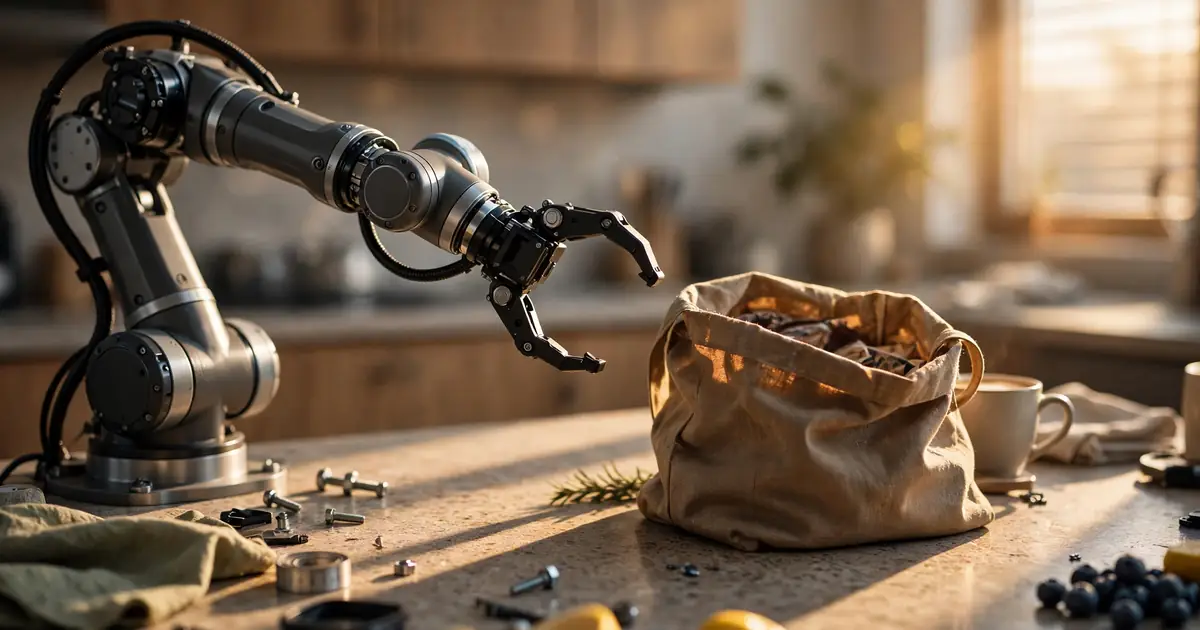
The gap shows up at the end of development. A robot that succeeds nine times out of ten makes a great demo, but nobody can deploy a model that fails every tenth run in a kitchen, a warehouse or a hospital. The last points of reliability come from rare situations — the cup half hidden by a bag, the shadow that crosses the counter at sunset, the box stacked slightly off — and those are almost impossible to capture in the real world. When you do catch one, you cannot replay it or vary it.
That is the problem Physicl set out to solve, and the reason it raised the money: a $10 million seed round led by Inovia Capital, with US Venture Partners participating, announced alongside the launch of Studio on November 6, 2026. The round funds the team in Paris and the San Francisco Bay Area, and the platform behind Studio.
What Studio does
Studio starts from failure. A researcher describes, in plain language, the situation their model gets wrong; Studio proposes a matching scene and variations; the researcher adjusts the ranges and fixes conditions such as the camera path; and the system renders and exports the result while recording the conditions behind each frame.
Three things set it apart, according to Physicl. First, the labels are exact by construction: depth, normals, segmentation, boxes and camera pose come from the scene itself, not estimated from the picture afterwards, so they stay right in the dark corner and behind the clutter where models fail. Second, one condition changes at a time — the light, the clutter, the camera or the objects, alone or together — so a model sees every version of a rare edge case before it meets one. Third, it is real 3D at scale from day one: 10,000 environments and 100,000 underlying assets built from real geometry with known materials, adding up to billions of possible scene variations.
Studio is in beta, opening to research teams in waves, and free during the beta. The audience is labs, universities and companies building vision, world-model and robotics models.
Already in use: SpAItial
Physicl already has an early customer with a measurable result. SpAItial, which builds world models that turn real rooms into explorable 3D, used Physicl data and more than halved its reconstruction error on real rooms, according to an evaluation by founder Matthias Niessner’s team at the Technical University of Munich. Niessner, SpAItial’s CEO and a professor of computer science at TUM, said Physicl “gives any researcher access to virtually any physical training data they can imagine.”
The longer-term pitch is agentic: a model running in training notices what it still gets wrong and asks for that data itself. Niessner sketched the loop to TechCrunch: “You’re running Claude, and it checks, ‘Oh, I need more data of this in my training,’ and then it auto generates that data, depending on the training state.” Physicl wants to be the tooling for that ongoing generation, not just a data vendor.
The team and the money
De Vigan spent the last ten years digitizing objects and rooms in 3D, building a library of real objects and rooms and the software to vary them for some of the world’s largest retailers, through his previous company nfinite. The same pipeline that turned unstructured product information into faithful 3D renderings for e-commerce is now aimed at robot training. His pitch to TechCrunch: the pipeline can “transform unstructured, incomplete, heterogeneous real-world information into a high-fidelity physical representation… with correct geometry, materials, and physics.”
The advisory bench is drawn from the field Physicl is building for: Thomas Wolf of Hugging Face, Christoph Lassner of World Labs, Matthias Niessner of TUM, Yaser Sheikh and Sébastien Deguy. Inovia partner Steve Woods said Physicl is “tackling a critical piece” of translating model capability into real-world performance: “scalable, high-quality physical data grounded in real-world physics.” Physicl says it also works with AI labs including Meta, World Labs, Epic Games and SpAItial.

A crowded field, a narrower bet
Physicl is entering a crowded category. Startups collecting, labelling or generating training data for foundation-model builders and robot operators are multiplying, and de Vigan admits “the space is very young and very blurry sometimes.” The bet is narrower than most: not more average data, but the rare case on demand, labelled exactly, as many times as training needs.
It is a bet the rest of the physical-AI stack is already making in parallel. Humanoid robots are learning factory jobs by watching human operators, and delivery-robot makers are turning their own fleets into data services — but every one of those systems still has to survive the long tail of situations it has never seen. The open question for Studio is the same one facing the whole synthetic-data field, as the research debate shows: whether data generated in simulation transfers to the real world, or just teaches models to be very good at the simulation. SpAItial’s halved error is one early datapoint in Physicl’s favour. Whether it generalises is what the beta will have to prove.
Frequently asked questions
What is Physicl Studio?
Studio is Physicl’s first app, launched November 6, 2026. It lets researchers describe a situation their model gets wrong and generate it thousands of ways — from 10,000 3D environments and 100,000 assets — with exact ground truth on every frame, for training robots, world models and vision systems.
How much does Studio cost, and who can use it?
Studio is in beta and free during that period. Access is opening in waves to labs, universities and companies building vision, world-model and robotics models.
Is there evidence the synthetic data works?
Physicl points to world-model builder SpAItial, which more than halved its reconstruction error on real rooms after training with Physicl data, in an evaluation by Matthias Niessner’s team at the Technical University of Munich.