A tiny 4B model is learning to code 3D scenes — on a single GPU, with the full release due tomorrow
A hobbyist fine-tune of Qwen3.5-4B is learning to write Three.js scenes that run on the first try, checkpoint by checkpoint, in public — and its creator says the full weights, dataset, and evaluation report land tomorrow.
- What it is: an independent fine-tune of Qwen3.5-4B for general coding, using Three.js scene generation as its main test — not an official Qwen release.
- The evidence: an 11-second clip of a blocky Roman-style scene from the latest checkpoint, posted to r/LocalLLaMA, with 401 upvotes and 89 comments at last check.
- The honest limit: it renders scenes; it does not simulate them. The creator concedes playable games with physics and collisions need more training data.
- What lands October 28: full FP16 weights, all quantizations, the training dataset, and an evaluation report, once training finishes at 07:30 UTC.

There is a particular kind of progress report that only the open-weights world produces: not a press release, but a training log, published checkpoint by checkpoint, with the failures left in. The latest one arrived on r/LocalLLaMA on Monday evening, in the form of an 11-second clip of a blocky Roman-style scene — a Colosseum-like structure rendered from code — and it struck a nerve. At last check the post had gathered 401 upvotes and 89 comments, most of them from people who have tried small-model coding themselves and know how hard the thing on screen actually is.
The project is a fine-tune of Qwen3.5-4B, a 4-billion-parameter model, built by an independent creator who goes by ccore on Hugging Face. The goal is general-purpose coding, but Three.js scene generation is the test the creator cares about most: prompt the model, get back a single self-contained HTML file, open it in a browser, and watch a scene appear. The latest checkpoint, the creator says, is noticeably better than the ones before it — both in how good the scenes look and in how often they run on the first try. The post is explicit that it still fails sometimes. Some scenes still need a second attempt.
How it was trained#
The part of the thread that separates this project from a demo is how much of the method the creator disclosed in replies. The training scenes were first generated by larger, more capable models, then tested, filtered, and curated by hand — a slow process the creator calls the hardest part of the whole project, harder than the GPU training itself. The training itself ran on a single graphics card: the creator says one L4, with around 22 GB of usable memory, is enough, and a single RTX 6000 is more than enough. Shorter context lengths could even squeeze it onto 16 GB.
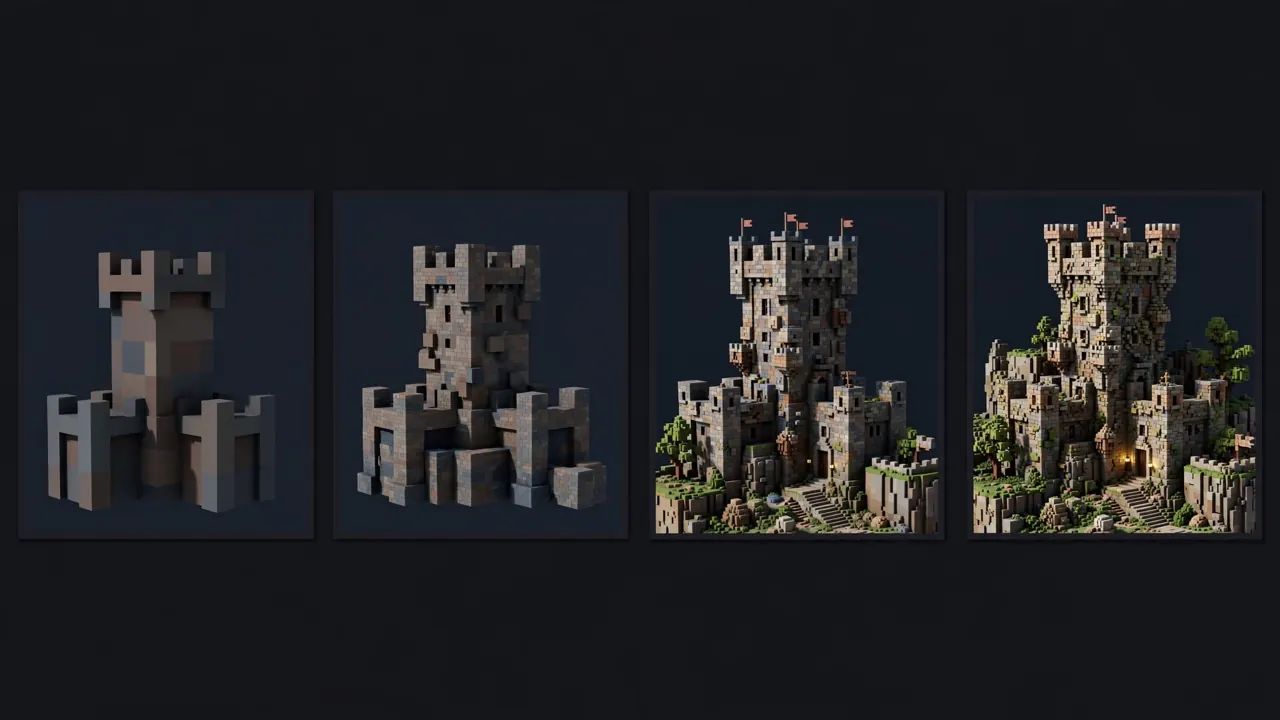
The evaluation is deliberately unglamorous. Eight examples held out from the training set are run across checkpoints, and the creator judges not just whether the result looks good but whether it runs and how much intervention it needed. The October 26 update to the Hugging Face page refreshed both the Q4_K_M and Q8_0 quantizations, fixing a layer-related issue some users had reported, and the creator says the new files produce more successful one-shot generations. The model card also publishes generation settings — temperature 0.6 to 0.8, top-p 0.90 to 0.95 — and a system prompt that restricts the model to the Three.js core module, with camera controls implemented by hand rather than imported.
What the comments got right#
The most important comment in the thread is a correction, and the creator accepted it. A 4B model writing Three.js code renders scenes; it does not simulate them. There are no collisions, no physics, no interaction — geometry, frozen in place. The creator replied that animated scenes do work, but playable games with physics and collisions have not been trained for yet, and would need the dataset expanded to cover those kinds of examples. Anyone picturing a playable world from a prompt should reset expectations to dioramas: gorgeous ones, but dioramas.
A second correction landed on the comparison some commenters reached for. One highly upvoted comment suggested the project had replicated an internal Roblox model for generating 3D assets; another commenter answered that Roblox's asset tools are text-to-3D generation models, a different technology from a code generator that writes Three.js, and pointed to Roblox's own developer forum, which names GLM 5.2 as the primary model for its in-Studio assistant. The distinction matters: writing code that draws a scene and generating a 3D mesh are different skills, and this project claims only the first.
A third point, raised by several commenters, is provenance. Because the training scenes were generated by larger models and curated, this is distilled capability as much as it is a from-scratch achievement — and the creator said so directly when asked, rather than letting the thread assume otherwise. That honesty is part of why the thread stayed constructive: the claims on the table are modest, specific, and checkable.
Why a 4B model coding scenes matters#
The reason a small result like this travels is what it implies about who gets to do this work. A 4B model can run on consumer hardware, and a fine-tune that needs one GPU and a carefully curated dataset is within reach of an individual in a way frontier training is not. If the promised release — full FP16 weights, every quantization, the dataset, and the evaluation report — actually lands, other people will be able to reproduce the result, extend it to new scene types, and find out exactly where it breaks. The creator has also floated what comes next: the same approach at 9B or 27B, image-to-3D scenes, and even Minecraft schematics, which the creator says might be easier than the Three.js work.
None of that is proven yet. The evaluation report is not out, the dataset is not out, and the full weights are not out. What exists today is a checkpoint, a clip, and a thread full of people kicking the tires. But the clip is real, the model page corroborates the post's timeline and update history, and the corrections that matter most came from the community and were accepted by the creator. That is a healthier basis for excitement than most viral demos get.
What to watch#
Training is scheduled to finish on October 28 at 07:30 UTC. Watch for three things: whether the full FP16 weights and dataset actually appear on schedule; whether independent users reproduce the one-shot scene results on their own hardware; and whether the evaluation report's held-out prompts show the same checkpoint-by-checkpoint improvement the creator describes. If the interactive and physics-driven scenes follow, the story gets bigger. If they do not, the project still stands as an unusually transparent example of what a small model, a curated dataset, and one GPU can do.
Sources: the original post by u/ConfidentDinner6648 on r/LocalLLaMA; the model page for ccore/Qwen3.5-4B-3D-Coder on Hugging Face; the Roblox developer forum thread cited in the comments on Roblox Assistant model sourcing. The editorial illustrations are AI-generated.