Publishers ship Content Telemetry v1.0: a five-stage tracker for AI's use of their content — and pitch OpenAI, Google, Meta, Microsoft on a licensing board
The Guardian, FT, AP, BBC and other publishers released the first version of the SPUR Content Telemetry standard today — a protocol that makes AI agents report how they retrieve, ground, cite, present and engage with journalism. OpenAI, Anthropic, Google, Meta and Microsoft have been invited to an invitation-only AI Licensing Advisory Board.

The publisher coalition that has spent the year trying to make AI companies pay for journalism just shipped its first finished product. SPUR — the Standards for Publisher Usage Rights initiative, backed by the Guardian, Financial Times, Associated Press, BBC, Sky, The Times of London and European media group MediaHaus, released version 1.0 of its Content Telemetry standard today. And it did something the labs will notice: it invited OpenAI, Anthropic, Google, Meta and Microsoft to join a new, invitation-only AI Licensing Advisory Board to shape how the standard gets implemented.
Formed in March, SPUR is the publishers' most technically serious move yet in the fight over AI's free use of their content. This is not another statement of principle. It is a protocol — wire format, JSON schemas, conformance tests — published under the Apache 2.0 license on GitHub, designed so that an AI agent's use of an article can be tracked, reported and ultimately priced.
What the standard tracks#
Content Telemetry follows a publisher's content through five stages: retrieved (content fetched over HTTP — what publishers can see today), grounded (loaded into the agent's generation context), cited (explicitly referenced in the response), presented (made perceivable on a user-facing surface), and engaged (the user clicked, copied, shared, or directed the agent to act). The gaps between stages are the point: grounding without citation means your content influenced the answer but you got no credit; citation without presentation means the credit never reached the user.
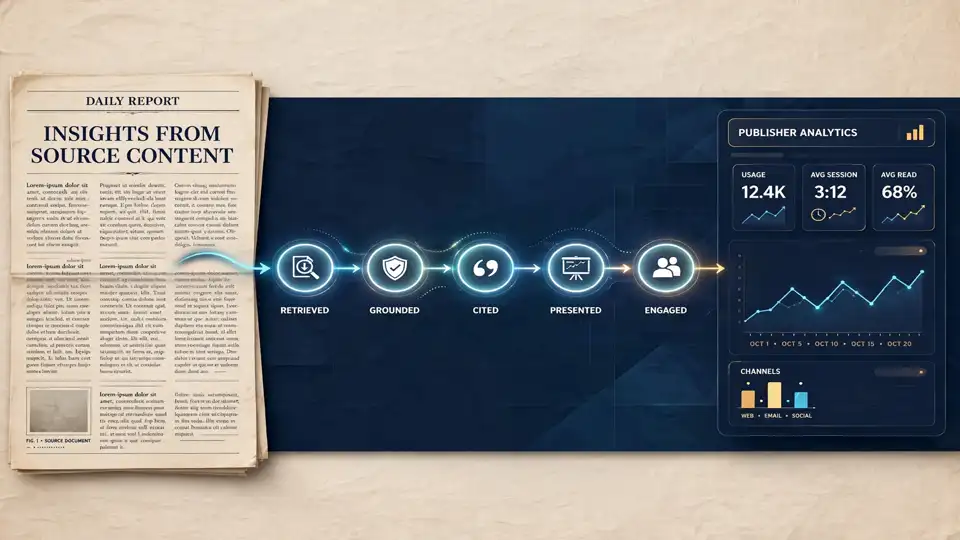
The design is deliberately post-hoc: events report what actually happened, not what an agent declared it would do, and they mark observable boundary crossings rather than trying to model an agent's internals. One bounded session, identified by a session ID carried on every event, ties retrieval through engagement together. The spec's own worked example shows an FT article grounded into a Copilot-style response, cited as a paraphrase, its link presented — and no engagement reported.
From draft to v1.0#
A draft of the standard was published in June and open for public comment until July 24. The finished v1, shaped by that consultation, adds multimodal support — not just text — and is designed to integrate with existing provenance frameworks like C2PA. The repository is explicit about what v1 does not solve yet: where exactly the "grounding" boundary sits in multi-stage pipelines, how to handle event volume at scale, and — the big one — verification. Grounding and citation events are self-reported by the agent, the same party that may owe compensation. Signed events and verifiable credentials are deferred; a Content-Telemetry-ID header correlates agent-reported retrievals with origin servers, but that covers retrieval only.
The pitch to the labs#
The headline move today is the board. The invitation-only AI Licensing Advisory Board is meant to give the companies building AI systems a seat at the table — about 20 members targeted, first meeting planned for this month. The coalition is working with tech and AI companies on pilot programs, and SPUR's technical lead Alex Springer declined to name participants but pointedly noted that Microsoft, Google and OpenAI have started releasing their own implementations of content usage reporting. Asked whether Google had accepted the board invitation, a Google spokesperson told Digiday: "We frequently engage with SPUR and other associations on a variety of topics." The others did not respond before publishing time.

The rhetoric from the publishers is less adversarial than it sounds. "The goal is to string this whole thing together into a stack of solutions that is easy for an agent to use," Springer said. "It's licensing payments — or not, free content has a place in this for sure — reporting provenance; it's that chain." And the implicit threat is clear: "Publishers right now want to block. We're moving towards this just-block-by-default stance." SPUR co-founder David Buttle added that the board "will ensure both sides of the equation have a seat at the table and can work together to drive through better, fairer and more sustainable ways of working." Michael Rubenstein, co-founder of the AI brand-agent platform Firsthand, put the publishers' case bluntly: "It'll be a better internet if the publishers can develop a sustainable revenue stream out of this, and continue to invest in premium content and journalism."
What to watch#
Whether any of the big five labs actually joins the advisory board — and on what terms. The first pilot programs with AI companies, which will test whether the standard survives contact with real agent infrastructure. And on October 15, SPUR's first technical committee meets to figure out "auditing and evidencing" — how to validate the signals AI tools send back to publishers. That is where this project either becomes the plumbing of AI licensing or stays a publishers' wish list.