What's inside#
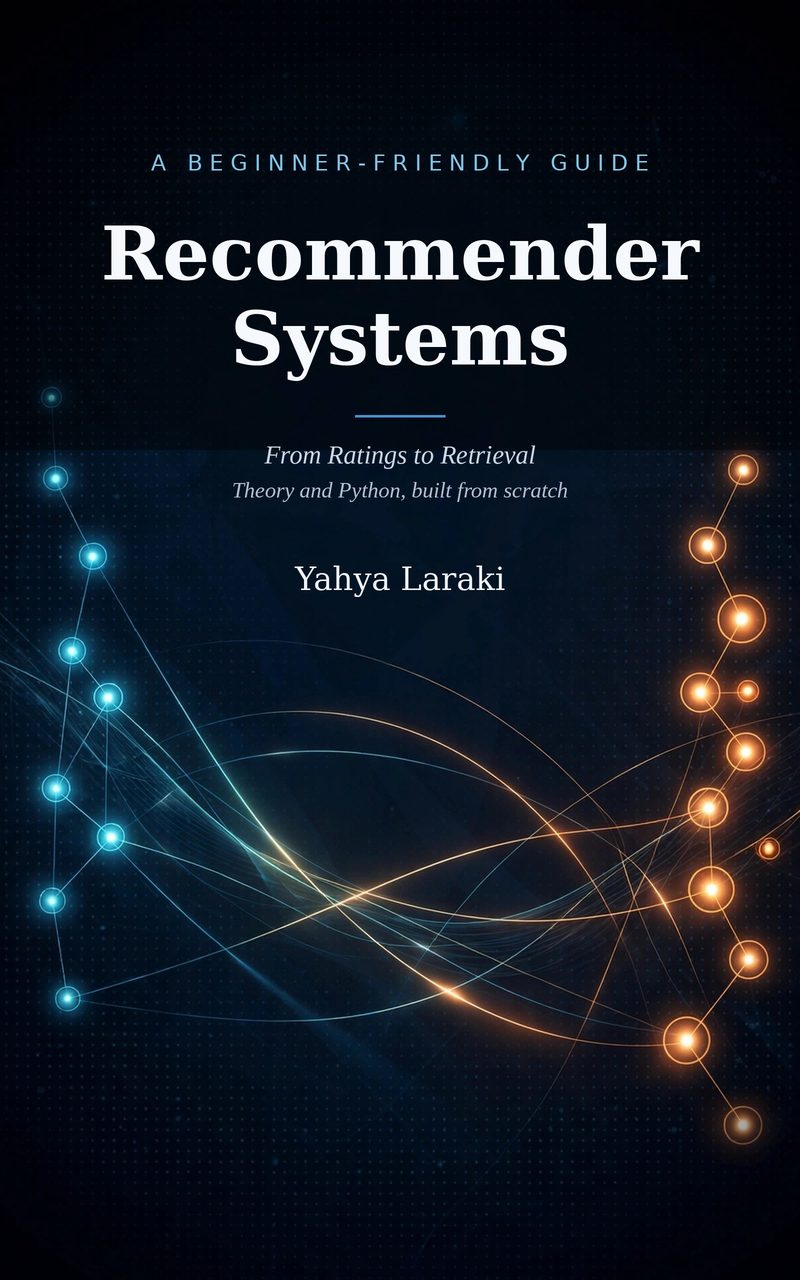
- Part I — Foundations: what recommenders are, how to frame the problem, and how to evaluate them honestly (RMSE, precision@k, NDCG, and why offline metrics lie)
- Part II — Classical methods: content-based filtering, nearest neighbors, matrix factorization and SVD, implicit feedback, hybrid models with LightFM
- Part III — Ranking & deep learning: learning to rank, two-tower retrieval in PyTorch, ANN search with FAISS
- Part IV — Frontiers & production: sequential recommenders (SASRec), graphs, LLMs in the recommendation loop, and shipping to production
Every chapter: learning objectives, runnable code, exercises, key terms. Every number in the book was produced by running the code — nothing hand-waved.
Who it's for#
- Developers and data scientists who want to understand recommenders, not just call an API
- Students and career-switchers who bounced off academic papers
- Anyone who's wondered “how does Netflix actually decide?”
Pricing#
| Tier | Price | You get | |
|---|---|---|---|
| Ebook | $29 | PDF + ePub, free lifetime updates | |
| Ebook + Code | $49 | Everything above + the complete runnable code repo, organized by chapter | |
| Team | $99 | Everything above, licensed for up to 10 people | |
| Kindle edition | $12.99 | On Amazon |
Direct sales open soon — the sample and the code are free today. The free sample PDF (preface + chapters 1–2) and the GitHub code repo are available right now.
FAQ#
I'm a complete beginner. Is this for me?
Yes — that's the point. Chapter 1 assumes nothing; each concept is built from scratch with intuition before math.
Which libraries does it use?
scikit-surprise, implicit, lightfm-next, Cornac, PyTorch, FAISS — all open-source, all verified current as of September 2026.
Do I need a GPU?
No. Everything runs on a laptop CPU.
What if the libraries change?
Ebook buyers get free lifetime updates.
Can I share it with my team?
The Team tier covers up to 10 people.
Read the first two chapters free#
Chapters 1–2 of Recommender Systems: From Ratings to Retrieval — what recommenders are, how to frame the problem, and your first real code on MovieLens data. Free PDF, no spam.