Ambiq heliaAOT 1.0: an edge AI compiler that cuts inference latency up to 76% on Apollo chips
Ambiq announced about 25 minutes ago that heliaAOT 1.0, its ahead-of-time AI compiler for the company’s Apollo chips, is available now. It turns a trained model into optimized C code that runs on the chip itself — with up to 76% lower inference latency and 72% lower energy per inference than LiteRT Micro in Ambiq’s Apollo510 benchmarks.
What we checked: Ambiq’s BusinessWire announcement (November 9, 2026, 9:30 a.m. ET), cross-checked against its republication on The News Hub.
- What: heliaAOT 1.0, Ambiq’s ahead-of-time AI compiler for the HELIA AI ecosystem, announced November 9, 2026.
- What it does: Converts trained AI models into optimized C code for on-device inference on Apollo chips.
- Headline numbers: Up to 76% lower inference latency and 72% lower energy per inference than LiteRT Micro, measured on the Apollo510 at 96 MHz.
- Best case: Health-monitoring workloads (ECG, PPG, sleep) saw the full 76% latency and 72% energy cuts, plus a 56% smaller firmware image.
- Scope: 65 operators plus custom operators, FP16 and FP32 models without integer quantization, and 15 Apollo SoCs retargetable with a one-line config change.
- Availability: Available now; benchmarks and evaluation requests at ambiq.com/ai/heliaaot.
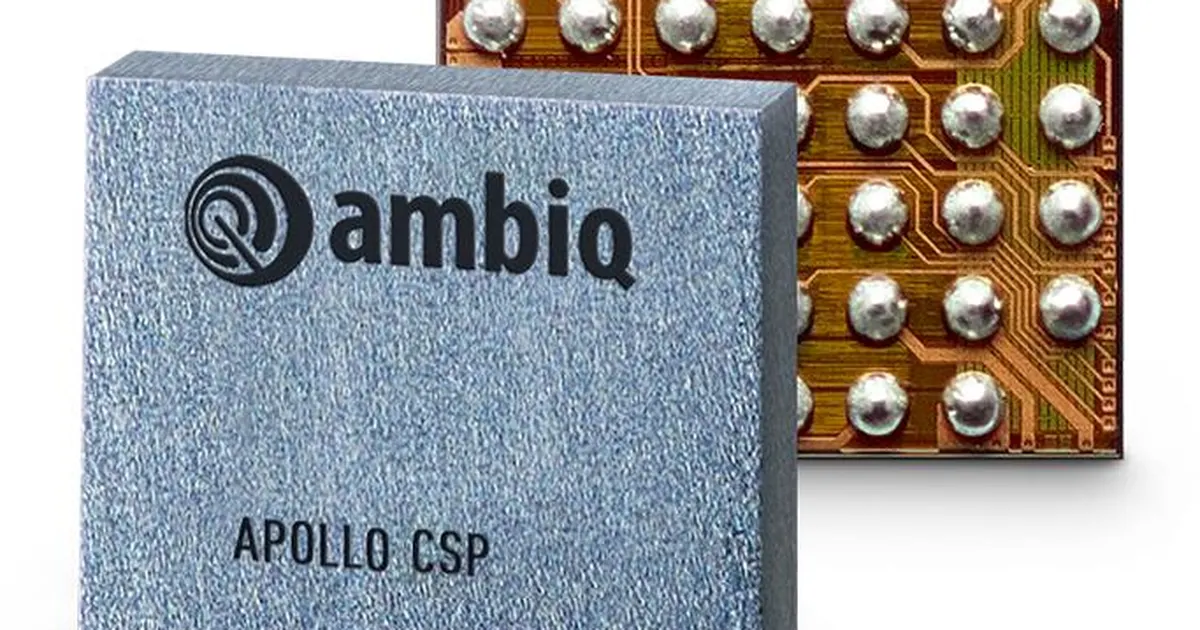
How a model becomes C code
heliaAOT is an ahead-of-time compiler, and the name is the mechanism. Instead of shipping a model file plus an interpreter to the device, you hand the compiler your trained model and it emits optimized C code for that exact model. The code is compiled into the firmware and runs directly on the Apollo chip — no runtime interpreter, no model file to load, no round trip to the cloud.
The pipeline has five steps. First, train the model as usual — heliaAOT accepts supported FP16 and FP32 models without integer quantization, so there is no accuracy trade-off from squeezing weights into 8-bit integers. Second, feed the trained model to the compiler. Third, heliaAOT emits C code tuned for the Apollo target. Fourth, flash it onto the chip. Fifth, measure the result on your own board with heliaPROFILER, Ambiq’s profiling tool for the Apollo line.
Take a concrete example: a health-monitoring model that reads ECG, PPG, and sleep signals on a wearable. On the Apollo510 at 96 MHz, Ambiq reports heliaAOT cut inference latency 76% and energy per inference 72% versus LiteRT Micro, the baseline it compared against, while shrinking the firmware image 56%. That is the difference between a health sensor that samples continuously and one that has to wake, think, and sleep in short bursts to save battery.
What Ambiq announced today
Ambiq introduced heliaAOT 1.0 on Monday, November 9, as the compiler for its HELIA AI ecosystem. It is available now, and Ambiq says it is already deployed in mass-produced products, with larger customers in discussions about deploying it in their current products.
The launch caps a year of iteration: Ambiq says it shipped 17 heliaAOT updates over the past 12 months, expanding operator support from 35 to 65 and Apollo target support from 8 to 15 chips. The compiler was recognized in the Best Tools category at Embedded World 2026.
“Customers want to bring more intelligence to their devices without exceeding their power and memory budgets,” said Dr. Adam Page, Head of Artificial Intelligence at Ambiq. “heliaAOT 1.0 helps them get more from Apollo silicon, deploy a broader range of models, and reuse their development work across products.”
The numbers, workload by workload
Ambiq benchmarked heliaAOT against LiteRT Micro on the Apollo510, and every workload group it tested improved on all three measures — latency, energy, and firmware size:
| AI workload | Lower latency | Lower energy per inference | Smaller firmware image |
|---|---|---|---|
| Health monitoring (ECG, PPG, sleep) | 76% | 72% | 56% |
| Vision | 61% | 51% | 29% |
| Voice and audio | 52% | 45% | 47% |
| MLPerf Tiny reference models | 36% | 27% | 37% |
Two details in the small print matter. The FP32 number is striking on its own: supported FP32 models run about 4× faster than LiteRT Micro FP32 in a matched comparison across six model families — the kind of gap that decides whether a model can run in full precision on a microwatt budget at all. And firmware images are 29% to 56% smaller at the median, which frees storage and RAM on chips where both are scarce.
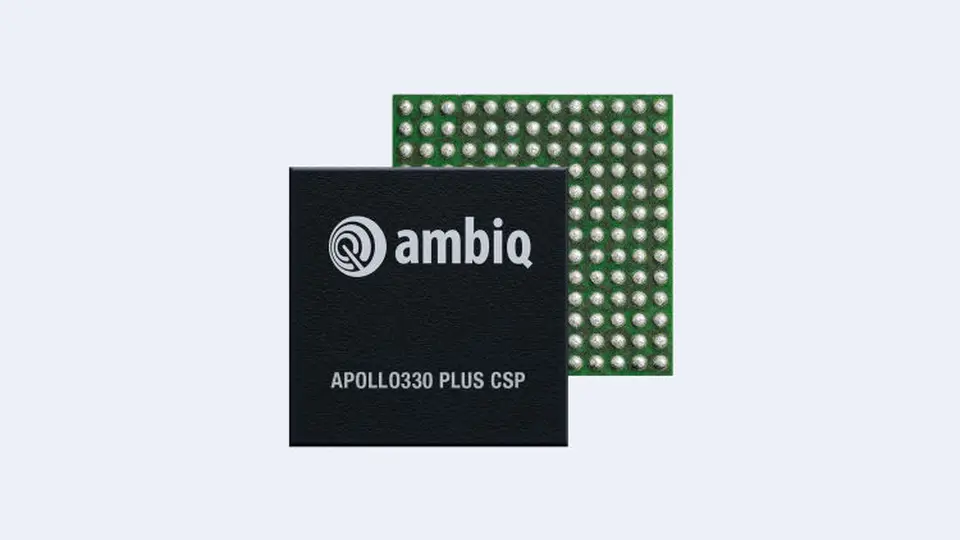
What it means for builders
The practical win is reuse. A model compiled for one Apollo chip can be retargeted to any of the other 14 supported Apollo SoCs with a one-line compiler configuration change, according to Ambiq — one codebase across a product line instead of one port per chip. Streaming LSTM, GRU, and SVDF support adds always-on voice, biosignal, and sensor processing, the workloads that make a wearable or a sensor feel responsive instead of laggy.
That puts heliaAOT in a small but growing club of tools squeezing real AI onto milliwatt hardware. Blumind’s BM110 evaluation kit, launched today, takes the analog route to the same problem — listening all day on about 50 microwatts — while NXP’s unified robotics platform shows the other end of the edge, going from motor control to a flying drone in 30 minutes. For builders who want to try small-model tooling hands-on, our Shim tutorial walks through a tiny local AI harness that runs any model with plain-English commands.
The catch
Every number here is Ambiq’s own, measured on one chip — the Apollo510 at 96 MHz — against one baseline, LiteRT Micro, under matched per-model conditions. Ambiq is explicit that the energy figures are gross MCU-rail energy per inference, model-level measurements rather than battery-life claims, and that the MLPerf Tiny figures use reference models rather than an official MLPerf submission. Independent benchmarks do not exist yet, so treat the table as a vendor best case until third parties reproduce it. And while heliaAOT 1.0 is available now, access runs through Ambiq’s evaluation process — there is no open download link in the announcement.