Blumind BM110 evaluation kit: analog AI that listens all day on about 50 microwatts
Blumind announced the BM110 Evaluation Kit about 35 minutes ago — a board, SDK and reference models that let developers test the Ottawa startup's analog AI chip for themselves, running always-on audio inference on roughly 50 microwatts, microphone included.
What we checked: Blumind's announcement via EINPresswire, November 9, 2026, 08:00 GMT (3:00 a.m. EST), and Blumind's own site, blumind.ai.
- Who: Blumind, an Ottawa-based startup founded in 2020; CEO and co-founder Niraj Mathur announced the kit.
- What: the BM110 Evaluation Kit — an evaluation board carrying BM110 silicon, an SDK, pre-loaded reference models, a datasheet and a technology validation report on request.
- When: announced November 9, 2026, at 08:00 GMT (3:00 a.m. EST); the kit is available now to qualified customers.
- Power: the neural network compute core runs continuously at under 3 microwatts; total always-on power including the microphone is about 50 microwatts.
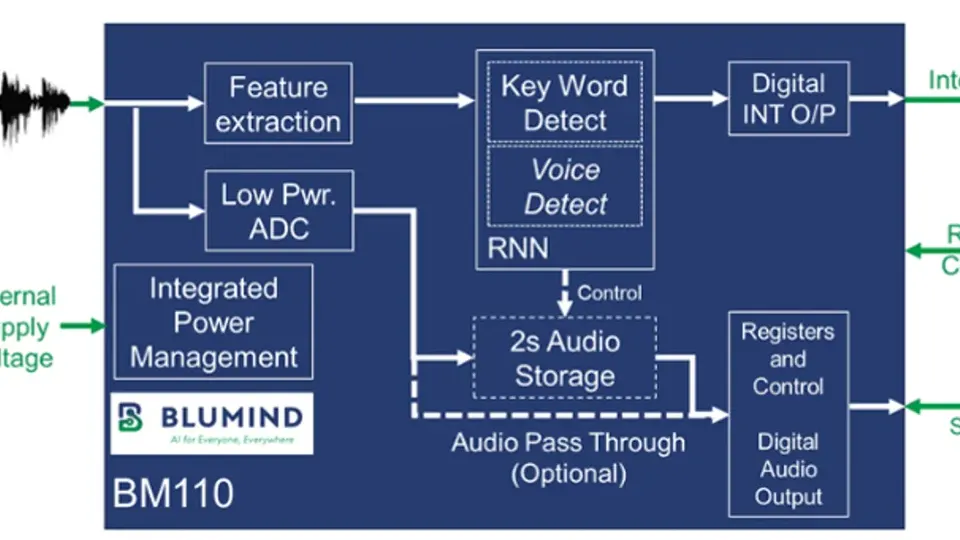
- How it works: Blumind's AMPL technology stores neural network weights in the chip fabric and computes in the analog domain, instead of shuttling data between memory and a digital multiply-accumulate array.
- Next: Blumind shows the kit at electronica 2026 in Munich, November 10–13, Hall B5-560; its next-generation platform targets 250 TOPS/W for vision and sensor fusion.

On the bench, the test is almost boring to watch — and that is the point. A small evaluation board sits wired to a meter through a series sense resistor, an analog microphone feeding it room sound, while the chip on it listens for a wake word and for voices. The current draw, measured live while the model runs, barely registers: the neural network core runs on less than 3 microwatts, and the whole always-on system, microphone included, on about 50.
That board is the BM110 Evaluation Kit, and Blumind announced it about 35 minutes ago. The Ottawa startup is handing developers the hardware and software to verify its boldest claim for themselves — that analog AI can listen all day on a sliver of the power digital chips need.
What Blumind just shipped#
The kit is a complete evaluation platform, not a bare chip. It ships with the BM110 silicon on a reference always-on audio board, an analog microphone and an integrated signal-processing front end, battery management and the series sense resistor that lets a team measure always-on current directly, in real time. The software side is an SDK with a hardware abstraction layer that isolates application code from the host platform and supports integration onto any MCU, plus a model-import flow for networks trained in standard cloud and server frameworks.
Two reference models come pre-loaded: voice activity detection and keyword spotting — the two jobs an always-on listener actually does. A BM110 datasheet is included, and the AMPL Technology Validation Report is available on request, covering weight storage and programming accuracy across process, voltage and temperature corners, weight drift over the product lifetime, and end-to-end system power for representative workloads.
The kit is available now, but only to qualified customers, who get the datasheet, the validation report and direct applications-engineering support through model bring-up. Blumind will also show it at electronica 2026 in Munich, November 10–13, at Hall B5-560.
The number that matters: 50 microwatts#
The headline figure is the power budget. Blumind says the BM110 neural network compute core runs continuously at under 3 microwatts, with total always-on power including the microphone at roughly 50 microwatts. The company's broader claim, stated on its own site, is up to 1,000 times lower power than legacy digital approaches — a vendor claim, but one the kit is explicitly designed to let customers check on their own bench.
| BM110 (today) | Blumind's next-gen platform (target) | |
|---|---|---|
| Workload | Always-on audio: voice and keyword detection | Vision, sensor fusion and physical AI |
| Efficiency | ~50 microwatts always-on, microphone included | 250 TOPS/W |
| Where it goes | Wearables, glasses, rings, smart-home audio | Wearables, cameras, drones and robots |
| Availability | Evaluation kit now, for qualified customers | In development |
The trick is where the math happens. A conventional digital chip stores neural network weights in memory and shuttles them to a multiply-accumulate array for every inference — and moving that data is the dominant energy cost. Blumind's AMPL technology stores the weights directly in the chip fabric, in charge-trap transistors, and computes in the analog domain, in standard CMOS. No high-speed clocks, no ADCs and DACs in the signal path, no memory-to-compute shuttle for every token of audio. "The BM110 kit lets developers measure analog AI accuracy and power on their own bench, running real models in real time," said CEO and co-founder Niraj Mathur. "That's the foundation the rest of our AMPL roadmap is built on."
Why always-on is the hard problem#
Always-on listening is the gateway drug for ambient AI — and the part that breaks the battery budget. A smartwatch, a pair of glasses or a ring that has to hear "hey" at any moment cannot afford a digital signal processor spinning at full clock all day; there is no power headroom to give. Today's answer is usually a compromise: a tiny, dumb wake-word detector that hands off to a bigger chip, or a cloud round-trip that costs latency and privacy.
That is why the BM110 matters beyond its own niche. It is the same bet the rest of the edge-AI world is making — Nordic's nRF71 puts edge AI on a chip built to run for years on a battery — but taken to the analog extreme. And the use case is growing: open voice models like Sophon-Realtime v1 are pushing conversational AI onto devices, which only raises the value of a listener that costs almost nothing to keep awake. Blumind frames it as Physical AI — intelligence that has to live inside a battery budget, not in a data center.

What to watch next#
Three things decide whether this is a real product line or a good demo. First, the electronica showing this week — November 10–13 in Munich — is where design teams get hands on the board and the power numbers stop being a press release. Second, independent measurements: every figure here is Blumind's own, and the honest test is a customer publishing bench results, not a vendor report. Third, the roadmap: the next-generation platform targets 250 TOPS/W and moves analog compute from audio into vision and sensor fusion, which is where the wearables, cameras, drones and robots Blumind names actually live.
The catch is access. "Available now to qualified customers" is not the same as available: no price is disclosed, the kit comes with an applications-engineering engagement rather than a shopping cart, and the validation report is on request rather than public. For a startup founded in 2020 that is still proving analog AI at scale, that gatekeeping is understandable — but it means the 50-microwatt claim will be judged first by the handful of teams Blumind lets in, not by the wider developer community. NVIDIA's Cosmos 3 world models show the other end of Physical AI — simulation in the cloud. The BM110 is the opposite bet: the intelligence lives in the device, and it sips power while it waits.
Sources: Blumind via EINPresswire, "Blumind Launches BM110 Evaluation Kit, Putting Ultra-Low-Power Analog AI Compute on the Customer's Bench" (November 9, 2026, 08:00 GMT), here; Blumind, blumind.ai; ARMdevices, "Blumind AMPL Analog AI at 60 Microwatts for Always-On Audio, Edge Wearables and Vision" (March 15, 2026), here. Cover and inline images: the BM110 block diagram is from the CES Innovation Awards; chip renders from Innovations.fr coverage of Blumind.