Claude maps the first 3D vault particle from bacteria: Anthropic's 96-copy L05 shell
Anthropic has mapped the first three-dimensional structure of a vault particle from bacterial life — a hollow protein shell built from 96 copies of a single phage protein — with Claude involved at every step, from searching 15 billion predicted proteins to processing the microscopy data. The structure gives researchers a simpler bacterial system for studying vaults, whose function has puzzled biologists since 1986, even though what vaults actually do remains unknown.
- Who and when: Anthropic's biology research lab published the work on November 4, 2026: the first 3D structure of a vault particle found in prokaryotic cells.
- The particle: a bacteriophage-derived vault built from 96 copies (48 per half) of one protein, L05, with a mass of about 9.5 megadaltons and a size of roughly 54 by 45 nanometres — about 25% more enclosed volume than the 78-copy mammalian vault.
- The search: Claude Science searched about 15 billion predicted proteins, finding vault relatives in 29 bacterial phyla and four archaeal phyla, in less than 1% of species with sequenced genomes. Of 44 candidates chosen for testing, 15 of 24 moved into E. coli produced soluble protein, and cryo-EM confirmed the vault shape in four.
- The speed: an optimised purification took about 90 minutes instead of about three days, a first structural model was ready in 34 hours, and the project took under four months. The map was reported at a nominal resolution of 3.2 angstroms.
- The limits: the vaults' function is still unknown, the particles have so far been made only in E. coli, one Claude-written protocol cost the project two weeks, and the structures and additional data are yet to be released.
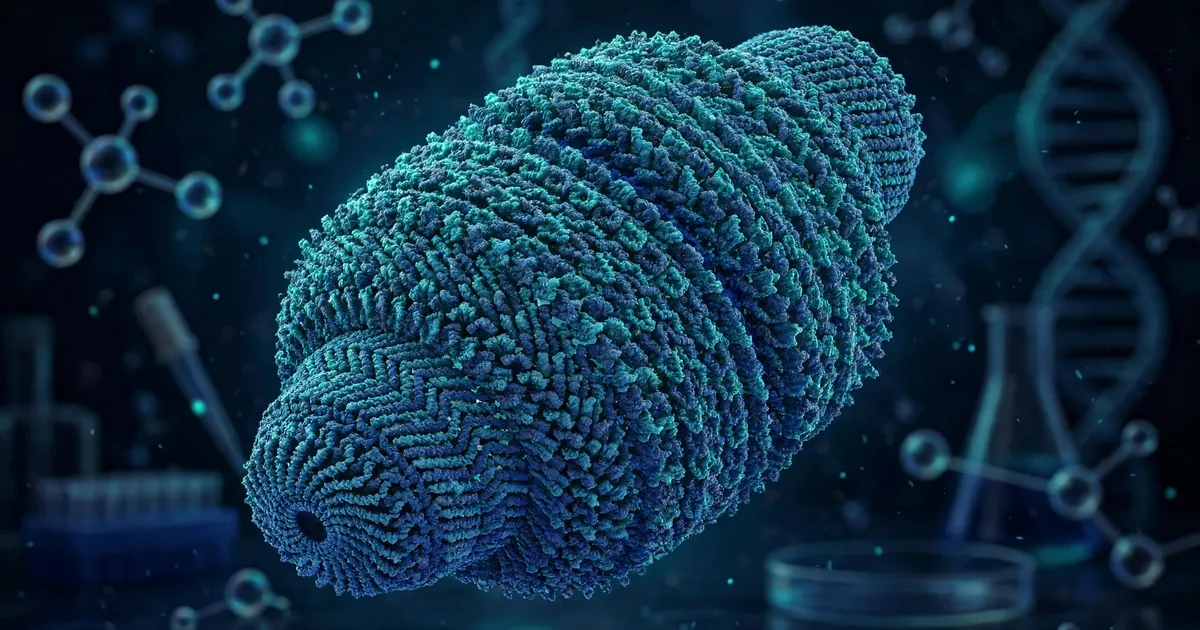
Anthropic described the work on November 4, 2026, as a finding from its biology research lab: the first 3D structure of a vault particle found in prokaryotic cells. Vaults are large, hollow shells of protein found in cells across the tree of life, and their function is still unknown. The new structure comes from a bacteriophage — a virus that infects bacteria — and was mapped with Claude involved at each step, from searching protein databases to processing microscopy data. Anthropic says more detail is in a preprint submitted to bioRxiv, and that it will release the structures and additional data soon.
Vaults have puzzled biologists for nearly 40 years. They were discovered in 1986 by Leonard Rome and Nancy Kedersha, and Anthropic notes that at roughly three times the mass of a ribosome, a mammalian vault is one of the largest known molecular complexes in eukaryotes. Researchers have proposed roles including moving molecules between the nucleus and cytoplasm, protecting cells from toxic compounds such as cancer drugs, and supporting innate immunity — but Anthropic says none of these has been conclusively confirmed, and mice bred without vault components still survive. A vault from a bacterium, which grows quickly in the lab, gives researchers a simpler system in which to ask what these shells are for.
What the L05 vault looks like
The particle is built from 96 copies (48 copies per half) of a single phage protein, which Anthropic calls L05, with a combined mass of about 9.5 megadaltons. It measures roughly 54 nanometres long and 45 wide, compared with 67 by 40 in mammals — shorter and wider, yet enclosing about 25% more volume because it is more spherical. Its wall is built from seven repeating segments, rather than the nine in mammalian vaults, and its end caps are flatter. Unite.AI's report of the work puts the cryo-EM map at a nominal resolution of 3.2 angstroms. Anthropic calls the L05 shell among the largest protein shells ever identified in prokaryotes.
The structure also shows how the shell closes. A wall 48 copies around narrows toward the pole in three steps, like a tiered dome: in every group of three neighbouring copies, one ends at the first step, one at the second, and one continues to the tip. To test which contacts hold the shell together, the team made 15 altered versions of the protein; some single changes near the cap were enough to prevent the shell from closing, producing open, rosette-like particles instead. Duplicating two wall segments, giving the protein nine repeats like the human vault, produced even larger closed particles with about 20% more enclosed volume. Anthropic presents that as evidence that vault size could be tuned by duplicating wall pieces — and suggests the shells could be adapted for biotechnology, for example as nanocapsules for delivering enzymes. That is a suggested direction, not a demonstrated delivery system.
One feature remains unexplained. A pocket partway up each of the 96 protein copies holds a small molecule that shows up clearly in the map but has not been identified. Anthropic says Claude found that its shape resembles coenzyme A, a common helper molecule cells use to shuttle chemical groups around — an early hint at a possible function, not a confirmed identity.
How Claude helped — and where researchers stayed in charge
The search started with Claude Science searching a database of about 15 billion predicted proteins. Vault relatives turned out to be rare but widely distributed: present in 29 major groups (phyla) of bacteria and four of archaea, but in less than 1% of species with a sequenced genome. The researchers chose 44 proteins to test; Claude turned each chosen sequence into a DNA design tailored to its host cell, added the control sequences that switch a gene on, and prepared the designs for ordering. Moved into living E. coli, 15 of 24 candidates produced soluble protein, seven of the 15 formed vault-like particles under the electron microscope, and cryo-EM confirmed the vault shape in four — two from phages and two from bacteria. L05 was chosen for detailed study because it was among the best at forming complete, closed particles.
Purification gave the clearest time comparison. The conventional method for eukaryotic vaults spins the sample through increasingly dense sugar and takes approximately three days; Anthropic's optimised size-exclusion chromatography method takes about 90 minutes from cells to microscopy grid. Claude first argued against that approach, Anthropic says, because clumps of misfolded protein come out in the same fraction — then helped make it work by recommending a specific column and tracking methods, and by proposing to load the contents of ruptured cells straight onto the column with no purification beforehand. For the structure itself, Claude set up and ran the open-source RELION processing software inside an internal multi-agent harness while the researchers advised on analysis decisions. A first full model was ready in 34 hours, and the final maps were ready about a week after processing began, where Anthropic estimates an initial model would normally have taken weeks. The whole project took under four months. Anthropic says most of the work could be done by a typical lab with existing Claude products, with one exception: the cryo-EM analysis used hundreds of GPUs in parallel, more computing than many academic institutions may have available.
The vault work extends a biology programme Anthropic has been building in public. The lab behind it is the same wet-lab programme described in August, and Claude was previously credited with finding a CRISPR-like enzyme system hiding in viral DNA. The wider pattern is AI models aimed directly at science: Hydrogen-1.0, a 753B open-weight model trained on lab records, was reported to have scored a science win over GPT-6-Astra earlier in November. The vault result is different in kind from a benchmark claim — it is a physical structure, measured in the lab, with the data still to come.
What went wrong, and what is still unproven
Anthropic is unusually candid about where Claude got it wrong. A protocol Claude wrote called for a growth medium containing an additive that interferes with getting DNA into cells, setting the project back by two weeks. Early in the cryo-EM processing, Claude skipped a standard step and produced a flawed map blended with its mirror image, and the team told it to stop improvising. Anthropic shared its lab notes with the researchers who train Claude, and says Claude got better at the tasks over the course of the project as new models arrived. Overall, the team concluded that the benefits of working this way far outweighed the drawbacks — but the errors cost real time, and were caught fastest in areas the researchers knew well.
Leonard Rome, brought on to advise the research, put the remaining question plainly: “Figuring out the function of vaults is still enormously challenging. I am pleased that Anthropic has so much good data.” What to watch now is concrete: the bioRxiv preprint link going live, the promised release of the structures and additional data, and whether these vaults form in the bacteria and phages where their genes naturally occur — so far, they have been made only in E. coli. Until then, the advance is a measured shell and a faster way to study it, not an answer to what vaults do.
Frequently asked questions
What is a vault particle?
A large, hollow shell of protein found in cells across the tree of life. Vaults were discovered in 1986 by Leonard Rome and Nancy Kedersha, and their biological function is still unknown.
What did Claude actually do in the vault research?
Under the researchers' direction, Claude searched about 15 billion predicted proteins, turned chosen protein sequences into DNA designs, helped optimise the 90-minute purification method, and set up and ran the cryo-EM processing software. The researchers chose the candidate proteins themselves and advised on the analysis decisions.
Is the vault's function now known, and can other scientists use the data yet?
No on both counts. The function is still unknown, the particles have so far been made only in E. coli, and Anthropic has submitted a preprint to bioRxiv and says it will release the structures and additional data soon — they have not been released yet.