Apple releases LensVLM-9B, a 9B model that reads long documents as compressed images
Apple's ML researchers have published LensVLM-9B on Hugging Face: a 9-billion-parameter vision-language model that scans compressed page images and selectively expands only the pages that matter — matching full-text accuracy at 4.3x compression.

Apple has quietly posted a new model to Hugging Face — and this one comes from its machine learning research team, not a product division. LensVLM-9B is a 9-billion-parameter vision-language model built for one of the most expensive problems in real-world AI: reading very long documents without burning through an enormous amount of context.
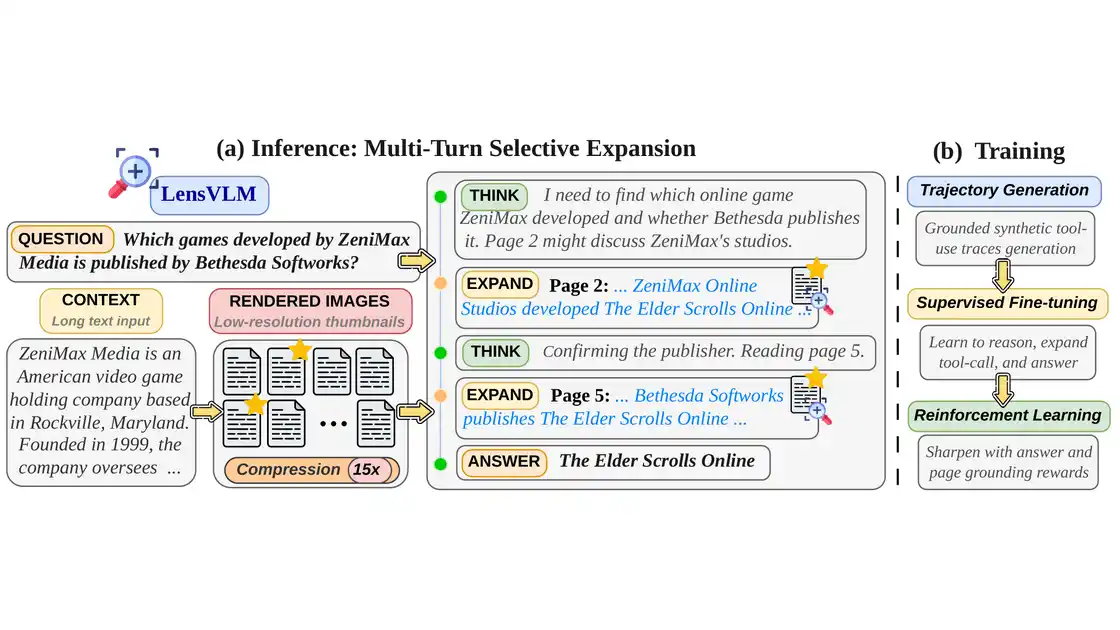
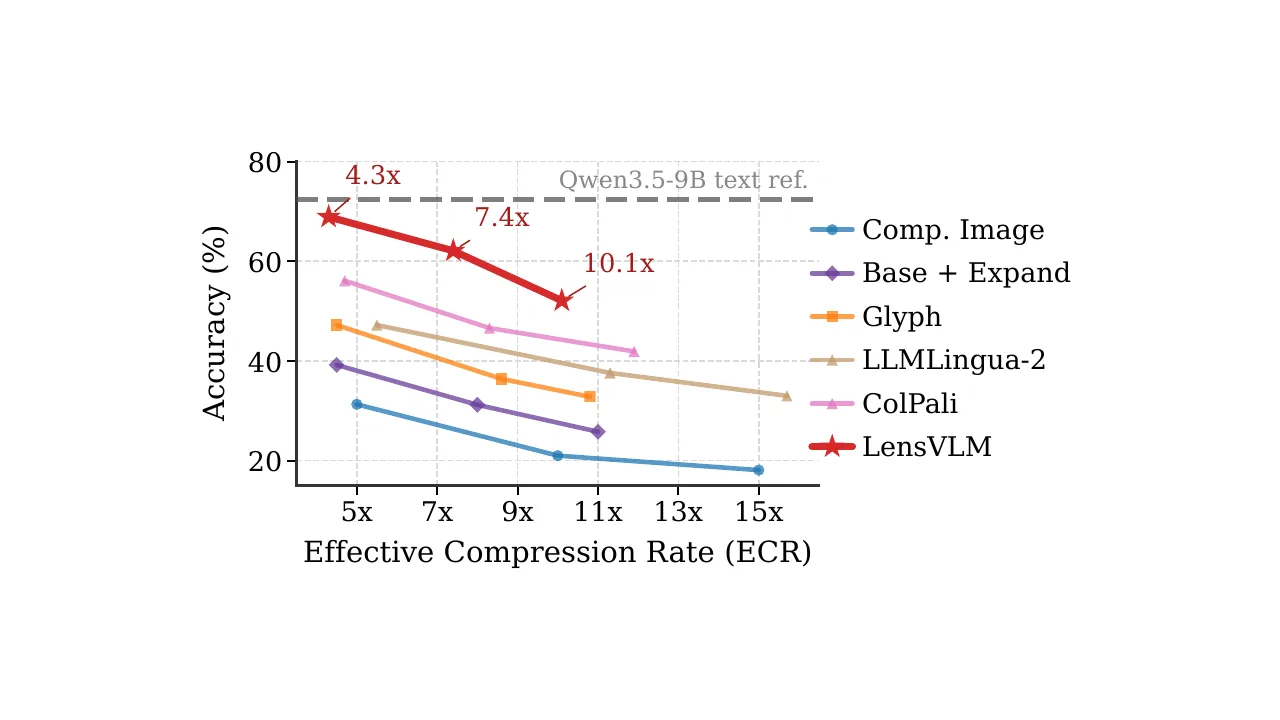
Instead of feeding the model raw text, LensVLM looks at documents as pictures. It renders pages into compressed images, scans the shrunken thumbnails, and then selectively re-expands only the pages that appear relevant to the question — a bit like skimming a stack of documents and pulling out the two that matter. According to the accompanying paper, the trick works: the model matches full-text accuracy at 4.3x compression and beats every baseline the authors tested all the way up to 10.1x.
How it works: skim everything, read only what matters#
Long documents are a token problem. A big report fed to a model as text turns into a very long token sequence, which costs money, memory, and latency on every call. Vision models offer an alternative: a fixed-size image maps to a fixed number of visual tokens, so rendering text as images and lowering the resolution gives you a compression knob. The catch is that shrinking too far makes the characters blur out and accuracy collapses.
LensVLM sidesteps the trade-off by splitting reading into two stages. First, cheap and lossy: the model looks at every page as a low-resolution thumbnail — rendered at a user-selectable 5x, 10x, or 15x compression. Then, expensive and lossless: a learned Expand tool fetches the original text (or a high-resolution image) of only the pages the model judges promising. It can think, expand, rethink, and expand again across multiple turns, revising its choices as the evidence comes in — which is a meaningful advantage over classic top-k retrieval, where the shortlist is fixed before the model ever sees it.
Taught to reach for the magnifier#
This behavior doesn’t come out of the base model by default. Apple’s team built a post-training recipe around it: they generated synthetic tool-use trajectories grounded to the correct pages, then supervised fine-tuned the model to reason, call the expansion tool, and answer — then sharpened it with reinforcement learning using answer-accuracy and page-grounding rewards.
The paper’s analysis suggests the training does something useful beyond the headline numbers: it makes the model robust to rendering choices, and as compression rises, the model increasingly relies on the expanded pages rather than trying to squint at the blurry thumbnails. In other words, the higher the compression, the more the model behaves like a researcher with a stack of documents — glancing at everything, reading a few.
One finding matters for anyone building document systems: how you expand matters. For rendered text pages, expanding back to source text works best; for native documents where layout carries task-relevant information, a high-resolution image expansion wins. It’s practical tool-choice guidance, straight from the paper.
What the numbers say#
On seven text QA benchmarks, the paper reports that LensVLM holds accuracy comparable to the full-text upper bound at 4.3x effective compression, and outperforms retrieval-based, text-compression, and visual-compression baselines all the way up to 10.1x effective compression. The approach also generalizes to multimodal document and code-understanding tasks, with its advantage over baselines growing as compression increases.
| Effective compression | What the paper reports |
|---|---|
| 4.3x | Accuracy comparable to reading the full text |
| Up to 10.1x | Outperforms retrieval-based, text- and visual-compression baselines |
Research-only, for now#
The weights are live under the apple org on Hugging Face, in Safetensors/BF16 format with a chat template, under Apple’s Machine Learning Research Model License — non-commercial research use only. The code ships separately under Apple’s Sample Code License, and no inference provider on Hugging Face hosts the model yet, so you’ll be running it yourself via the published apple-aiml-research/ml-lensvlm repository. Apple hasn’t disclosed a context-window size, official benchmark scores, or anything about pricing.
Two things make this release notable beyond the technique itself. First, Apple rarely publishes model weights at all, so each release is a data point on where its research attention is going. Second, the base model is Alibaba’s Qwen3.5-9B — Apple fine-tuning a Chinese lab’s open base is a reminder of how porous the frontier has become, with the best ideas getting recombined across labs and borders regardless of who trained the foundation.
What to watch#
Does selective expansion generalize upward? The paper’s recipe worked at 9B parameters; the interesting question is whether the gains hold — and grow — on much larger models, and whether agentic retrieval pipelines adopt the scan-then-expand pattern natively.
Watch the licensing. Research-only terms keep this out of production, but the technique itself is a paper, not a patent filing. If the results hold, expect the same ideas to reappear in permissively licensed models within months.
Benchmarks beyond QA. The paper shows document QA and some code/multimodal tasks. The real test for enterprise RAG teams is contracts, filings, and manuals — messy, layout-heavy documents where the “expand the right page” instinct matters most.
Sources#
- LensVLM-9B — Hugging Face model card (Apple)
- apple-aiml-research/ml-lensvlm — GitHub
- LensVLM: Selective Context Expansion for Compressed Visual Representation of Text — arXiv:2605.07019
- Apple LensVLM-9B: 9B VLM for Compressed Text Documents — TPS Report
- Apple LensVLM-9B — Local Model Watch
- Apple releases LensVLM-9B for compressed document analysis — AlexTech