Boston Dynamics gave Atlas a new pair of hands — and Reddit is arguing about the missing pinky
The new generation hand for Atlas has four fingers, 13 degrees of freedom, dense tactile sensors, and no pinky. The accompanying blog post explains exactly why — and the r/singularity thread that surfaced the video within hours went straight for the missing digit.
Boston Dynamics doesn’t do surprise announcements often, so when it quietly uploaded "New Hands for Atlas" to its YouTube channel, the robot-watch corners of the internet noticed fast. The video surfaced on r/accelerate in the morning and reached r/singularity by lunchtime, and the threads are still the best commentary track on the reveal: engineers, skeptics, and at least one person asking the truly important question — "Will it ever be able to play guitar chords?"
The hardware itself is the real story, though. In a detailed technical blog post published alongside the video, Boston Dynamics describes a new generation hand designed from the ground up for the electric Atlas — a clean break from the previous seven-DOF hands, which were built to grasp a large variety of objects. The new hand is built to manipulate them.
What the new hands do#
The spec sheet, straight from the blog: four fingers including a more dexterous thumb, 13 degrees of freedom total — four in the opposable thumb, three in each other finger, configured to allow finger splaying and full fingertip control. The actuators are directly driven, all a single actuator type, and completely encapsulated with no fragile cables crossing joints, mirroring the design language of Atlas’s body.
Strength hasn’t been sacrificed for dexterity: the hand is about the size of a large human hand but can carry a 100lb+ loaded minifridge, matching the previous generation. Dense pressure tactile sensors cover the fingertips and palm so it can pick up small contact signals, and the backdrivable, transparent actuators let the robot rely on proprioception for fast, agile manipulation instead of slow visual servoing.
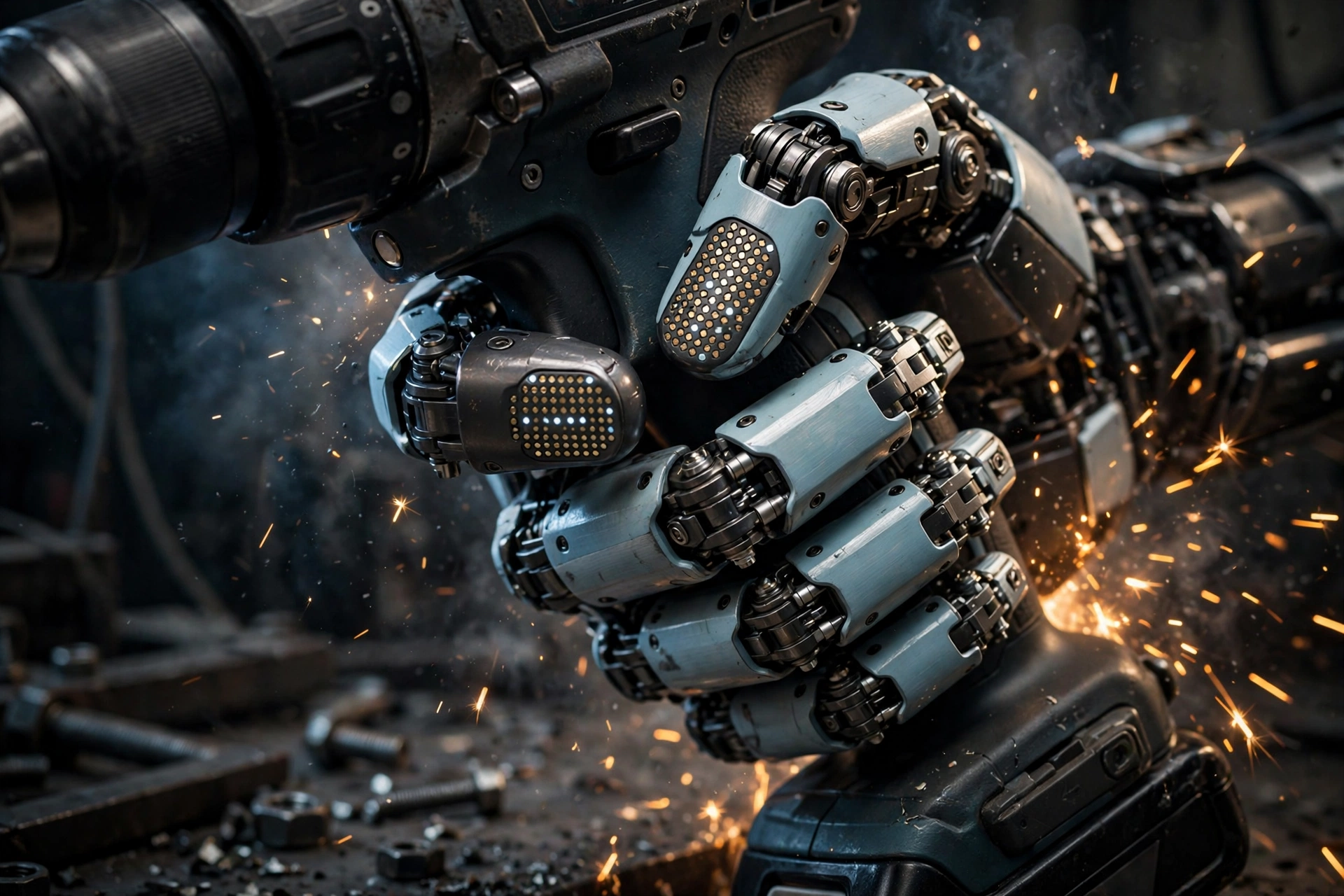
The payoff is a catalog of tricks the old hands couldn’t do: sliding the thumb tip along the length and across the width of all the other fingers, dexterous pinch grasps between the thumb and any finger, tripodal grasps, and — the headline item — triggered tool grasps on drills, power torque drivers, grinders, nail guns, and welding torches. Tool use, the blog says, "is at the top of our list."
Built for sim-to-real#
The most interesting paragraph of the blog post isn’t about the hand at all — it’s about how Boston Dynamics plans to train it. The company is blunt about the limits of human demonstration data: wearable devices like gloves capture "only proxy signals" relevant to pretraining intuitive physics, not the high-rate closed-loop control and force regulation that agile manipulation actually requires.
So the hand is designed as a simulation object first. Rigid-drive actuation, a backdrivable transmission, and control innovations to compensate for cogging and friction make it possible to simulate the hand with high dynamic fidelity — and that fidelity makes reinforcement learning in simulation dramatically more effective, with domain randomization over motor torque profiles, surface friction, object geometries, and task disturbances. Boston Dynamics says it already has "initial results showing promising sim2real transfer in dynamic tasks," trained in simulation and rolled out on hardware relying only on high-rate actuator proprioception for feedback. That is the playbook that made Atlas’s whole-body control work, now extended to its fingers.
The missing pinky#
And now, the thread. The sharpest critique on r/singularity came from u/Sauna_Freak81: the pinky "optimized away," a stiff flat palm, limited finger DoF — "This seems like the bare minimum for 'hands'."
Here’s the delightful part: Boston Dynamics anticipated this exact complaint. The blog has a whole section titled "The Missing Finger." Adding a pinky "is not hard given the modularity of the design," the company concedes — but the team asked itself what the pinky would actually add. At one point, CTO Zack asked the engineers to tape their pinky and ring finger together for a day and report back on what they couldn’t do. At the end of the experiment, the agreement was unanimous: no pinky. Four fingers and 13 DOF already unlock in-hand reorientation, recovery from slipping grasps, and tool use; a fifth finger means three more actuators with the corresponding extra cost, volume, and failure probability. "If you want to ship great products, the best part is no part."
The rebuttals came from the other side too. u/baseketball pointed out the packaging reality: the fingers are chunkier than a human hand’s because they house real motors and sensors — "these are extremely impressive hands." And u/coolredditor3 summed up the prevailing mood: "Mogs figure and tesla and unitree."
That’s worth pausing on. The competing humanoid race — Tesla’s Optimus, Figure’s robots, Unitree’s line — has largely treated the human hand as the template. Boston Dynamics’ argument is the contrarian one: the hand shouldn’t replicate the human original, it should be designed for minimal cross-embodiment from human demonstration, clean simulability, and manufacturability at low cost. Aristotle called the human hand the "tool of tools," the blog notes; the ultimate general-purpose manipulator won’t be an over-complicated hand, but a reliable one that can use tools.
What to watch#
- The sim-to-real evidence. "Promising" is doing a lot of work in the blog post. The question is how quickly the RL-trained behaviors scale beyond demos — and how they compare to the demonstration-driven approaches at rival labs.
- Factory deployment. The hand is a companion to the new Atlas generation — the 100lb+ payload, mass-manufacturable electric robot Boston Dynamics is already training at the Hyundai metaplant. Hands are where factory tasks live.
- The pinky discourse. It will not die. Somewhere, a roboticist is already prototyping a five-finger version and posting it on r/singularity. That’s how progress works.
As for the guitar chords: unknown. But if Boston Dynamics keeps its tape-the-pinky philosophy, the first songs Atlas learns will presumably be power chords only.
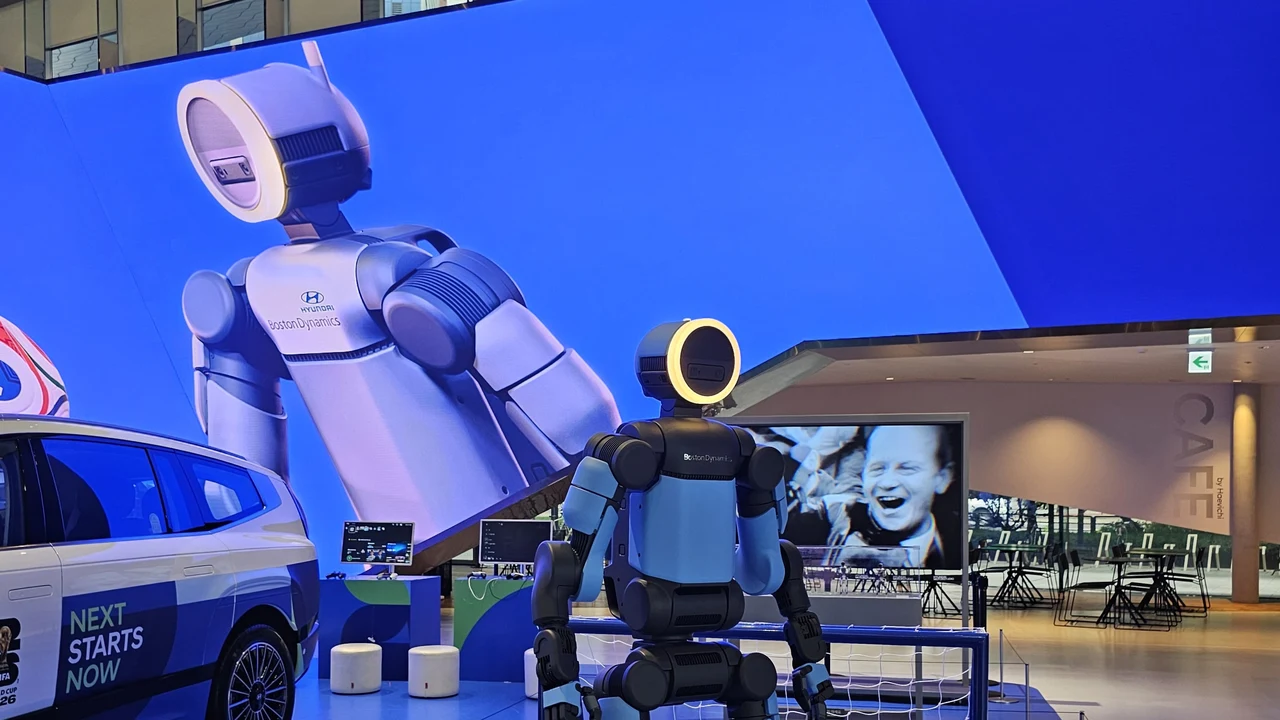
Sources: the original video "New Hands for Atlas" on YouTube, the Boston Dynamics blog post "Robot Hands for Modern AI and Real Work", and the discussion threads posted by u/Recoil42 on r/singularity and u/SharpCartographer831 on r/accelerate. The inline illustration is AI-generated; the cover photo is a real Atlas by Damian B Oh (CC BY-SA 4.0, via Wikimedia Commons).