Baidu launches Apollo World, a world model that simulates 100,000 km of robotaxi driving a day
Unveiled at Baidu AI Day in Shenzhen on November 3, 2026, Apollo World is an agent-driven multimodal world model that generates real-time camera and lidar streams for training Apollo Go’s robotaxis, drawing on more than 350 million kilometres of real-world driving.
- Who and when: Baidu, at its AI Day in Shenzhen on November 3, 2026, during the Apollo session for its autonomous-driving brand.
- What: Apollo World, an agent-driven multimodal world model built for physical AI that simulates real-world environments and predicts how they evolve.
- Output: Up to 100,000 km (62,000 miles) of simulated driving a day, equivalent to about three years of real-world testing by a safety-driver-equipped autonomous vehicle, with real-time camera and lidar streams.
- Foundation: Data from more than 350 million kilometres of real-world Apollo Go testing; vehicles and pedestrians in the simulation act as agents making their own decisions.
- Already in use: Integrated into Apollo Go and used to train its robotaxi fleet to be operated globally; Apollo Go is China’s largest robotaxi service operator.
- Context: Rivals include WeRide, Pony.ai and Momenta Global; Morgan Stanley has estimated China’s robotaxi fleet could reach 1 million vehicles by 2035. Baidu also proposed a ‘2+3’ evaluation standard for world models.
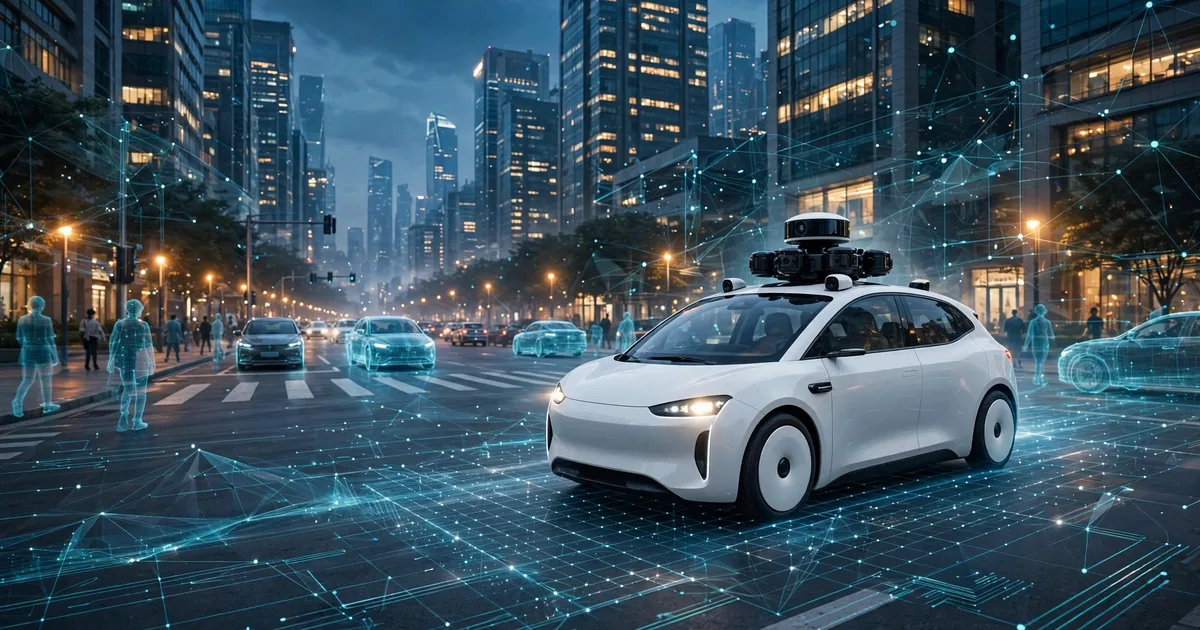
Baidu launched Apollo World on November 3, 2026, at its AI Day in Shenzhen. It is an agent-driven multimodal world model built for physical AI: an AI system that simulates real-world environments for training robotaxis and predicts how those environments evolve.
The pitch is cost. Automakers are racing to cut what it takes to develop autonomous vehicles, Reuters reported, and simulation is Baidu’s answer to gathering every edge case on real roads. Apollo World lets Baidu’s driving systems practise in worlds it can generate, vary and replay, rather than waiting for the same situations to occur in traffic.
100,000 kilometres a day, on camera and lidar
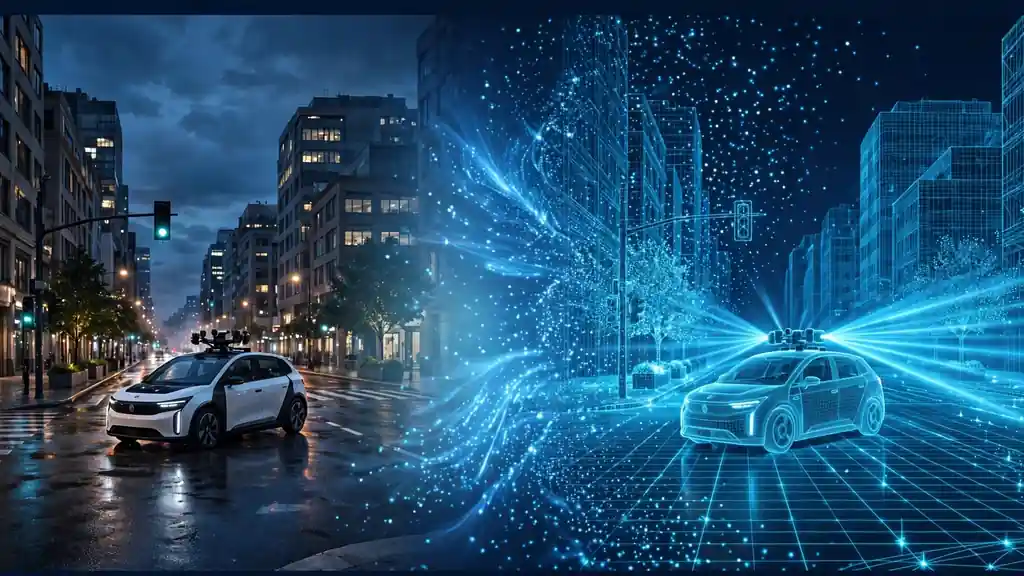
Apollo World can generate “up to 100,000 km” (62,000 miles) of simulated driving daily, Baidu said, equivalent to about three years of real-world testing by a safety-driver-equipped autonomous vehicle. The system produces real-time multimodal data streams, such as camera and lidar observations, enabling self-driving systems to directly sense and navigate simulated environments.
That last point matters. The simulated world does not hand the driving system an abstract summary of the road; it feeds it the same kinds of sensor signals it would receive on a real street, so what is learned in simulation transfers more directly to the vehicle.
Agents inside the simulation
“Agent-driven” is the key phrase. Vehicles and pedestrians inside the simulation are treated as agents, Crypto Briefing reported from the announcement, meaning each one makes its own decisions and reacts to the others. The setup is designed to support intelligent decision-making and interaction among traffic participants, rather than scripting every other road user in advance.
The engine draws on data gathered from more than 350 million kilometres of real-world testing by Apollo Go, Baidu’s robotaxi service. That driving history gives the model a large library of actual road behaviour to learn from before it starts inventing new situations. Apollo World is already integrated into Apollo Go, where it handles verification and simulation across what Baidu frames as infinite virtual scenarios.
Baidu also proposed a ‘2+3’ evaluation standard for world models alongside the launch, described as a more rigorous way to assess this kind of AI. Whether other developers adopt it will decide whether Baidu gains influence over how the whole category defines quality.

Why Baidu is betting simulation scales robotaxis
Apollo World is already being used for training Apollo Go’s robotaxi fleet to be operated globally, Baidu said. Apollo Go is China’s largest robotaxi service operator and competes with rivals such as WeRide, Pony.ai and Momenta Global. Volkswagen’s Chinese partner XPeng also plans to launch robotaxi operations in 2027, and Morgan Stanley has estimated China’s robotaxi fleet could grow to 1 million vehicles by 2035.
Chinese robotaxi firms have largely pursued asset-light expansion overseas, supplying autonomous-driving technology and partnering with automakers, ride-hailing platforms and local fleet operators rather than owning and operating fleets themselves. Developing the technology itself remains expensive. “They still have the capex of training models … and vehicles, a challenge that every autonomous vehicle company is going to face,” Frank McCleary, an expert in autonomous mobility at Arthur D. Little, told Reuters.
Tesla, which is seeking to expand its Cybercab robotaxi fleet, takes a different route, using an “end-to-end neural network” trained on video of human driving. Baidu’s bet is that a world model grounded in hundreds of millions of kilometres of its own fleet’s driving can generate the practice its systems need faster and more cheaply than either real-world mileage or video alone.
Baidu is positioning Apollo World as a general engine for physical AI, not just a robotaxi tool, with potential applications in robotics and broader physical AI contexts. The test of that ambition now runs inside Apollo Go itself: whether simulation mileage converts into safer, more adaptable driving on real roads, at the scale Baidu is planning for.
Frequently asked questions
What is Apollo World?
Apollo World is Baidu’s agent-driven multimodal world model for physical AI, unveiled at Baidu AI Day in Shenzhen on November 3, 2026. It simulates real-world environments for training robotaxis and predicts how those environments evolve.
How much simulated driving can Apollo World generate?
Up to 100,000 km (62,000 miles) of simulated driving a day, Baidu said — equivalent to about three years of real-world testing by a safety-driver-equipped autonomous vehicle — with real-time camera and lidar data streams.
Is Apollo World already in use?
Yes. It is already integrated into Apollo Go and is being used to train Apollo Go’s robotaxi fleet to be operated globally. Apollo Go is China’s largest robotaxi service operator, and Baidu positions Apollo World for robotics and broader physical AI as well.